Agent Memory Deep Dive #5: What a Brain-Inspired Memory Architecture Actually Looks Like
Neuroscience solved this decades ago. We just haven’t built the database for it yet.
TLDR: Human memory has three systems (episodic, semantic, procedural), five properties (selective encoding, cue-based retrieval, offline consolidation, reconsolidation on recall, forgetting as feature). Map these to software: episodic store (SQLite with decay scoring) → consolidation worker (background LLM extraction) → semantic layer (graph + facts) → multi-cue retrieval (spreading activation) → decay engine. The missing piece isn’t a library — it’s a database where decay, consolidation, and multi-cue retrieval are native primitives. Three Rust engines (YantrikDB, Vestige, Engram-AI) are attempting this. None is production-ready. Here’s the architecture for when one is.
What Neuroscience Already Figured Out
Human memory isn’t one system. It’s at least three, with different storage mechanisms, different retrieval patterns, and different decay rates:
| Brain system | What it stores | How it works | Decay pattern |
|---|---|---|---|
| Episodic (hippocampus) | Events: “Tuesday I debugged Terraform with Claude” | Time-stamped, sequential, context-rich | Fast — raw events fade in days-weeks unless replayed |
| Semantic (neocortex) | Facts: “Terraform state locking uses DynamoDB” | Distilled from episodes, abstract, durable | Slow — reinforced facts persist for years |
| Procedural (cerebellum) | Patterns: “When I see OOM in logs, check the memory limit first” | Implicit, learned from repetition, hard to verbalize | Very slow — “muscle memory” persists even with disuse |
Critical insight: These aren’t three copies of the same data. They’re three different representations that arise from the same raw experiences through different processing pathways.
You experience debugging a Terraform issue (episodic). Over time, your brain extracts the general principle about state locking (semantic). After hitting the same pattern five times, you automatically check DynamoDB first without thinking about it (procedural).
Current agent memory systems skip the processing. They store raw facts and hope retrieval handles the rest. That’s like having a hippocampus with no neocortex — you can recall specific events but never form general knowledge.
Five Biological Properties Agents Must Have
1. Selective Encoding — Don’t Store Everything
Your brain discards >99% of sensory input. It only encodes what’s:
- Novel — something you haven’t seen before
- Salient — emotionally charged or personally important
- Surprising — contradicts existing beliefs
- Effortful — required active processing to understand
What this means for agents: storing every message verbatim is the equivalent of never filtering sensory input. It’s noise. The system should decide — at capture time or shortly after — what’s worth indexing vs. what’s routine.
What’s worth encoding:
- Errors, bugs, and their solutions (novel, effortful)
- Architectural decisions and their reasoning (salient, important)
- User corrections and preference changes (surprising, contradicts existing)
- New tools, patterns, or techniques learned (novel)
What’s NOT worth encoding:
- “Yes, do that” / “Looks good” (routine acknowledgment)
- Standard tool output that matches expectations (expected)
- Boilerplate code generation (repetitive)
- Navigation messages (“now let’s look at file X”)
Most memory systems encode everything and rely on retrieval to filter. But retrieval over a noisy corpus is inherently worse than retrieval over a curated one. Selective encoding before storage makes everything downstream better.
2. Cue-Based Retrieval — Not Address Lookup
You don’t remember things by index. You remember them because multiple contextual signals converge:
“That conversation about… it was last week… I was working on the deploy… and there was that weird error about ports…”
Three cues: timing (last week), context (deploy work), and content (port error). None alone is sufficient. Together they activate the specific memory.
What this maps to technically: Multi-signal retrieval where results must score well on multiple dimensions simultaneously:
- Semantic similarity to query (vector search)
- Keyword overlap (BM25 / full-text search)
- Entity connections (graph traversal from known entities)
- Temporal proximity (time-range weighting)
- Strength/frequency (decay-weighted)
The key difference from typical search: it’s not “return results matching any signal.” It’s “return results where multiple signals converge.” A memory that’s strong on one signal but zero on others should rank below one that’s moderate on three signals.
This is spreading activation — the neural pattern where one activated node energizes its neighbors, and memories fire when enough neighbors are simultaneously active.
3. Offline Consolidation — Process in the Background
During sleep, your hippocampus replays recent episodes while your neocortex extracts patterns. This is why you often understand something better the next morning — your brain processed it offline.
What this maps to:
A background worker that periodically:
- Reads recent episodic entries (raw conversations from the last N hours)
- Extracts durable facts (“User decided to use Fastify for edge services”)
- Links to existing semantic knowledge (connects to “web framework” cluster)
- Strengthens reinforced facts (same preference stated multiple times → higher strength)
- Identifies contradictions (new fact conflicts with existing → flag for resolution)
Critical: This does NOT happen on the write path. Capture is fast and cheap (just store the raw episode). Consolidation runs async, in the background, on a schedule. It’s not blocking the conversation.
TencentDB’s L0→L1→L2→L3 plugin pipeline does this (triggered by turn count and time intervals). Hindsight’s “Reflect” operation does this (but manually triggered). Codex CLI does a lightweight version (post-session extraction when idle). But true automatic background consolidation — continuously running, independent of session activity — is still rare.
4. Reconsolidation on Recall — Memories Update When Accessed
Every time you retrieve a memory, it briefly becomes editable. This is reconsolidation — the mechanism that allows beliefs to update gradually rather than requiring explicit overwrite.
What this maps to:
When a memory is retrieved and used:
- Its strength score increases (reinforcement)
- Its recency timestamp updates (accessed just now)
- New context may be appended (the memory gains information from the current conversation)
- If contradicted by current context, its strength decreases
This is the mechanism that makes decay work elegantly. You don’t need explicit “strengthen this” or “weaken that” commands. The act of using a memory reinforces it. The act of contradicting a memory weakens it. The system self-tunes.
5. Forgetting as a Feature — Decay Prevents Pollution
Covered in depth in Post #3, but the architectural implication: decay is not a periodic cleanup job. It’s a continuous function of time that runs on every memory simultaneously.
At any given moment, every memory in the system has a current strength. Strength decays continuously (in practice: updated on each query or periodic tick). Retrieval is always strength-weighted.
The effect: the system naturally focuses on recent, relevant, frequently-accessed knowledge without any explicit curation.
The Five-Layer Architecture
Putting it all together:
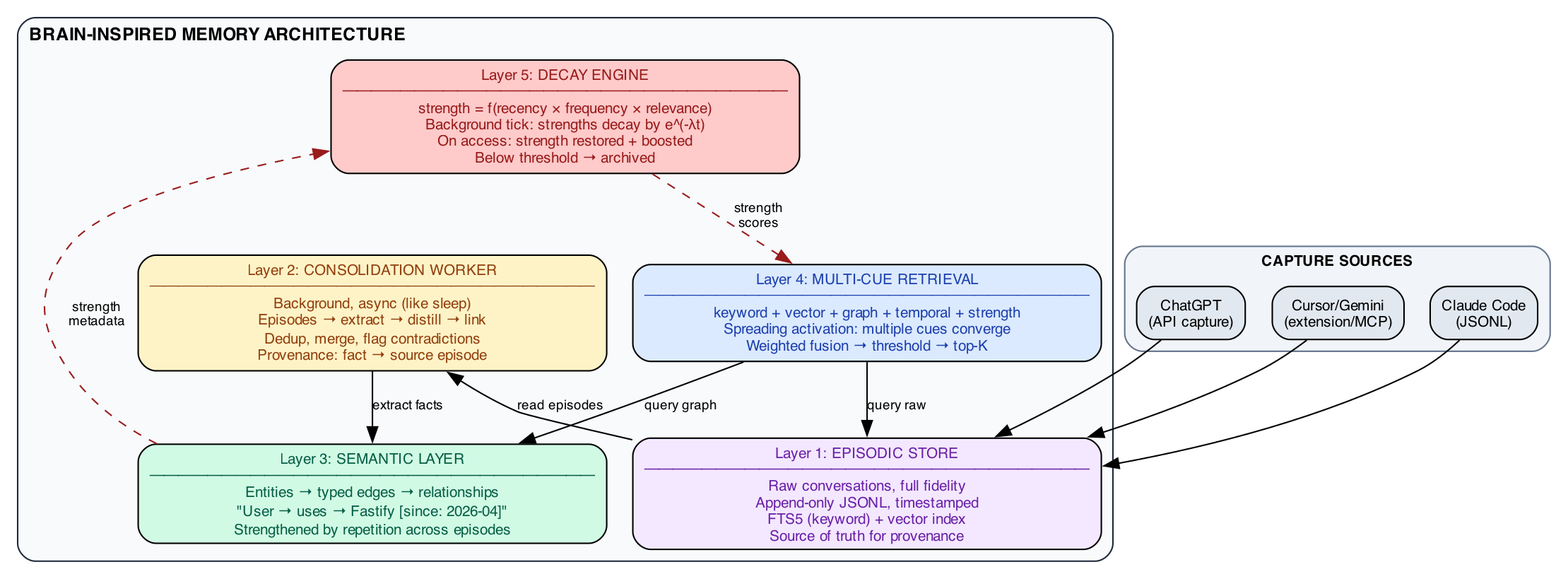
What Each Layer Does That Others Can’t
Why not just episodic? Raw conversations are too verbose for retrieval. Searching 50k tokens of transcript for “what framework do I use?” is imprecise. You need extracted, structured facts.
Why not just semantic? Extracted facts lose context. “Uses Fastify” doesn’t tell you why, when that decision was made, or what was considered and rejected. Provenance back to episodes preserves this.
Why not just graph? Graphs capture relationships but not the full context of events. You need the raw episodes for replay, reanalysis, and detailed recall.
Why not just vector search? Single-signal retrieval has fundamental precision limits. Multi-cue retrieval (vector + keyword + graph + time + strength) finds memories that no single signal would surface alone.
Why not just decay? Decay without consolidation means raw episodes fade before knowledge is extracted. You need consolidation to move knowledge into the durable semantic layer before the episodic source decays.
They’re all necessary. The system is the composition of layers, not any single layer.
The Missing Database
Here’s the hard truth: implementing this architecture today requires stitching together 4-5 separate systems:
- SQLite for episodic storage
- A vector DB (Qdrant, ChromaDB) for embeddings
- Neo4j or similar for the graph layer
- A scheduled job system for consolidation
- Custom application code for decay scoring
That’s operational complexity most teams won’t accept. What’s needed is a single database that natively supports:
| Capability | What it replaces |
|---|---|
| Append-only event log | SQLite episodic layer |
| Vector similarity index | Qdrant / ChromaDB |
| Graph traversal | Neo4j / FalkorDB |
| Full-text search | SQLite FTS5 / Elasticsearch |
| Native decay scoring | Custom application code |
| Background consolidation triggers | External job scheduler |
One binary. One query interface. All capabilities.
The Emerging Rust Engines
Three projects are building exactly this. All experimental. All Rust. All aiming for “SQLite for memory.”
| Engine | Key differentiator | Decay model | Maturity |
|---|---|---|---|
| YantrikDB | Most “embedded SQLite” vision. Link a library, call functions. | Configurable per collection | Very early, not production |
| Vestige | FSRS (spaced repetition) decay. Single binary. | Battle-tested algorithm from Anki | Experimental |
| Engram-AI | Most neuroscience-faithful. Explicit hippocampus/neocortex analogy. | Ebbinghaus-inspired | Tiny community |
| DriftDB | Performance (1.9M ops/sec). | Missing native decay | Early |
| MuninnDB | Ebbinghaus decay as DB primitive. Go-based. | Native, first-class | Patent risk concern |
Why Rust? Because the target is embedded — linked into the agent process, no server to run, no network hop. This is the SQLite playbook: a library you link that gives you a database. Rust’s safety guarantees + zero-cost abstractions + no GC makes it ideal for an embedded engine that needs to be fast and reliable.
The convergence point: When one of these matures to production quality, it enables the full 5-layer architecture as a single dependency. You import memorydb and get episodic + semantic + graph + vector + decay + retrieval in one package.
We’re probably 12-18 months from that.
What You Can Build Today (Pragmatic Version)
Don’t wait for the ideal database. Here’s the 80/20 approach using existing tools:
Minimum viable brain-inspired memory:
Layer 1 (Episodic): SQLite + sqlite-vec
  - Store raw conversations with timestamps and source metadata
  - Full-text search (FTS5) for keyword recall
  - Vector column for semantic similarity

Layer 2 (Consolidation): Background cron job + LLM
  - Every 6 hours: read new episodes, extract facts
  - Write facts to a separate "semantic" table
  - Link facts to source episode IDs (provenance)

Layer 3 (Semantic): Same SQLite DB, separate tables
  - Facts table: id, content, entity_ids, strength, access_count, created, last_accessed
  - Entities table: id, name, type, aliases
  - Relations table: source_id, target_id, type, valid_from, valid_to

Layer 4 (Retrieval): Application code
  - Query across both episodic (FTS5 + vector) and semantic (entity + facts)
  - Score = semantic_sim × 0.3 + keyword_match × 0.2 + entity_proximity × 0.2
            + recency × 0.15 + strength × 0.15
  - Return top-K with provenance metadata

Layer 5 (Decay): Background cron job
  - Every hour: UPDATE facts SET strength = strength * 0.995 WHERE last_accessed < now() - interval
  - On access: UPDATE facts SET strength = min(1.0, strength + 0.1), access_count = access_count + 1
  - Archive: WHERE strength < 0.1 → move to archive table
Total infrastructure: One SQLite file. Two cron jobs. One LLM for consolidation. No Neo4j, no Qdrant, no separate services.
This won’t be as good as the ideal architecture. The graph is simulated via foreign keys rather than native traversal. The multi-cue fusion is application code rather than query-planner optimized. The decay is periodic rather than continuous.
But it captures 80% of the value: raw episodes get consolidated into durable facts, facts have provenance, unused facts fade, retrieval uses multiple signals. That’s already better than any production system today.
The Honest Assessment
What’s solved: We know the architecture. The biological model maps cleanly to software. The research (FadeMem, AgeMem, ActiveMem, OBLIVION) validates the approach empirically.
What’s not solved:
- The unified database (12-18 months away)
- Cross-tool capture (requires reverse-engineering each vendor’s API)
- Consolidation quality (LLMs still make extraction errors that propagate)
- Provenance at scale (Merkle-DAG is clean but expensive for millions of memories)
- The economics (who pays for background LLM consolidation at scale?)
What you should do:
- If you’re building agents: implement the “pragmatic version” above. You’ll immediately have better memory than 95% of agent deployments.
- If you’re building a memory product: bet on the database layer. The team that ships a production-quality embedded memory database with native decay wins this space.
- If you’re using agents: push for export. Ask vendors for transcript access. The more portable your data, the sooner cross-tool memory becomes possible.
Series Summary
This 6-part series covered:
- Overview — Where we are, what’s broken, what ideal looks like
- Failure Modes — The 4 ways memory fails (overflow, amnesia, retrieval miss, stale pollution)
- Landscape — 10 systems scored on 7 dimensions (max 5.5/7, no winner)
- Forgetting — Why append-only breaks and what decay means (FadeMem: 45% reduction, quality up)
- Cross-Tool — Why agents are siloed (no capture standard, no interchange format, no incentive)
- Architecture — The brain-inspired 5-layer system and the missing database
The one-sentence version: Agent memory is broken because we’re storing everything and forgetting nothing, with no cross-tool bridge and no database purpose-built for the workload.
The fix isn’t another memory library. It’s a memory database — where decay, consolidation, and multi-cue retrieval are primitives, not application code. That database is being built (in Rust, by small teams). When it ships, the 5-layer architecture becomes trivial to implement. Until then, the pragmatic SQLite approach gets you 80% of the way.
Previous: Agent Memory Deep Dive #4: The Cross-Tool Memory Gap
#AgenticAI #AIMemory #SecondBrain #AIInfra #MemoryArchitecture