Agent Memory Deep Dive #3: The Forgetting Problem — Why Append-Only Memory Breaks
Your agent remembers too much. That’s worse than remembering too little.
TLDR: Every major memory system is append-only. After months of use, stale facts overwhelm retrieval. The fix isn’t deletion — it’s graduated strength decay: memories that are never accessed gradually lose retrieval priority. FadeMem (2026) proved this works: 45% storage reduction with retrieval quality improving. Three experimental engines now implement decay as a database primitive (MuninnDB, Vestige, YantrikDB). This is the most important unsolved piece of agent memory.
The Problem Nobody Talks About
Every memory demo looks great at day 1. You add 10 memories. Retrieval is perfect. You find what you need instantly.
Now imagine day 180. You’ve been using the system daily. You have 8,000 stored memories. Here’s what happened:
- 2,000 are about your current projects and preferences (useful)
- 3,000 are about projects you’ve finished (occasionally useful for reference)
- 2,000 are about things that have changed (preferences that evolved, tools you switched, decisions you reversed)
- 1,000 are fragments that were never coherent enough to be useful
When you search “what web framework do I use?”, retrieval returns 15 results:
- “Uses Express for the API gateway” (from January, no longer true)
- “Evaluating Fastify as Express replacement” (from March, intermediate state)
- “Migrated main service to Fastify” (from April, was true then)
- “Trying Hono for the new edge service” (from May, current)
- “Express middleware patterns for auth” (from February, implementation detail)
Which answer should the agent use? The system has no way to know. They all have equal retrieval weight. The agent picks whichever is closest to the query embedding — which might be the January entry because it has the most explicit language.
The result: having memory makes the agent less reliable than having no memory. At least without memory, the agent reads the code and gives you the current answer. With polluted memory, it gives you a confident wrong answer from six months ago.
Why “Just Delete Old Stuff” Doesn’t Work
The naive solution: set a TTL (time-to-live). Delete anything older than 30 days.
This destroys valuable long-term knowledge:
- “User’s architectural principles” — timeless
- “The DynamoDB throughput incident from March and how we fixed it” — reusable
- “Why we chose event sourcing over CRUD for this domain” — enduring decision
Time alone is a terrible signal for relevance. A memory from 6 months ago might be critical today (a seasonal pattern, a past decision that constrains current choices). A memory from yesterday might be useless tomorrow (a one-off debugging session for a resolved issue).
What you actually need is strength, not timestamps.
How Human Memory Solves This
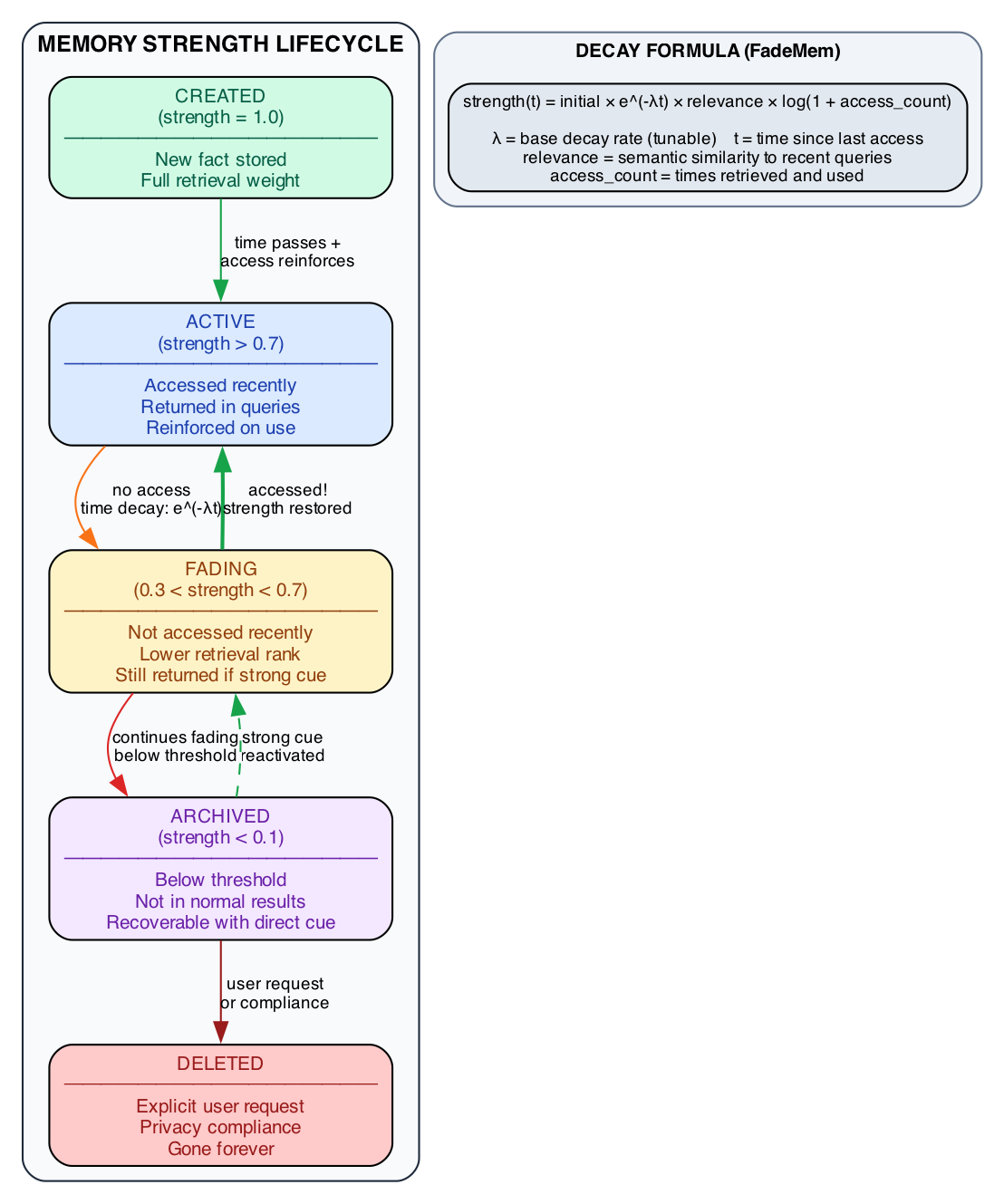
Hermann Ebbinghaus discovered the forgetting curve in 1885. The key insight: memory strength decays exponentially with time, but is restored and strengthened by retrieval.
Strength
  │
  ██████████─┐
  │           └──────┐
  │                  └──────┐          ← Natural decay
  │                         └──────
  │
  ██████████████████─┐                 ← Accessed once: strength restored
  │                  └──────┐
  │                         └──────
  │
  ███████████████████████████████████  ← Accessed repeatedly: stable
  │
  └─────────────────────────────────── Time
The properties that matter:
- Decay is continuous — strength decreases every moment you don’t access it
- Access resets the clock — retrieving a memory reinforces it
- Frequency matters — memories accessed many times decay slower than one-timers
- Decay rate varies — emotional/surprising memories decay slower than routine ones
- It’s not deletion — decayed memories can still be retrieved with strong enough cues
This is elegant because it’s self-maintaining. You don’t need a librarian deciding what to keep. Useful memories naturally persist because they keep getting accessed. Useless ones fade. No manual curation required.
What Research Says (2025-2026)
Three papers directly address forgetting in agent memory:
FadeMem (Wei et al., 2026)
The strongest empirical result. Implements adaptive exponential decay modulated by three factors:
strength(memory, t) = initial_strength × e^(-λt) × relevance_boost × frequency_bonus

where:
  λ = base decay rate (tunable per memory type)
  t = time since last access
  relevance_boost = f(semantic similarity to recent queries)
  frequency_bonus = log(1 + access_count)
Results:
- 45% storage reduction (memories below threshold are archived, not deleted)
- Retrieval precision increased (removing noise improved signal)
- Agent task performance improved on multi-session benchmarks
Key insight: Less memory can mean better performance. The system’s failure mode was never “not enough stored” — it was always “too much noise drowning signal.”
OBLIVION (Rana et al., 2026, NEC Research)
Different approach: uncertainty-gated reads + feedback-driven writes.
- On read: Before surfacing a memory, estimate confidence. Low-confidence memories get suppressed (not deleted, just not returned).
- On write: After the agent uses a memory and gets feedback (user says “no that’s wrong”), the memory’s strength is explicitly reduced.
The uncertainty gate: Instead of returning everything above a similarity threshold, OBLIVION asks “how confident am I that this memory is still accurate?” Factors: age, consistency with recent memories, number of contradicting entries.
The feedback loop: Explicit negative signal (“that’s outdated”) directly weakens the specific memory. Most systems have no mechanism for “this memory is wrong” beyond manual deletion.
EvoMemBench (Wang et al., 2026)
The benchmark paper. Tests 15 memory methods across evolving-knowledge scenarios (facts that change over time).
The uncomfortable finding: Long-context models (just put everything in the window) still compete with sophisticated memory systems for short-to-medium timescales. The advantage of external memory only becomes clear at:
- Many sessions (>50)
- Long time spans (>30 days)
- Frequently-changing facts (preferences that evolve)
What this means: If you’re building a quick demo, “just use a bigger context window” actually works. Memory systems earn their keep over time, not over a single session. This matches intuition — you don’t need a filing system for a one-day project.
What Exists in Code
Three experimental databases implement decay as a native primitive. All are Rust-native, all are early-stage:
MuninnDB
Named after Odin’s raven of memory. Implements Ebbinghaus forgetting curves as a native database operation:
// Memory strength decays automatically
// Accessing a memory updates its strength
// Queries factor strength into ranking
Each memory has a strength field that the database manages. No application code needed for decay. Queries automatically rank by relevance × strength.
Concern: Patent risk. The spaced-repetition-as-database-primitive space has existing IP.
Vestige
Single-binary engine using FSRS (Free Spaced Repetition Scheduler) as its decay model. FSRS is the algorithm behind Anki 23+ — well-validated for human learning, now applied to agent memory.
How it maps:
- Memory “review” = agent accessing the memory
- “Difficulty” = how specialized/niche the memory is
- “Stability” = how many times reinforced
- “Retrievability” = current probability of successful recall (this is what decay affects)
Queries return memories sorted by semantic_similarity × retrievability. A memory with 0.95 similarity but 0.3 retrievability (old, unused) ranks below one with 0.7 similarity but 0.9 retrievability (recent, active).
YantrikDB
Closest to the “embedded SQLite for memory” vision. Designed to be dropped into any application without running a server:
- SQLite-like embedding (link a library, call functions)
- Built-in vector similarity (no separate embedding service needed)
- Native decay scoring (configurable per collection)
- Local-first, zero network dependencies
Most aligned with the “memory database as infrastructure” idea. But extremely early — not production-ready.
Why Decay Isn’t Just “Delete Old Stuff”
The subtle distinction that matters:
| Operation | What it does | When it’s right |
|---|---|---|
| Delete | Memory is gone forever | Explicit user request, privacy compliance, obviously wrong facts |
| Archive | Memory is stored but unsearchable | Past project details, completed task context |
| Decay | Memory loses retrieval priority gradually | Everything else — natural lifecycle management |
Decay means: “I’m less likely to surface this memory, but I can if the cues are strong enough.” This preserves the ability to recall old knowledge when specifically relevant, while preventing it from polluting everyday retrieval.
Example: “User’s first apartment was on 3rd Street” should decay (you don’t need this for daily interactions). But if someone asks “have you ever lived in that neighborhood?” — the memory should be recoverable with a direct enough cue. Deletion would lose this. Decay preserves it at low priority.
The Contradiction Resolution Problem
Decay alone doesn’t solve contradictions. When two facts conflict:
- “Uses Express” (January, strength: 0.3 after decay)
- “Uses Fastify” (April, strength: 0.8 after decay)
Decay helps — the newer fact naturally wins because it’s been accessed more recently. But what if both are still above the retrieval threshold? The agent gets conflicting information.
Approaches in the literature:
-
Temporal supersession (Graphiti’s approach): Later fact about the same entity+attribute automatically supersedes. Requires knowing “same slot” — hard without schema.
-
Strength-based winner (FadeMem): Return only the highest-strength match per topic cluster. Simpler, no schema needed, but might suppress legitimate parallel truths.
-
Explicit contradiction detection (SuperMemory, Mem0 partial): On ingest, check new fact against existing facts with same entity. If conflict detected, either update or mark as superseded.
-
Present both with metadata (most honest): Return both facts with their timestamps and strength. Let the agent decide. Works, but burns tokens and attention on resolution.
None is universally better. In practice, you want (1) for clear factual evolution (addresses, tools, versions), (3) for preferences that might genuinely change, and (4) for decisions where historical context matters.
What a Decay Engine Needs
If you’re building one (or waiting for one to mature), here’s the interface:
memory.add(content, metadata)
  → assigns initial_strength (high)
  → indexes for retrieval

memory.search(query, top_k)
  → score = f(semantic_relevance, keyword_match, strength, recency)
  → strength is FACTORED into ranking, not just a filter

memory.access(memory_id)
  → reinforces strength (resets decay clock)
  → called automatically on retrieval

memory.decay_tick()  [background, periodic]
  → for all memories: strength *= e^(-λ × time_since_access)
  → below threshold: move to archive tier (still queryable with explicit effort)

memory.weaken(memory_id, signal)
  → explicit negative signal: "this memory was wrong/unhelpful"
  → immediately reduces strength (not just waiting for time-based decay)
The critical design choice: decay runs in the background, access reinforces in the foreground. You don’t wait for a query to update strengths. Strengths are always current.
The Economic Argument
“Why not just store everything and improve retrieval?” Because:
-
Retrieval quality degrades with corpus size — precision drops as you have more candidates to rank. Even with perfect embeddings, more noise means more false positives.
-
LLM attention is finite — even if you retrieve 20 relevant memories, the agent can only usefully attend to 5-10 in its context window. The selection matters.
-
Cost scales — vector stores charge by stored vectors. Graph databases charge by nodes. LLM calls for re-ranking charge per token. Letting memory grow unbounded has real infrastructure cost.
-
User trust — when an agent confidently states something wrong because of a stale memory, users lose trust faster than if it said “I don’t know.” The cost of a wrong confident answer is higher than no answer.
FadeMem’s 45% reduction isn’t just a storage win. It’s a quality win. Fewer memories, better results.
What This Means for Practitioners
If you’re building agents today:
- Mem0 and similar tools are fine for prototypes and short-lived deployments
- The moment your users interact over weeks/months, append-only will degrade
- Implement manual decay as a stopgap: periodic job that reduces strength of unaccessed memories, archives below threshold
- Track retrieval quality over time — if precision drops as memory grows, you have a decay problem
If you’re choosing a memory system:
- Ask: “What happens at 10,000 memories?” If the answer is “same as 100 memories,” they haven’t solved decay.
- Ask: “How do contradictions resolve?” If the answer is “we deduplicate on ingest,” that only works for exact contradictions, not evolved preferences.
- Ask: “Can I weaken a specific memory?” If not, you have no mechanism for “that answer was wrong.”
If you’re building a memory system:
- Decay is the highest-value unsolved problem in this space
- Don’t treat it as deletion — treat it as graduated relevance
- Consider FSRS (Vestige’s approach) — it’s battle-tested in spaced repetition and maps naturally to agent memory
- Make strength a first-class field that affects every query, not an optional filter
Previous: Agent Memory Deep Dive #2: The Memory Landscape Next: Agent Memory Deep Dive #4: The Cross-Tool Memory Gap