Agent Landscape #5: Sandboxing — The Missing Security Boundary
Your agent just generated
subprocess.run(["rm", "-rf", "/"]). What stops it?
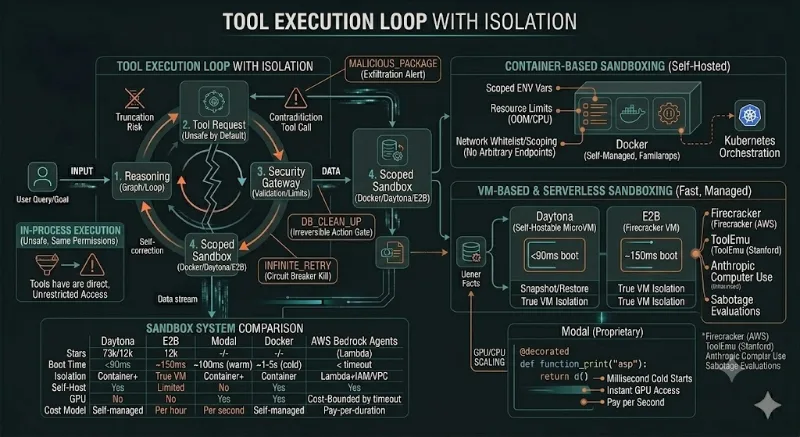
TLDR: Most frameworks run tools in-process with full permissions — fine for demos, fatal in production. Daytona (73k) offers the fastest sandbox (<90ms, self-hostable, MCP-native). E2B (12k) provides strongest isolation (Firecracker microVMs). Docker per-call works for self-hosted. Production agents need: scoped credentials, network isolation, resource limits, ephemeral execution, and audit trails. The isolation spectrum runs from in-process (no safety) to full VM (overkill).
The Problem
Real incidents from production agents:
- Agent asked to “clean up old test data” → ran
DELETE FROM users WHERE created_at < '2024-01-01'— on production - Code-generation agent hallucinated
pip install malicious-package→ executed in the same process with network access - Research agent sent company-internal documents to an external summarization API → data exfiltration via tool call
- Agent in an infinite retry loop called a paid API 10,000 times in 3 minutes → $2,400 bill
The root cause is always the same: the tool executes with the same permissions as the agent process. No isolation, no scoping, no limits.
This isn’t a hypothetical risk — it’s the reason enterprise CISOs block agent deployments. The question isn’t whether your agent will hallucinate a dangerous action. It’s when.
Research & Industry Context
Key Papers & Concepts
Firecracker (Agache et al., 2020, AWS) — lightweight microVMs that boot in <125ms with minimal memory overhead. The technology powering Lambda and Fargate. Proved that VM-level isolation can be fast enough for interactive workloads.
ToolEmu (Ruan et al., 2024, Stanford) — emulation framework for evaluating LLM agent tool-use safety. Simulates tool execution to identify dangerous behaviors (data leakage, unauthorized actions) without real-world consequences. Showed that even GPT-4 agents commit unsafe actions in 23% of risky scenarios.
Anthropic’s “Computer Use” safety research (2024) — documented the risk model of agents with access to real computers. Key findings: prompt injection via screen content, unintended action cascades, and the need for human-in-the-loop gates at irreversible actions.
Sabotage Evaluations for Frontier Models (Anthropic, 2024) — framework for testing whether AI agents deliberately undermine oversight mechanisms. Directly motivates sandboxing: agents with unrestricted tool access can exfiltrate data or disable monitoring even without explicit intent.
How Industry Solves This
Anthropic (Claude Code): Permission system — tools categorized by risk level. Destructive operations require explicit user approval. File system access scoped to project directory. No network requests without user visibility.
OpenAI (Code Interpreter): Ephemeral sandbox per session — Python code runs in a containerized environment with no network access, no persistence between sessions, and resource limits. The gold standard for “code execution that can’t hurt anything.”
Cursor: Runs generated code in the user’s own environment but with a diff-based approval UI. The user sees exactly what will change before it executes. Human-in-the-loop as the security boundary.
Replit Agent: Full VM-level isolation per user project. Agent can modify files, run code, install packages — all within a sandboxed Nix environment that’s destroyed on session end.
AWS (Bedrock Agents): Lambda-based tool execution. Each tool is a Lambda function with IAM roles scoped to minimum permissions. Network isolated by VPC. Cost-bounded by timeout.
Common production patterns:
- Tiered approval (low-risk auto-approve, high-risk human-in-the-loop)
- Credential scoping (each tool gets only what it needs)
- Ephemeral by default (no state leaks between executions)
- Cost circuit breakers (kill execution if spend exceeds threshold)
- Audit logging (full input/output trace of every tool execution)
Open Source Solutions
Four approaches exist, each at a different point on the security vs. performance tradeoff.
Daytona — 73k stars
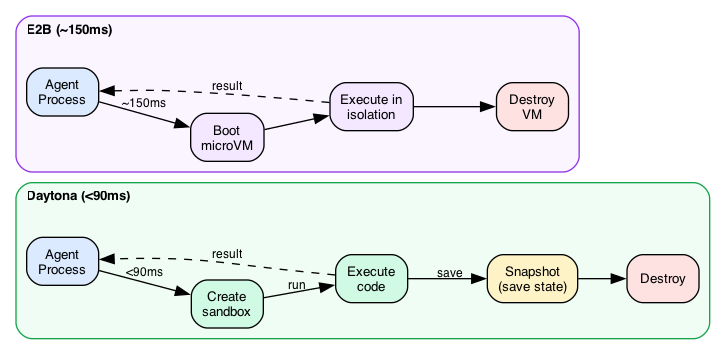
What it is: Secure, elastic infrastructure for running AI-generated code. Sub-90ms sandbox spin-up with snapshot/restore capabilities. The fastest-growing sandboxing project in the agent ecosystem.
Strengths:
- Sub-90ms sandbox creation (faster than E2B)
- Snapshot/restore — pause and resume execution state
- MCP server built-in (agents discover sandbox capabilities via protocol)
- Self-hostable on AWS/GCP (not managed-only)
Limitations:
- Newer project — less battle-tested in production
- Focus is code execution (not API-call sandboxing)
Verdict: The new default for agent code execution. Fastest, self-hostable, MCP-native.
E2B — 12k stars
What it is: Cloud sandboxes purpose-built for AI code execution. Each sandbox is a Firecracker microVM with its own filesystem, network, and process space.
(See sandbox flow diagram above)
Strengths:
- True VM-level isolation (not just containers)
- Fast boot (~150ms) — viable for interactive use
- Multi-language (Python, JS, R, Julia)
- Pre-built templates for common environments
Limitations:
- Managed service only (can’t self-host easily)
- Code execution focus — doesn’t help with API calls
- Cost per sandbox-hour adds up for long sessions
Verdict: Strongest isolation guarantee. Choose when security matters more than cost.
Modal — (proprietary)
What it is: Serverless Python compute. Decorate a function, it runs in the cloud with GPU/CPU scaling.
@modal.function(gpu="A10G", timeout=300)
def run_tool(code: str) -> str:
    return exec_sandboxed(code)
Strengths:
- Best DX for serverless Python
- Instant GPU access (no cluster management)
- Container caching (millisecond cold starts on repeat calls)
- Pay per second of actual compute
Limitations:
- Proprietary (can’t self-host)
- Not agent-aware (general compute)
- Python-only
Verdict: Best when agent tools need GPUs. Pay-per-second without Kubernetes.
Docker-Based Sandboxing
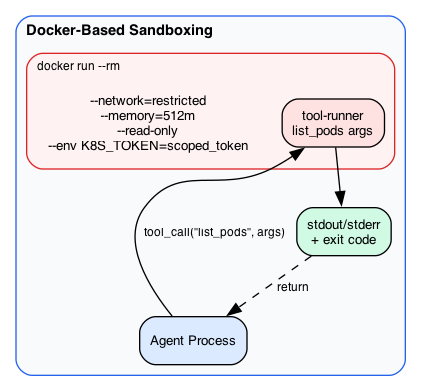
What it is: Run each tool call in a fresh container with scoped permissions, network restrictions, and resource limits.
Strengths:
- Self-hostable (no vendor dependency)
- Fine-grained permission control
- Familiar to any ops team
- Can scope credentials per-container
Limitations:
- Slower cold start (~1-5s)
- Isolation weaker than VMs (shared kernel)
- Requires container orchestration
Verdict: Right choice when you need self-hosted sandboxing for API-call tools and already run Kubernetes.
The Isolation Spectrum

What Agents Need from Sandboxing
| Requirement | Why |
|---|---|
| Sub-second boot | Agent UX requires fast tool responses |
| Credential scoping | Tool X gets read-only DB, tool Y gets write S3 |
| Network isolation | Tool can’t call arbitrary endpoints |
| Resource limits | Prevent runaway compute (OOM, infinite loops) |
| Ephemeral by default | No persistent state leaking between calls |
| Audit trail | Every tool execution logged with inputs, outputs, duration |
Comparison
| Approach | Stars | Boot time | Isolation | Self-host | GPU | Cost model |
|---|---|---|---|---|---|---|
| Daytona | 73k | <90ms | Container+ | Yes | No | Self-managed |
| E2B | 12k | ~150ms | VM | Limited | No | Per hour |
| Modal | — | ~100ms (warm) | Container+ | No | Yes | Per second |
| Docker | — | ~1-5s (cold) | Container | Yes | Yes | Self-managed |
Key Takeaway
Most agent frameworks run tools in-process — same trust boundary as the agent itself. Fine for demos. In production, the tool execution layer needs:
- Scoped credentials (principle of least privilege)
- Resource limits (prevent runaway cost/compute)
- Network restrictions (prevent data exfiltration)
- Audit logging (know what every tool call did)
The right abstraction: a Sandbox interface with multiple backends (Docker for dev, Daytona/E2B for production). The agent developer picks the isolation level; the framework handles the rest.
Previous: Agent Landscape #4: Memory — Beyond Context Window Overflow Next: Agent Landscape #6: Coordination & Protocols — Agents Talking to Everything