Agent Memory Deep Dive #1: Why Your Agent Forgets — The 4 Failure Modes
You told it three times. It still doesn’t know.
TLDR: Agent memory failures aren’t bugs — they’re architectural gaps. Four distinct failure modes explain every frustrating “I already told you this” moment: context overflow (finite window, silent eviction), session amnesia (no persistence), retrieval miss (stored but never surfaced), and stale pollution (outdated facts never die). Understanding which one bit you tells you what to fix. Spoiler: most teams try to solve all four with “just add a vector DB” and it doesn’t work.
The Problem
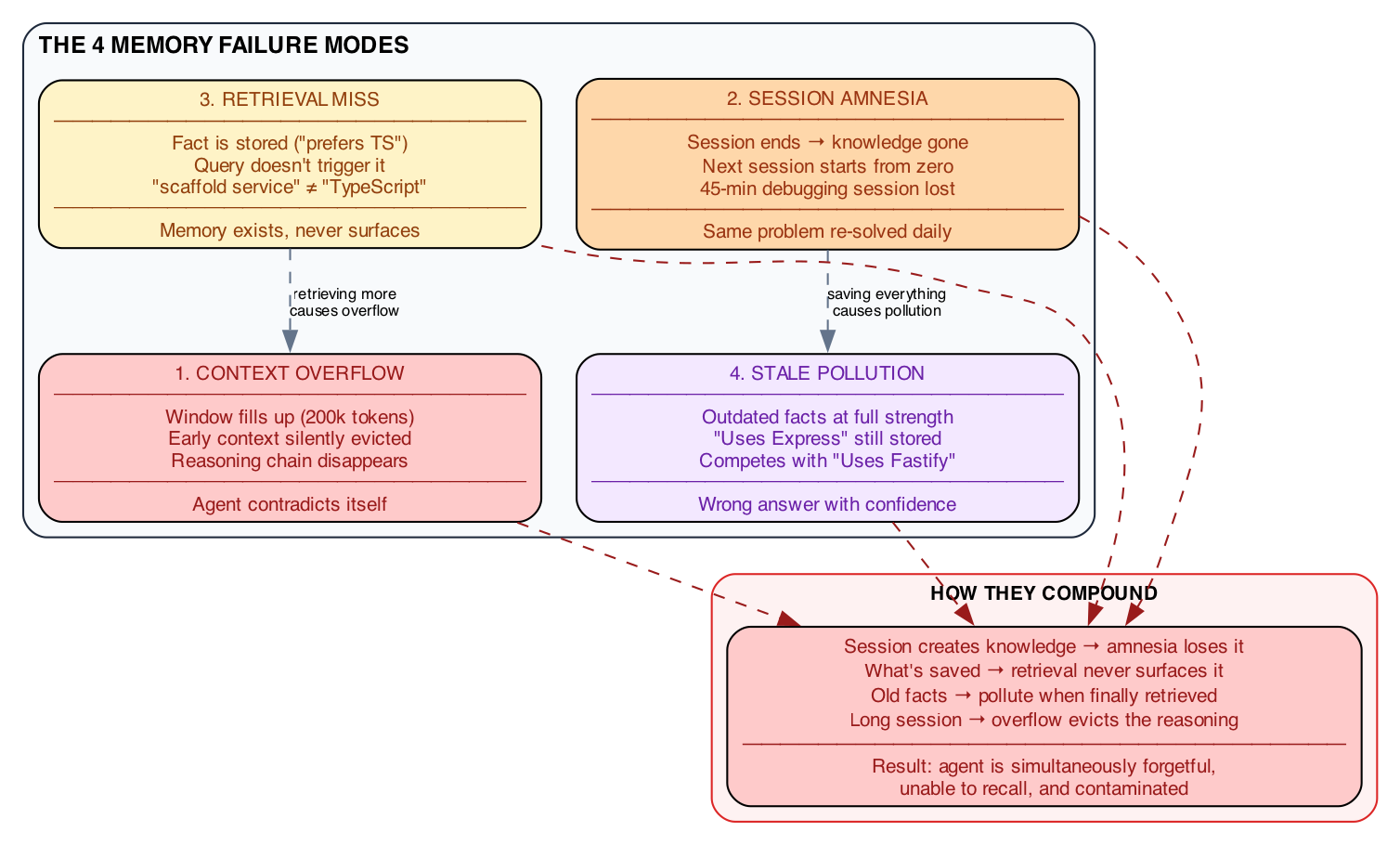
Here are four conversations I’ve actually had with agents in the past month:
Conversation 1: I’m 40 messages deep in a complex refactoring. The agent starts contradicting decisions it made at message 5. Why? Because messages 1-15 were silently summarized to make room for new tool results. The reasoning behind the approach is gone. The agent continues with confidence, unaware it’s now inconsistent.
Conversation 2: I spent 45 minutes debugging a Terraform state issue with Claude. Found the root cause, applied the fix, confirmed it works. Three days later, same project, same agent, same type of issue — starts from scratch. No memory of the last session existing.
Conversation 3: I’ve set up project memory. It stores “user prefers TypeScript.” But when I ask it to scaffold a new service, it suggests Python. The memory exists. It was just never retrieved for this specific context — the query “scaffold a service” doesn’t trigger retrieval of “language preference.”
Conversation 4: Six months ago I configured my project to use Express. I switched to Fastify three months ago and told the agent. But the old “uses Express” memory still lives in the system. Sometimes retrieval returns the old fact instead of the new one. The agent gives advice for a framework I no longer use.
These are four different failures with four different root causes.
Failure Mode 1: Context Overflow
What happens: The agent’s context window fills up. Earlier messages get evicted or compressed. The agent loses the reasoning context that informed its decisions.
Why it happens:
Even 200k tokens isn’t that much in practice. A single tool call with output might consume 2-5k tokens. After 50 tool calls (a medium-complexity task), you’ve used 100-250k tokens just on tool results. Add the conversation itself, system prompt, and memory files — the window is full.
What gets evicted? The earliest context — which is where:
- The user explained what they’re trying to achieve (the “why”)
- The agent reasoned about approach choices (the “how”)
- Key constraints were established (“don’t use X because…”)
The agent doesn’t know this happened. There’s no “I’ve lost context” signal. It continues with the same confidence, now making decisions that contradict its earlier reasoning.
How current systems handle it:
| System | Approach | What’s lost |
|---|---|---|
| Claude Code | Conversation compaction (summarize old turns) | Nuance, reasoning chains, minority considerations |
| OpenClaw | Auto-compaction when tokens exceed threshold + pre-flush of durable state | Same as Claude Code, but at least memory state is persisted before summarization |
| Hermes | Frozen snapshot (memory injected once at session start, never updated mid-session) | Anything learned after turn 1 of the current session isn’t in working memory |
| ChatGPT | Silent truncation | Everything beyond window |
| Letta | Explicit paging (agent decides what to evict) | Agent must spend tokens managing memory instead of working |
| LangGraph | Checkpoint-based (save full state at breakpoints) | Inter-checkpoint reasoning |
The fundamental tension: Compression is lossy. Summarization removes the reasoning path and keeps the conclusion. But when circumstances change, you need the reasoning path to know whether the conclusion still holds.
Example:
- Original reasoning: “I chose approach A because constraint X exists and constraint Y rules out approach B”
- After compression: “Using approach A”
- When constraint X changes: agent has no basis to reconsider
Failure Mode 2: Session Amnesia
What happens: The session ends. Everything learned during the conversation ceases to exist. Next session starts from zero (or near-zero).
Why it happens:
Most AI systems treat each conversation as independent. There’s no automatic mechanism to extract, store, and later retrieve knowledge gained during a session.
The partial solutions:
- Claude Code: Per-project memory files. But the agent has to decide to save something during the session, competing with its main task for attention. Most valuable insights never get written.
- ChatGPT Memory: Auto-extraction. But extremely limited — a handful of short facts. Can’t store complex reasoning, architectural decisions, or debugging solutions.
- Codex CLI: Has an opt-in Memories system that runs background extraction after sessions go idle. But it’s disabled by default — most users never turn it on. And even when enabled, extracted memories are flat text injected into the next session’s prompt, not structured knowledge you can query.
- Hermes: Writes MEMORY.md and USER.md on disk, available next session. But hard character limits (~800 tokens for MEMORY.md) force aggressive compression — complex debugging context doesn’t fit.
What’s actually lost between sessions:
Think about a 45-minute debugging session. You and the agent discovered:
- The root cause (non-obvious, took 20 minutes to find)
- Three approaches that were tried and failed (and why they failed)
- The fix that worked (and the reasoning for why)
- Side discoveries (“oh, this module also has the same pattern and might break”)
None of this persists. The next time a similar issue appears, you repeat the entire diagnostic journey.
The economic waste is staggering. If you have 5 sessions/day and 20% involve problem-solving that would be reusable — that’s one full debugging session per day repeated from scratch that shouldn’t need to be.
Failure Mode 3: Retrieval Miss
What happens: The fact is stored. The agent has memory. But at the moment the fact would be useful, it doesn’t get surfaced.
Why it happens:
This is the subtlest failure and the most common in systems that have memory. The problem is the gap between how you store something and how you’d query for it later.
Consider: you told the agent “I prefer TypeScript for all new services.” This gets stored as a memory entry.
A week later you ask “scaffold me a new microservice for the billing domain.” The retrieval query is something like “scaffold microservice billing.” This has zero semantic similarity to “prefers TypeScript.” The memory exists. It just never fires.
The retrieval approaches and their blind spots:
| Approach | What it finds | What it misses |
|---|---|---|
| Vector similarity | Text that sounds like the query | Preferences, rules, constraints (different semantic space) |
| Keyword/BM25 | Text containing the same words | Anything expressed differently |
| Graph traversal | Entities connected to query entities | Broad preferences not linked to specific entities |
| LLM-driven | Agent explicitly asks “what do I know about X?” | Everything the agent didn’t think to ask about |
The core issue: Retrieval is currently reactive — it surfaces memories matching the query. But the most valuable memories are proactive — they should fire based on the situation, not the query. “User prefers TypeScript” should activate whenever any language choice is being made, not just when the query mentions TypeScript.
This is what neuroscience calls spreading activation — a memory fires because multiple contextual cues converge, not because of direct similarity to a query. No production system does this well.
Failure Mode 4: Stale Pollution
What happens: Outdated facts remain in memory at full strength. New facts compete with old ones during retrieval. Sometimes the old fact wins.
Why it happens:
Almost every memory system is append-only. When you tell the agent “I moved to NYC,” it stores this as a new memory. But “lives in SF” still exists with equal strength. Now retrieval for “where does the user live?” returns both. Which one does the system trust?
Real patterns where this bites:
- Preference evolution: “Use Express” → “Actually, switch to Fastify” → “We’re now on Hono.” Three memories exist. The system has no way to know which is current.
- Technology migrations: “Our database is PostgreSQL” is still stored from before the DynamoDB migration.
- Team/process changes: “Deploy by pushing to main” was true before the team adopted release branches.
- Factual corrections: You told the agent something wrong. Corrected it later. Both versions persist.
Why simple overwrite doesn’t work:
“Just replace the old memory with the new one” assumes you know they’re about the same topic. But memories are stored as embedded vectors — there’s no structural way to know “lives in SF” and “lives in NYC” are the same slot with a different value. They look like two independent facts.
Mem0 attempts deduplication via LLM comparison during ingestion. It works sometimes. But it requires checking every new memory against all existing ones — O(n) LLM calls, expensive, and the LLM can misjudge what’s a contradiction.
What humans do (and agents don’t):
Human memory handles this via strength decay. “Lives in SF” naturally weakens because:
- It’s never reinforced (nobody mentions SF anymore)
- It’s contradicted by new info (NYC appears in recent context)
- Time alone reduces its activation potential
The old memory doesn’t need to be explicitly deleted. It just stops winning retrieval competitions.
OpenClaw has a 30-day half-life decay — the only major agent with time-based weakening. But it’s purely time-driven: it doesn’t consider access frequency or contradiction signals. A critical decision and a trivial question from the same date fade at the same rate. That’s closer to TTL than to human forgetting.
How These Failures Compound
In isolation, each failure mode is annoying. In combination, they’re crippling.
The compounding scenario:
- Session 1: Long debugging session. Agent discovers root cause and fix. (Useful knowledge created)
- End of session: Most knowledge lost (Failure 2: amnesia)
- What little is saved: Stored as extracted fact (partial preservation)
- Session 2, different context: Stored fact never retrieved (Failure 3: retrieval miss)
- Session 3, same issue returns: Agent starts from scratch. Meanwhile…
- The stored fact from session 1 is now stale (codebase has changed). If it does get retrieved, it misleads (Failure 4: pollution)
- Session 3 goes long trying to debug: Early reasoning gets evicted (Failure 1: overflow)
The result: the agent is simultaneously forgetful, unable to recall what it does have, and contaminated by what it shouldn’t remember. This is the default state of every agent memory system in 2026.
The Uncomfortable Truth
Each failure mode has a “simple” solution that doesn’t actually work:
| Failure | Naive fix | Why it doesn’t work |
|---|---|---|
| Context overflow | “Just make the window bigger” | Cost scales linearly. 1M tokens still fills up. And bigger windows have worse attention to details in the middle. |
| Session amnesia | “Just save everything” | You get Failure 4 (stale pollution). Without curation, storage becomes a liability. |
| Retrieval miss | “Just retrieve more” | More results = more noise in context = Failure 1 (overflow). Precision-recall tradeoff. |
| Stale pollution | “Just delete old stuff” | Which old stuff? You need to know what’s stale before you can remove it. That requires understanding, not just timestamps. |
The real answer isn’t solving each failure independently. It’s building a system where:
- Memory has a lifecycle (create → strengthen → decay → archive)
- Retrieval is multi-cue (situation-aware, not just query-matching)
- Storage is tiered (working memory ≠ long-term ≠ archival)
- The agent manages its own memory (not a passive recipient of whatever the system stores)
That’s what the rest of this series digs into.
Next: Agent Memory Deep Dive #2: The Memory Landscape — 10 Approaches, No Winner