Model Routing
Classifying input difficulty and dispatching to small/medium/large models — saving 60-80% on inference cost without sacrificing quality.
Not every request needs your largest model. A “what’s the weather?” query doesn’t require 405B parameters. Model routing classifies each request’s difficulty and dispatches it to the cheapest model that can handle it well — saving 60-80% on inference cost while maintaining quality where it matters.
1. The Economics of Routing
Using a single model for all traffic is simple but wasteful:
| Query type | % of traffic | Needed model | Cost if always use 405B |
|---|---|---|---|
| Simple factual (“capital of France?”) | 40% | 8B is fine | $5.00/M tokens (overkill) |
| Medium reasoning (“explain photosynthesis”) | 35% | 70B is fine | $5.00/M tokens (overkill) |
| Complex multi-step (“prove this theorem”) | 25% | 405B needed | $5.00/M tokens (correct) |
Always-405B cost: $5.00/M tokens.
With routing:
65% cost reduction — and quality stays the same because each request goes to a model that can handle it.
2. Router Architectures
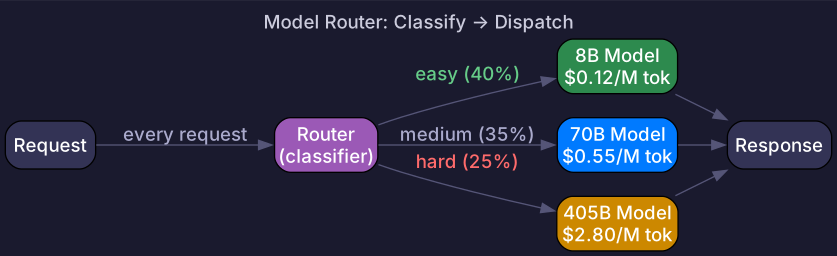
Pre-Routing (Classify Then Dispatch)
A lightweight classifier examines the request before any model sees it, then dispatches to the appropriate model:
Request → Router (classifier) → small / medium / large modelThe classifier runs once per request. If it’s fast (1-5ms), the overhead is negligible.
Three Classifier Approaches
Rule-based — simplest, no training needed:
def rule_router(prompt: str) -> str:
    """Route based on heuristics."""
    # Short, simple queries → small model
    if len(prompt.split()) < 20 and "?" in prompt:
        return "8b"

    # Code generation, math, multi-step → large model
    code_keywords = ["implement", "debug", "algorithm", "prove", "derive"]
    if any(kw in prompt.lower() for kw in code_keywords):
        return "405b"

    # Everything else → medium model
    return "70b"
Accuracy: ~60-70%. Cheap to run, easy to understand, but brittle — misses nuance.
Learned classifier — a small model trained on difficulty labels:
from sklearn.linear_model import LogisticRegression
from sentence_transformers import SentenceTransformer

# Embed queries with a tiny model (30M params, <1ms per query)
embedder = SentenceTransformer("all-MiniLM-L6-v2")

# Train on historical data: (query, which_model_was_needed)
# Labels come from comparing small/large model outputs
X_train = embedder.encode(training_queries)
y_train = difficulty_labels  # "easy", "medium", "hard"

classifier = LogisticRegression().fit(X_train, y_train)

def learned_router(prompt: str) -> str:
    embedding = embedder.encode([prompt])
    difficulty = classifier.predict(embedding)[0]
    return {"easy": "8b", "medium": "70b", "hard": "405b"}[difficulty]
Accuracy: ~80-85%. The embedding model adds ~1ms latency. Training data comes from offline evaluation: run the same queries through all models, label which model was the cheapest correct one.
LLM-based classifier — ask a small model to judge difficulty:
ROUTER_PROMPT = """Rate this query's difficulty: EASY, MEDIUM, or HARD.
EASY: Simple facts, greetings, short answers.
MEDIUM: Explanations, summaries, moderate reasoning.
HARD: Multi-step reasoning, code, math proofs, creative writing.

Query: {query}
Difficulty:"""

def llm_router(prompt: str, router_model) -> str:
    response = router_model.generate(ROUTER_PROMPT.format(query=prompt))
    difficulty = response.strip().upper()
    return {"EASY": "8b", "MEDIUM": "70b", "HARD": "405b"}.get(difficulty, "70b")
Accuracy: ~85-90%. But adds 50-200ms latency (a full LLM call). Only worth it if the cost savings from correct routing exceed the router model’s cost.
Which Classifier to Use?
| Classifier | Latency | Accuracy | Cost | Best for |
|---|---|---|---|---|
| Rule-based | <1ms | 60-70% | $0 | Starting point, low-stakes |
| Learned (embedding + sklearn) | 1-5ms | 80-85% | ~$0.001/M queries | Production at scale |
| LLM-based | 50-200ms | 85-90% | $0.05-0.20/M queries | High-value, latency-tolerant |
3. Training Data for Learned Routers
The hardest part: generating accurate difficulty labels. Two approaches:
Offline Model Comparison
Run a sample of production queries through all candidate models:
def generate_routing_labels(queries, models):
    """Compare model outputs to find cheapest adequate model."""
    labels = []
    for query in queries:
        outputs = {name: model.generate(query) for name, model in models.items()}

        # Use the largest model as reference
        reference = outputs["405b"]

        # Find cheapest model that matches reference quality
        # (measured by LLM-as-judge or task-specific metric)
        for model_name in ["8b", "70b", "405b"]:
            if quality_score(outputs[model_name], reference) > 0.9:
                labels.append(model_name)
                break
    return labels
Online Feedback Loop
Log routing decisions and outcomes, then retrain:
Request → Router → 8B model → user feedback (👍/👎)
  If 👎 → re-run with 70B → label this query as "medium"
  If 👍 → confirm this query as "easy"
Over time, the classifier improves as it sees more labeled data.
4. Routing in Practice: Real Systems
| System | Approach | Models | Key insight |
|---|---|---|---|
| Martian | Learned router | Any OpenAI/Anthropic/open models | Trains on model-specific benchmarks, routes per-query |
| OpenRouter | User-selected + auto | 100+ models | Price/quality tiers, fallback chains |
| Unify | Benchmark-based | Multiple providers | Routes based on benchmark category match |
| RouteLLM (open source) | Trained classifier | Any pair of models | Trains on Chatbot Arena preference data |
RouteLLM Example
# RouteLLM: open-source router from LMSYS
from routellm.controller import Controller

client = Controller(
    routers=["mf"],  # matrix factorization router
    strong_model="gpt-4o",
    weak_model="gpt-4o-mini",
)

# Threshold controls cost-quality tradeoff
# Lower threshold = more queries go to strong model
response = client.chat.completions.create(
    model="router-mf-0.116",  # 0.116 = threshold
    messages=[{"role": "user", "content": query}],
)
At threshold 0.116, RouteLLM achieves 95% of GPT-4 quality while routing 50% of queries to the cheaper model — halving cost.
5. Monitoring Router Quality
A router that misclassifies “hard” queries as “easy” degrades quality silently. Monitor:
# Key metrics for router health
router_metrics = {
    # Routing distribution — should be stable
    "pct_easy": count_easy / total,      # expect ~40%
    "pct_medium": count_medium / total,   # expect ~35%
    "pct_hard": count_hard / total,       # expect ~25%

    # Quality per tier — catch misrouting
    "quality_easy_tier": avg_score_easy,   # should be >0.85
    "quality_medium_tier": avg_score_medium,
    "quality_hard_tier": avg_score_hard,

    # Escalation rate — how often users retry after routing to small model
    "escalation_rate": retries / total,    # should be <5%

    # Cost savings vs always-large
    "cost_savings_pct": 1 - (routed_cost / always_large_cost),
}
Red flags:
escalation_rate > 10%→ router is too aggressive, sending hard queries to small modelspct_easysuddenly drops → query distribution shifted, retrain routerquality_easy_tierdrops → small model degraded, or easy queries got harder
Self-Check
- Calculate cost savings from routing 50% of queries to a model 10× cheaper
- Compare rule-based, learned, and LLM-based classifiers on latency, accuracy, and cost
- Describe how to generate training data for a learned router using offline model comparison
- Explain why monitoring escalation rate is critical for router health
- Design a routing strategy for a customer support chatbot with 3 model sizes