End-to-End RAG Serving
Orchestrating retriever → reranker → generator with latency budgets, parallelization, failure handling, and quality monitoring.
Individual RAG components — embedding, retrieval, reranking, generation — are well-understood. The hard part is orchestrating them into a reliable, low-latency production pipeline. This chapter covers the end-to-end architecture: latency budgets, parallelization, caching, failure handling, and quality monitoring.
1. End-to-End Architecture
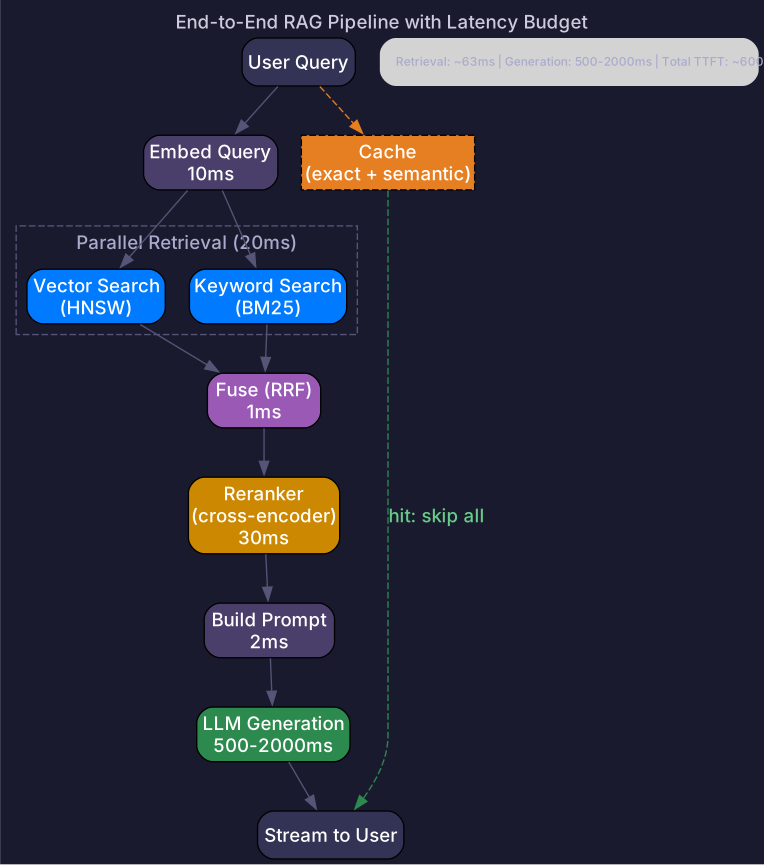
User query
  │
  ├─→ Embed query (10ms)
  │     │
  │     ├─→ Vector search (20ms)           ─┐
  │     └─→ BM25 keyword search (15ms)      │── Parallel
  │                                         ─┘
  ├─→ Fuse results (RRF, 1ms)
  │
  ├─→ Rerank top-K (30ms)
  │
  ├─→ Build prompt (context + query) (2ms)
  │
  └─→ LLM generation (500-2000ms)
        │
        └─→ Stream tokens to user
Total latency: 65ms retrieval + LLM generation. The retrieval pipeline should be <100ms to keep TTFT low.
2. Latency Budget Allocation
Every millisecond in the retrieval pipeline delays the first token. Allocate a budget and enforce it:
class LatencyBudget:
    """Track and enforce per-stage latency budgets."""

    BUDGETS = {
        "embed_query":     15,   # ms
        "vector_search":   30,   # ms
        "keyword_search":  25,   # ms
        "fusion":           2,   # ms
        "rerank":          40,   # ms
        "prompt_build":     5,   # ms
        "total_retrieval": 100,  # ms (hard ceiling before LLM call)
    }

    def __init__(self):
        self.timings = {}
        self.start = time.monotonic()

    def record(self, stage: str, duration_ms: float):
        self.timings[stage] = duration_ms
        budget = self.BUDGETS.get(stage)
        if budget and duration_ms > budget * 1.5:  # 50% over budget = warning
            logger.warning(f"Stage {stage} took {duration_ms:.1f}ms (budget: {budget}ms)")

    def remaining(self) -> float:
        elapsed = (time.monotonic() - self.start) * 1000
        return max(0, self.BUDGETS["total_retrieval"] - elapsed)

    def should_skip_rerank(self) -> bool:
        """Skip reranking if we've already blown the budget."""
        return self.remaining() < self.BUDGETS["rerank"]
3. The RAG Orchestrator
from fastapi import FastAPI
from fastapi.responses import StreamingResponse
import asyncio

app = FastAPI()

class RAGOrchestrator:
    def __init__(self, embedder, vector_db, bm25_index, reranker, llm):
        self.embedder = embedder
        self.vector_db = vector_db
        self.bm25_index = bm25_index
        self.reranker = reranker
        self.llm = llm

    async def query(self, user_query: str, top_k: int = 5) -> AsyncIterator[str]:
        budget = LatencyBudget()

        # Stage 1: Embed query
        t0 = time.monotonic()
        query_vector = self.embedder.encode(user_query)
        budget.record("embed_query", elapsed_ms(t0))

        # Stage 2: Parallel retrieval (vector + keyword)
        t0 = time.monotonic()
        vector_task = asyncio.create_task(
            self.vector_db.search(query_vector, top_k=top_k * 4)
        )
        keyword_task = asyncio.create_task(
            self.bm25_index.search(user_query, top_k=top_k * 4)
        )
        vector_results, keyword_results = await asyncio.gather(
            vector_task, keyword_task
        )
        budget.record("parallel_retrieval", elapsed_ms(t0))

        # Stage 3: Fuse results
        t0 = time.monotonic()
        fused = reciprocal_rank_fusion(vector_results, keyword_results, top_k=top_k * 2)
        budget.record("fusion", elapsed_ms(t0))

        # Stage 4: Rerank (skip if over budget)
        if not budget.should_skip_rerank():
            t0 = time.monotonic()
            passages = [r.text for r in fused]
            reranked = self.reranker.rerank(user_query, passages, top_k=top_k)
            budget.record("rerank", elapsed_ms(t0))
            context_passages = [p.text for p in reranked]
        else:
            logger.warning("Skipping rerank — over latency budget")
            context_passages = [r.text for r in fused[:top_k]]

        # Stage 5: Build prompt
        prompt = self._build_prompt(user_query, context_passages)

        # Stage 6: Stream LLM response
        async for token in self.llm.stream(prompt):
            yield token

    def _build_prompt(self, query: str, passages: list[str]) -> str:
        context = "\n\n---\n\n".join(passages)
        return f"""Answer the question based on the provided context. If the context doesn't contain enough information, say so.

Context:
{context}

Question: {query}

Answer:"""

@app.post("/rag")
async def rag_endpoint(query: str):
    orchestrator = RAGOrchestrator(embedder, vector_db, bm25_index, reranker, llm)
    return StreamingResponse(
        orchestrator.query(query),
        media_type="text/event-stream",
    )
4. Parallelization Strategies
What Can Run in Parallel
Sequential (must wait):         Parallelizable:
  embed → search (needs vector)   vector_search ║ keyword_search
  search → rerank (needs results)  multi-source retrieval (DB1 ║ DB2 ║ DB3)
  rerank → LLM (needs context)    embed_query ║ check_cache
Multi-Source Retrieval
For complex RAG, retrieve from multiple sources simultaneously:
async def multi_source_retrieve(query_vector, query_text, sources):
    """Retrieve from multiple sources in parallel."""
    tasks = []
    for source in sources:
        if source.type == "vector":
            tasks.append(source.db.search(query_vector, top_k=20))
        elif source.type == "keyword":
            tasks.append(source.index.search(query_text, top_k=20))
        elif source.type == "knowledge_graph":
            tasks.append(source.kg.query(query_text, max_hops=2))

    results = await asyncio.gather(*tasks, return_exceptions=True)

    # Handle partial failures — use whatever succeeded
    valid_results = []
    for source, result in zip(sources, results):
        if isinstance(result, Exception):
            logger.error(f"Source {source.name} failed: {result}")
            continue
        valid_results.extend(result)

    return valid_results
5. Caching Architecture
Three levels of caching in a RAG pipeline:
| Cache level | What’s cached | Hit rate | Savings |
|---|---|---|---|
| Query embedding cache | Embed(query) → vector | 10-30% (repeated queries) | Skip embedding model |
| Retrieval cache | Query → retrieved passages | 15-40% (FAQ-heavy workloads) | Skip vector search + rerank |
| Response cache | (Query, context) → LLM response | 5-20% (exact duplicates) | Skip entire LLM call |
class RAGCache:
    def __init__(self, redis_client, ttl=3600):
        self.redis = redis_client
        self.ttl = ttl

    async def get_or_retrieve(self, query: str, retrieve_fn):
        """Check cache before retrieval."""
        cache_key = f"rag:retrieval:{hashlib.md5(query.encode()).hexdigest()}"

        cached = await self.redis.get(cache_key)
        if cached:
            return json.loads(cached)  # Cache hit — skip retrieval + reranking

        # Cache miss — run full pipeline
        results = await retrieve_fn(query)
        await self.redis.setex(cache_key, self.ttl, json.dumps(results))
        return results

    async def get_or_generate(self, query: str, context: list[str], generate_fn):
        """Check cache before LLM generation."""
        # Hash both query and context — different context = different answer
        content = query + "||" + "||".join(context)
        cache_key = f"rag:response:{hashlib.md5(content.encode()).hexdigest()}"

        cached = await self.redis.get(cache_key)
        if cached:
            return cached  # Full response from cache

        response = await generate_fn(query, context)
        await self.redis.setex(cache_key, self.ttl, response)
        return response
Cache Invalidation
When documents change, cached results become stale:
async def invalidate_on_doc_update(doc_id: str):
    """Invalidate all cache entries that used this document."""
    # Option 1: Nuke all retrieval cache (simple, aggressive)
    await redis.delete_pattern("rag:retrieval:*")

    # Option 2: Track which cache entries used which docs (precise, complex)
    affected_keys = await redis.smembers(f"rag:doc_refs:{doc_id}")
    if affected_keys:
        await redis.delete(*affected_keys)
6. Failure Handling
RAG has multiple failure modes. Handle each gracefully:
| Failure | Impact | Fallback |
|---|---|---|
| Embedding service down | Can’t search | Return cached results or fall back to keyword search |
| Vector DB timeout | No retrieval results | Fall back to keyword search only |
| Reranker timeout | Unranked results | Skip reranking, use vector search order |
| All retrieval fails | No context | Generate without context (warn user) |
| LLM timeout | No response | Retry with shorter context, or return “try again” |
async def resilient_rag(query: str, orchestrator: RAGOrchestrator):
    """RAG with cascading fallbacks."""
    try:
        # Full pipeline
        return await orchestrator.query(query, top_k=5)
    except RetrievalTimeout:
        logger.warning("Retrieval timeout — trying keyword-only")
        try:
            # Fallback: keyword search only (no vector, no rerank)
            results = await orchestrator.bm25_index.search(query, top_k=5)
            context = [r.text for r in results]
            return await orchestrator.llm.generate(
                orchestrator._build_prompt(query, context)
            )
        except Exception:
            pass
    except Exception as e:
        logger.error(f"RAG pipeline failed: {e}")

    # Last resort: generate without context
    return await orchestrator.llm.generate(
        f"Answer this question (no additional context available): {query}"
    )
7. Quality Monitoring
RAG quality degrades silently — you need continuous measurement:
Retrieval Quality
# Track retrieval metrics per query
retrieval_metrics = {
    "num_results": len(retrieved),             # Should be ≥ top_k
    "avg_relevance_score": mean(scores),       # Should be stable
    "min_relevance_score": min(scores),        # Watch for garbage results
    "retrieval_latency_ms": retrieval_time,    # Watch for degradation
    "cache_hit": was_cached,                   # Track hit rate
}
Answer Quality (Automated)
async def assess_rag_quality(query, context, answer):
    """Use LLM-as-judge to assess RAG answer quality."""
    assessment = await judge_llm.generate(f"""
    Rate this answer on two dimensions (1-5):

    FAITHFULNESS: Does the answer only use information from the context?
    RELEVANCE: Does the answer address the question?

    Question: {query}
    Context: {context[:2000]}
    Answer: {answer}

    Respond as JSON: {{"faithfulness": X, "relevance": X}}
    """)
    return json.loads(assessment)

# Run on 1-5% of production traffic
if random.random() < 0.03:
    quality = await assess_rag_quality(query, context, answer)
    metrics.record("faithfulness", quality["faithfulness"])
    metrics.record("relevance", quality["relevance"])
Hallucination Detection
The most dangerous RAG failure: the LLM ignores context and makes things up.
def detect_hallucination(answer: str, context_passages: list[str]) -> float:
    """Estimate hallucination risk by checking answer against context."""
    answer_sentences = split_sentences(answer)
    hallucination_score = 0

    for sentence in answer_sentences:
        # Check if sentence is supported by any context passage
        max_support = max(
            semantic_similarity(sentence, passage)
            for passage in context_passages
        )
        if max_support < 0.5:  # Low support = potentially hallucinated
            hallucination_score += 1

    return hallucination_score / len(answer_sentences)

# Alert if hallucination rate exceeds threshold
if hallucination_rate > 0.15:
    alert("RAG hallucination rate above 15% — check retrieval quality")
Self-Check
- Design a RAG pipeline with latency budget allocation per stage
- Implement parallel retrieval from multiple sources with failure handling
- Build a three-level caching strategy (embedding, retrieval, response)
- Describe cascading fallbacks when RAG components fail
- Set up automated quality monitoring with faithfulness and relevance scoring
References
- Retrieval-Augmented Generation for Knowledge-Intensive NLP Tasks (Lewis et al., 2020)
- RAGAS: Automated Evaluation of Retrieval Augmented Generation
- LlamaIndex RAG Documentation
- For reranker details, see Reranker Serving
- For embedding model selection, see Embedding Pipeline