GPU Scheduling
Gang scheduling for training, bin packing for inference, preemption policies, priority queues, and fair-share across teams.
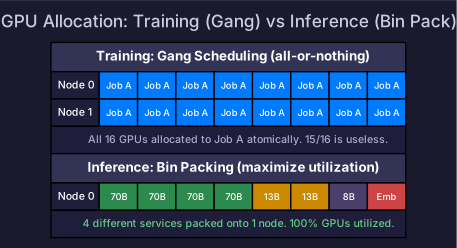
GPU scheduling determines who gets which GPUs, when, and for how long. The policies differ dramatically between training (all-or-nothing) and inference (fractional, elastic) — getting this wrong means either wasted GPUs or stalled jobs.
1. The Two Worlds
| Property | Training scheduling | Inference scheduling |
|---|---|---|
| Allocation unit | All N GPUs at once (gang) | 1-8 GPUs per pod (fractional) |
| Duration | Hours to weeks | Indefinite (always running) |
| Failure handling | Checkpoint + restart | Health check + restart pod |
| Scaling | Fixed size for duration | Auto-scale with load |
| Preemption | Acceptable (with checkpoint) | Avoid (user-facing) |
2. Gang Scheduling
Distributed training needs ALL requested GPUs simultaneously. 63 out of 64 is useless — the job can’t start.
Cluster: 128 GPUs total

Job A (submitted first): needs 64 GPUs → starts immediately (64/128 used)
Job B (submitted second): needs 64 GPUs → starts immediately (128/128 used)
Job C (submitted third): needs 96 GPUs → WAITS (only free after A or B finish)

Without gang scheduling:
  Job C might get 64 GPUs → can't use them → deadlock

With gang scheduling (Slurm default):
  Job C waits until 96 GPUs are simultaneously free → starts atomically
Backfill Scheduling
While Job C waits for 96 GPUs, smaller jobs can backfill the gap:
Job C waiting for 96 GPUs (ETA: 12 hours when Job A finishes)
Job D (needs 8 GPUs, runs 2 hours): can backfill! Fits in the gap.
Job E (needs 32 GPUs, runs 1 hour): can backfill!

Backfill condition: Job D/E must FINISH before Job C needs those GPUs
→ Requires accurate time estimates (--time in Slurm)Rule: Always set accurate --time limits — Slurm uses them for backfill decisions. Overestimate = blocks backfill. Underestimate = job gets killed.
3. Bin Packing for Inference
Inference pods need 1-8 GPUs each. Pack them tightly to minimize wasted GPUs:
8-GPU node:
  Bin packing:
    Pod A: 4 GPUs (70B model, TP=4)
    Pod B: 2 GPUs (13B model, TP=2)
    Pod C: 1 GPU (8B model)
    Pod D: 1 GPU (embedding model)
    → 100% utilized, 0 GPUs wasted

  Spread (anti-affinity):
    Pod A: 4 GPUs on Node 0
    Pod B: 2 GPUs on Node 1
    Pod C: 1 GPU on Node 2
    → Fault tolerant but 11 GPUs idle across 3 nodes
# Kubernetes: prefer bin packing (pack onto fewer nodes)
apiVersion: v1
kind: Pod
spec:
affinity:
nodeAffinity:
preferredDuringSchedulingIgnoredDuringExecution:
- weight: 100
preference:
matchExpressions:
- key: gpu-utilization
operator: Lt
values: ["80"] # prefer nodes with available GPUs4. Priority and Preemption
Not all workloads are equal. Production serving must never be preempted; dev experiments can be:
| Tier | Priority | Preemptible | Examples |
|---|---|---|---|
| P0: Production | Highest | Never | Live inference serving |
| P1: Training (scheduled) | High | Only by P0 | Pre-training, scheduled fine-tuning |
| P2: Training (ad-hoc) | Medium | By P0, P1 | Experiment runs, hyperparameter search |
| P3: Development | Low | By anyone | Notebooks, debugging, exploration |
Preemption in Practice
P3 job running on 8 GPUs (dev experiment)
P1 job submitted (scheduled training, needs 64 GPUs, only 56 free)

→ Scheduler preempts the P3 job (checkpoints, then frees 8 GPUs)
→ P1 job now has 64 GPUs → starts
→ P3 job re-queued, waits for resources
5. Fair-Share Scheduling
Prevent one team from monopolizing the cluster:
Cluster: 256 GPUs
Team quotas: Team A = 40%, Team B = 35%, Team C = 25%

This week:
  Team A used 60% (over quota) → priority reduced next week
  Team B used 20% (under quota) → priority boosted next week
  Team C used 20% (under quota) → priority boosted

Fair-share adjusts priorities dynamically so everyone gets their share over time.
# Slurm fair-share configuration
sacctmgr add account team-a fairshare=40
sacctmgr add account team-b fairshare=35
sacctmgr add account team-c fairshare=25
# Check current fair-share status
sshare -l -aFor sharing a single GPU across workloads, see GPU Virtualization. For dynamic scaling, see Dynamic Allocation.
Self-Check
- Explain gang scheduling and why training requires it
- Explain backfill scheduling and why accurate time estimates matter
- Compare bin packing vs spread for inference pods
- Design a 4-tier priority scheme with preemption rules
- Configure Slurm fair-share for 3 teams with different quotas