API Gateway
LLM-specific gateway concerns — per-token rate limiting, streaming proxy, model routing, request logging with PII redaction.
The API gateway is the front door to your inference service. But LLM serving has gateway requirements that differ fundamentally from traditional web APIs: requests vary in cost by 100×, responses stream for seconds, and prompts contain sensitive data that must be logged carefully.
1. Why LLM Gateways Are Different
| Property | Traditional API | LLM API |
|---|---|---|
| Request cost | ~uniform | 100× variance (10 tokens vs 10,000) |
| Response time | 50-200ms | 500ms-60s |
| Response delivery | Single JSON | Token-by-token stream (SSE) |
| Rate limiting | Per-request | Per-token (cost varies dramatically) |
| Payload sensitivity | Moderate | High (prompts contain user data) |
| Backend selection | Round-robin | Model-specific, prefix-cache-aware |
A gateway that treats LLM requests like REST requests will fail — you need token-aware rate limiting, streaming-compatible proxying, and model-specific routing.
2. Architecture
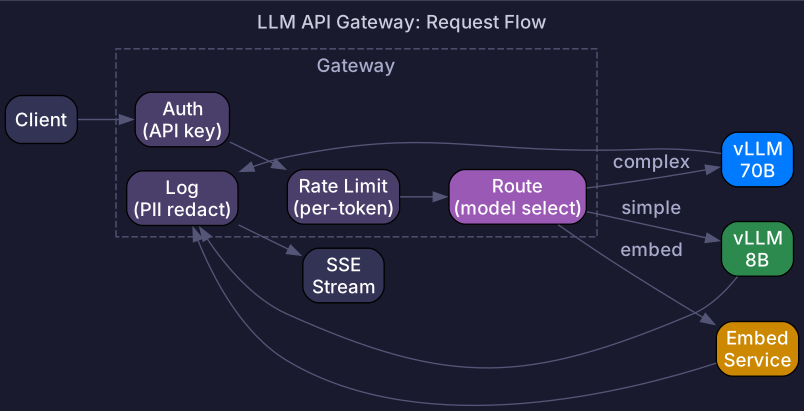
Client → Gateway → Router → Inference Pool → Streamed Response
           │                    │
           ├── Auth             ├── vLLM instance 1
           ├── Rate limit       ├── vLLM instance 2
           ├── Log              └── vLLM instance 3
           └── Transform
Request Flow
class LLMGateway:
    async def handle_request(self, request: Request) -> StreamingResponse:
        # 1. Authenticate
        tenant = await self.authenticate(request)

        # 2. Parse and validate
        body = await request.json()
        model = body.get("model", "default")
        max_tokens = body.get("max_tokens", 4096)

        # 3. Token-based rate limiting
        estimated_tokens = count_tokens(body["messages"]) + max_tokens
        if not await self.rate_limiter.allow(tenant.id, estimated_tokens):
            raise HTTPException(429, "Token rate limit exceeded")

        # 4. Route to appropriate backend
        backend = self.router.select(model, tenant.tier)

        # 5. Proxy request with streaming
        async def stream_response():
            actual_tokens = 0
            async for chunk in backend.stream(body):
                actual_tokens += chunk.token_count
                yield f"data: {json.dumps(chunk.dict())}\n\n"

            # 6. Log completion (after streaming finishes)
            await self.logger.log_completion(
                tenant=tenant,
                model=model,
                input_tokens=count_tokens(body["messages"]),
                output_tokens=actual_tokens,
                latency_ms=elapsed(),
            )

            # 7. Update billing meter
            await self.billing.record(tenant.id, actual_tokens)

        return StreamingResponse(stream_response(), media_type="text/event-stream")
3. Token-Based Rate Limiting
Per-request rate limiting is unfair — one 10-token request and one 10,000-token request cost vastly different amounts.
Token Bucket with Per-Minute Limits
class TokenRateLimiter:
    """Rate limit by token count, not request count."""

    def __init__(self, redis: Redis):
        self.redis = redis

    async def allow(self, tenant_id: str, estimated_tokens: int) -> bool:
        key = f"ratelimit:{tenant_id}:{current_minute()}"

        # Get current usage
        current = int(await self.redis.get(key) or 0)
        limit = await self.get_limit(tenant_id)

        if current + estimated_tokens > limit:
            return False

        # Increment usage
        pipe = self.redis.pipeline()
        pipe.incrby(key, estimated_tokens)
        pipe.expire(key, 120)  # TTL: 2 minutes
        await pipe.execute()
        return True

    async def get_limit(self, tenant_id: str) -> int:
        """Per-tenant token limits."""
        tier = await self.get_tier(tenant_id)
        return {
            "free":       10_000,     # 10K tokens/min
            "starter":   100_000,     # 100K tokens/min
            "pro":     1_000_000,     # 1M tokens/min
            "enterprise": 10_000_000, # 10M tokens/min
        }[tier]
Multi-Dimensional Limits
Production systems need limits on multiple axes:
| Limit dimension | Typical values | Why |
|---|---|---|
| Tokens per minute | 10K-10M | Cost control |
| Requests per minute | 60-10,000 | Prevent abuse patterns |
| Concurrent requests | 10-1,000 | Prevent resource monopolization |
| Max tokens per request | 4K-128K | Prevent single huge requests |
| Monthly token budget | 1M-1B | Billing cap |
4. Request Routing
Model-Based Routing
class ModelRouter:
    """Route requests to the correct model backend."""

    def __init__(self, backends: dict[str, list[Backend]]):
        self.backends = backends  # model_name → [backend instances]

    def select(self, model: str, tenant_tier: str) -> Backend:
        candidates = self.backends.get(model, [])
        if not candidates:
            raise HTTPException(404, f"Model {model} not available")

        # Filter by tenant tier (enterprise gets dedicated instances)
        if tenant_tier == "enterprise":
            candidates = [b for b in candidates if b.pool == "dedicated"] or candidates

        # Select backend with shortest queue
        return min(candidates, key=lambda b: b.queue_depth)
A/B Traffic Splitting
Test new model versions on a subset of traffic:
class ABRouter:
    def __init__(self, control_backend, treatment_backend, treatment_pct=0.05):
        self.control = control_backend
        self.treatment = treatment_backend
        self.treatment_pct = treatment_pct

    def select(self, request_id: str) -> Backend:
        # Deterministic split based on request ID (consistent per user)
        if hash(request_id) % 100 < self.treatment_pct * 100:
            return self.treatment
        return self.control
5. Authentication and Tenant Management
class AuthMiddleware:
    async def authenticate(self, request: Request) -> Tenant:
        # API key authentication
        api_key = request.headers.get("Authorization", "").replace("Bearer ", "")
        if not api_key:
            raise HTTPException(401, "Missing API key")

        # Look up tenant (cached in Redis)
        tenant = await self.cache.get(f"apikey:{api_key}")
        if not tenant:
            tenant = await self.db.get_tenant_by_key(api_key)
            if not tenant:
                raise HTTPException(401, "Invalid API key")
            await self.cache.setex(f"apikey:{api_key}", 300, tenant.json())

        # Check if key is rotated/expired
        if tenant.key_expires_at and tenant.key_expires_at < datetime.utcnow():
            raise HTTPException(401, "API key expired")

        return tenant
Key Management
| Feature | Implementation |
|---|---|
| Key rotation | Issue new key, grace period for old key (72h), then revoke |
| Key scoping | Per-key model access list, max tokens, IP allowlist |
| Usage attribution | Every request tagged with tenant + key ID for billing |
| Audit trail | Log key creation, rotation, revocation events |
6. Request/Response Logging
LLM logs are sensitive — prompts contain user data, completions may contain PII.
class RequestLogger:
    async def log_completion(self, tenant, model, input_tokens, output_tokens,
                              latency_ms, prompt=None, completion=None):
        log_entry = {
            "timestamp": datetime.utcnow().isoformat(),
            "tenant_id": tenant.id,
            "model": model,
            "input_tokens": input_tokens,
            "output_tokens": output_tokens,
            "latency_ms": latency_ms,
            "status": "success",
        }

        # PII redaction for prompt/completion logging
        if tenant.log_prompts:
            log_entry["prompt_hash"] = hashlib.sha256(prompt.encode()).hexdigest()
            if tenant.log_level == "full":
                log_entry["prompt"] = self.redact_pii(prompt)
                log_entry["completion"] = self.redact_pii(completion)

        await self.log_store.write(log_entry)

    def redact_pii(self, text: str) -> str:
        """Remove emails, phone numbers, SSNs, credit cards."""
        import re
        text = re.sub(r'\b[\w.+-]+@[\w-]+\.[\w.]+\b', '[EMAIL]', text)
        text = re.sub(r'\b\d{3}[-.]?\d{3}[-.]?\d{4}\b', '[PHONE]', text)
        text = re.sub(r'\b\d{3}-\d{2}-\d{4}\b', '[SSN]', text)
        text = re.sub(r'\b\d{4}[\s-]?\d{4}[\s-]?\d{4}[\s-]?\d{4}\b', '[CARD]', text)
        return text
Log Retention Policies
| Data type | Retention | Storage |
|---|---|---|
| Request metadata (tokens, latency) | 90 days | Time-series DB (ClickHouse) |
| Prompt/completion (redacted) | 30 days | Encrypted object storage |
| Billing records | 7 years | Immutable audit log |
| Error traces | 14 days | Log aggregation (ELK) |
7. Gateway Implementation Options
| Option | Pros | Cons | Best for |
|---|---|---|---|
| Kong + plugins | Mature, plugin ecosystem | LLM streaming needs custom work | Enterprise with existing Kong |
| Envoy + Lua/WASM | High performance, streaming native | Complex configuration | High-throughput platforms |
| Custom (FastAPI/Go) | Full control, LLM-optimized | Build everything yourself | Startups, specific requirements |
| LiteLLM Proxy | LLM-native, multi-provider | Less battle-tested at scale | Multi-provider routing |
| Cloudflare AI Gateway | Managed, caching, analytics | Vendor lock-in | Quick start |
Self-Check
- Explain why per-request rate limiting is insufficient for LLM APIs
- Implement token-based rate limiting with per-minute buckets
- Design model-based routing with A/B traffic splitting
- Build a request logger with PII redaction for prompt/completion data
- Compare gateway implementation options for LLM serving
References
- LiteLLM Proxy Documentation
- Kong Gateway
- Envoy Proxy
- For LLM-specific load balancing, see Load Balancing for LLMs