PyTorch DataLoader
num_workers, prefetching, pin_memory, multiprocessing overhead — understanding the default data loading path and its limits at scale.
The PyTorch DataLoader is the default data feeding mechanism. Understanding its internals — worker processes, memory pinning, prefetching — is essential for diagnosing training bottlenecks.
1. How DataLoader Works
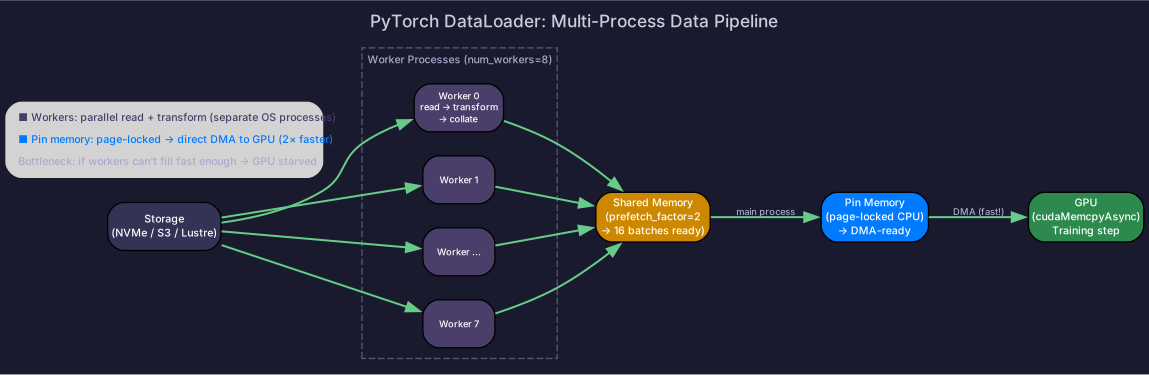
Main process (GPU training)
  ↓ requests batch
DataLoader
  ├── Worker 0: read data → transform → collate
  ├── Worker 1: read data → transform → collate
  ├── ...
  └── Worker N: read data → transform → collate
  ↓ prefetched batch
Pin memory (optional: CPU → pinned CPU)
  ↓
GPU transfer (cudaMemcpyAsync)
  ↓
Training step
Each worker is a separate OS process (not thread — Python GIL forces multiprocessing). Workers read data from disk/network, apply transforms, and send batches to the main process via shared memory.
2. Key Parameters
| Parameter | Default | What it does | Tuning |
|---|---|---|---|
num_workers | 0 (main process) | Number of parallel data loading processes | 4-16 per GPU (test!) |
prefetch_factor | 2 | Batches prefetched per worker | 2-4 (more hides latency) |
pin_memory | False | Copy data to CUDA-pinned memory | Always True for GPU training |
persistent_workers | False | Keep workers alive between epochs | True (avoids respawn cost) |
drop_last | False | Drop incomplete last batch | True for distributed training |
num_workers Tuning
# Too few workers: GPU starved (data loading slower than training)
# Too many workers: CPU/memory contention, diminishing returns
# Sweet spot: typically 4-8 per GPU

# Empirical test:
for nw in [0, 2, 4, 8, 16, 32]:
    loader = DataLoader(dataset, num_workers=nw, pin_memory=True)
    throughput = measure_throughput(loader)
    print(f"num_workers={nw}: {throughput:.1f} samples/sec")
Rule of thumb: Start with num_workers = 4 × num_gpus. Increase until throughput plateaus or CPU becomes saturated.
pin_memory Explained
Normal (pageable) memory → GPU transfer: kernel must copy to pinned memory first, then DMA to GPU (2 copies).
Pinned memory → GPU transfer: DMA directly to GPU (1 copy, 2× faster).
# Always use for GPU training
loader = DataLoader(dataset, pin_memory=True, num_workers=8)Cost: Pinned memory is non-swappable — too much pins can reduce available system RAM.
3. Common Bottlenecks
| Symptom | Cause | Fix |
|---|---|---|
| GPU utilization < 80% | Data loading too slow | Increase num_workers, use pin_memory |
| CPU at 100% | Workers saturated | Pre-process data offline, simpler transforms |
| High RAM usage | Too many workers + large batches | Reduce num_workers or batch size |
| Workers keep restarting | persistent_workers=False | Set persistent_workers=True |
| Slow first epoch | Workers initializing | Use persistent workers + warmup |
| I/O wait dominant | Disk/network too slow | Move to faster storage (NVMe, streaming) |
Diagnosing the Bottleneck
import torch.profiler

with torch.profiler.profile(
    activities=[torch.profiler.ProfilerActivity.CPU,
                torch.profiler.ProfilerActivity.CUDA],
) as prof:
    for batch in loader:
        train_step(batch)

# Look for: large gaps between CUDA kernels = data loading bottleneck
# Look for: DataLoader.__next__ dominating CPU time = I/O bottleneck
4. Limits of DataLoader
| Limitation | Impact | Solution |
|---|---|---|
| Python multiprocessing | IPC overhead, serialization cost | Use C++ data pipelines (DALI) |
| Local storage assumption | Doesn’t natively stream from cloud | Use StreamingDataset, WebDataset |
| No cross-node coordination | Each node reads independently | Streaming datasets with sharding |
| Memory copies | Shared memory → main process → pinned → GPU | DALI: direct GPU loading |
| Single-machine design | No built-in distributed data sharding | DistributedSampler or streaming |
For streaming from cloud storage, see Streaming Datasets. For GPU-native loading, see GPU-Accelerated Preprocessing.
Self-Check
- Draw the DataLoader pipeline (workers → shared memory → pin → GPU)
- Tune
num_workersfor a given GPU count and measure throughput - Explain why
pin_memory=Truespeeds up CPU→GPU transfer - Diagnose a data loading bottleneck from profiler output
- Identify when DataLoader isn’t enough and alternatives are needed