Cleaning & Filtering
Language detection, quality scoring, deduplication (MinHash, exact, semantic), PII removal, toxicity filtering — turning raw text into training data.
Raw collected data is noisy — duplicates, spam, PII, toxic content, and low-quality text. Cleaning and filtering transforms it into a training corpus. This stage has the highest impact on model quality of any data pipeline step.
1. The Cleaning Pipeline
Raw text
  → Language detection
  → Heuristic filters (length, repetition, special chars)
  → Quality scoring (perplexity, classifier)
  → Deduplication (exact → fuzzy → semantic)
  → PII removal
  → Toxicity filtering
  → Clean corpus
Each stage is a filter — data flows through and low-quality content is removed or flagged.
2. Language Detection
# fastText language detection (most common)
import fasttext
model = fasttext.load_model('lid.176.bin')

def detect_language(text):
    predictions = model.predict(text.replace('\n', ' ')[:512])
    lang = predictions[0][0].replace('__label__', '')
    confidence = predictions[1][0]
    return lang, confidence

# Filter: keep only target language with confidence > 0.65
Threshold matters: Too strict (>0.9) drops code-mixed text. Too loose (<0.5) includes wrong-language content.
3. Quality Scoring
Heuristic Filters
| Filter | What it catches | Threshold |
|---|---|---|
| Minimum length | Empty/stub pages | > 50 words |
| Maximum length | Generated spam, data dumps | < 100K words |
| Repetition ratio | SEO spam, template pages | < 30% repeated lines |
| Special char ratio | Encoding errors, non-text | < 20% non-alphanumeric |
| Word count / line count | Lists, navigation menus | > 5 words per line average |
| Bullet/list ratio | Table-of-contents pages | < 50% lines starting with bullets |
Perplexity-Based Scoring
Use a small language model to score text quality:
Low perplexity = text looks like typical language → likely high quality. High perplexity = unusual text → could be spam, encoding errors, or non-English.
Caveat: Very low perplexity can also indicate repetitive templates (e.g., product listings, boilerplate legal text, auto-generated pages). These score well on PPL because they’re predictable — but they’re low-value training data. Best practice: filter out both extremes (very high AND very low PPL), or combine PPL with a trained quality classifier.
# KenLM perplexity scoring (fast, used by CCNet)
import kenlm
model = kenlm.Model('cc_en.arpa')
ppl = model.perplexity("This is a well-written sentence.")  # low PPL = good
Classifier-Based Scoring
Train a binary classifier (fastText or small BERT) on “high quality” vs “low quality” examples:
- Positive: Wikipedia, curated textbooks, edited articles
- Negative: Random web samples, spam, boilerplate
4. Deduplication
Dedup is critical — duplicated data biases the model toward repeated content and wastes compute.
Exact Dedup
Hash each document, remove identical hashes:
import hashlib
seen = set()
for doc in corpus:
    h = hashlib.sha256(doc.encode()).hexdigest()
    if h not in seen:
        seen.add(h)
        yield doc  # keep unique
Fast but limited: Misses near-duplicates (same content with minor formatting differences).
Fuzzy Dedup (MinHash + LSH)
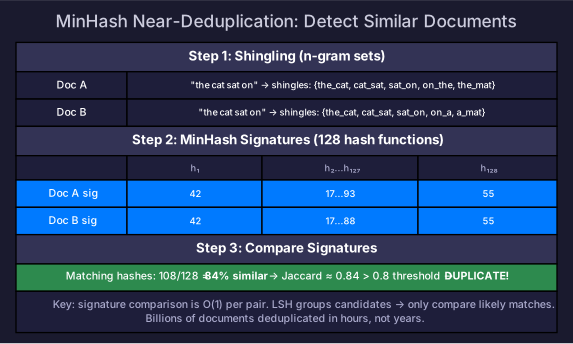
MinHash creates compact signatures for documents. Similar documents have similar signatures:
Document A: "The cat sat on the mat"
Document B: "The cat sat on a mat"  (1 word different)

MinHash signature (128 hashes): 95% of hashes match
→ Flagged as near-duplicate → remove one copy
MinHash at scale: Datasketch or Spark-based implementations process billions of documents. Typical threshold: Jaccard similarity > 0.8 → duplicate.
Semantic Dedup
Embed documents, find clusters of semantically similar content:
Document A: "Python is a programming language..."
Document B: "Python programming language overview..."

Embedding similarity: 0.95 → semantically duplicate
→ Keep the higher-quality version
Most expensive but catches paraphrased duplicates that MinHash misses.
5. PII Removal
| PII type | Detection method | Action |
|---|---|---|
| Email addresses | Regex | Replace with [EMAIL] |
| Phone numbers | Regex | Replace with [PHONE] |
| Names | NER (spaCy, Presidio) | Replace with [NAME] |
| Addresses | NER + regex | Replace with [ADDRESS] |
| SSN / ID numbers | Regex | Replace with [ID] |
| URLs with PII | Pattern matching | Redact |
from presidio_analyzer import AnalyzerEngine
from presidio_anonymizer import AnonymizerEngine

analyzer = AnalyzerEngine()
anonymizer = AnonymizerEngine()

results = analyzer.analyze(text=document, language='en')
anonymized = anonymizer.anonymize(text=document, analyzer_results=results)
6. Toxicity Filtering
Remove or flag content that’s harmful:
| Approach | Speed | Coverage |
|---|---|---|
| Keyword blocklist | Very fast | Low (easy to evade) |
| Classifier (Perspective API, custom) | Medium | Good |
| LLM-as-judge | Slow | Best (understands context) |
The tradeoff: Too aggressive filtering removes legitimate content about sensitive topics (medical, legal, historical). Too loose passes harmful content into training data.
For how cleaned data gets mixed into training, see Data Mixing.
Self-Check
- Design a cleaning pipeline with all 7 stages
- Explain perplexity-based quality scoring and when high PPL is bad vs interesting
- Compare exact vs MinHash vs semantic deduplication
- Implement MinHash near-dedup at the conceptual level
- Describe PII removal with Presidio
- Balance toxicity filtering aggressiveness vs content coverage