Data Mixing
Balancing domains (code, math, web, books), curriculum strategies, upsampling/downsampling, and how mixing ratios affect model capabilities.
Data mixing determines what the model learns to do well. The ratio of code vs math vs web text directly shapes capabilities — and getting it wrong means expensive retraining.
1. Why Mixing Matters
The training data distribution directly determines model capabilities:
| If you over-weight… | Model gets better at… | But worse at… |
|---|---|---|
| Web text | General knowledge, fluency | Code, math, reasoning |
| Code | Programming, structured reasoning | Creative writing, general knowledge |
| Math | Mathematical reasoning | General fluency |
| Books | Long-form coherence, depth | Short-form, conversational |
| Instruction data | Following instructions | Raw knowledge generation |
There is no universally optimal mix — it depends on the target use case. Llama-3’s mix differs from DeepSeek’s which differs from CodeLlama’s.
2. Mixing Strategies
Static Mixing
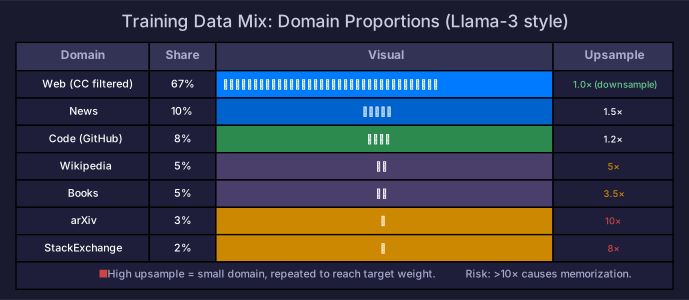
Fix the ratios before training and don’t change them:
# Example: Llama-style static mix
mix = {
    "common_crawl_filtered": 0.67,  # 67% web
    "github_code": 0.08,           # 8% code
    "wikipedia": 0.05,             # 5% encyclopedia
    "books": 0.05,                 # 5% books
    "arxiv": 0.03,                 # 3% academic
    "stackexchange": 0.02,         # 2% Q&A
    "c4_realnews": 0.10,           # 10% news
}
Upsampling and Downsampling
High-quality domains are often small. Repeat them to increase their effective weight:
| Domain | Raw size | Target weight | Upsampling factor |
|---|---|---|---|
| Web (Common Crawl) | 5 TB | 67% | 1.0× (downsample!) |
| Code (GitHub) | 500 GB | 8% | 1.2× |
| Math (proofs, textbooks) | 20 GB | 5% | 18× (heavily upsampled) |
| Books | 100 GB | 5% | 3.5× |
Upsampling risk: Too much repetition → model memorizes specific examples. Rule of thumb: don’t upsample more than 5-10× for any domain.
Curriculum Learning (Dynamic Mixing)
Change the mix during training:
Phase 1 (0-50% tokens): Heavy web text (learn language)
Phase 2 (50-80%): Increase code + math (learn reasoning)
Phase 3 (80-100%): High-quality curated data (refine quality)Annealing: Increase the proportion of high-quality data toward the end of training. The model learns broad patterns first, then refines on curated content.
3. How Mixing Ratios Are Determined
| Method | How it works | Cost |
|---|---|---|
| Scaling law experiments | Train small models at different mixes, extrapolate | Medium (many small runs) |
| Ablation studies | Train same-size models varying one domain at a time | High (multiple full runs) |
| Domain weighting by loss | Weight domains inversely to their loss (DoReMi) | Medium |
| Copy from prior art | Use published mixes (Llama, Falcon, etc.) | Free |
DoReMi: Data Reweighting by Model Inspection
DoReMi trains a small proxy model to determine optimal domain weights:
- Train a small model on uniform mix → observe per-domain losses
- Upweight domains where the model struggles → train again
- Use the resulting weights for the large model training
4. Practical Considerations
| Issue | Solution |
|---|---|
| Domain proportions don’t sum to 1.0 | Normalize: weight_i / sum(weights) |
| Small domain exhausted before large | Repeat small domain (with shuffle), or stop sampling it |
| Data quality varies within domains | Quality-filter each domain separately, then mix |
| Can’t re-run full training to tune mix | Use scaling law proxy experiments (1B model, 10B tokens) |
For how to tokenize the mixed data, see Tokenization at Scale.
Self-Check
- Explain how data mixing ratios affect model capabilities (with examples)
- Compare static mixing vs curriculum learning
- Calculate upsampling factors for a given domain size and target weight
- Explain the upsampling risk (memorization) and the rule of thumb
- Describe DoReMi’s approach to determining optimal domain weights