💾 Data & Storage· 8 min read
Data Flywheel
Using production model outputs to improve training data — feedback loops, human-in-the-loop annotation, and continuous data improvement.
data-flywheelfeedback-loopannotationhitlcontinuous-improvement
The data flywheel turns production usage into training data — model outputs, user corrections, and human feedback loop back to improve the next model version.
1. The Flywheel Concept
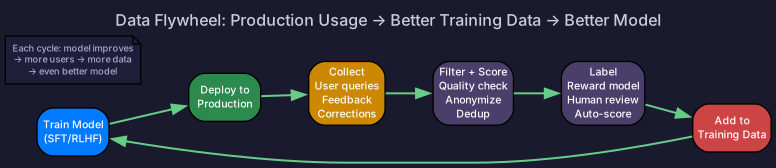
Train model v1 → Deploy → Users interact
  ↓                              ↓
Collect: queries, outputs, feedback, corrections
  ↓
Filter: quality checks, dedup, privacy
  ↓
Label: human review, automated scoring
  ↓
Add to training data
  ↓
Train model v2 (better!) → Deploy → ...
Each iteration: Model gets better → attracts more users → generates more data → next model is even better.
2. Data Sources from Production
| Source | What you collect | Value |
|---|---|---|
| User queries | Real input distribution | Better than synthetic prompts |
| Chosen responses | Which generation users accepted | Preference signal |
| Corrections | When users edit/regenerate | Direct quality signal |
| Thumbs up/down | Explicit feedback | Reward model training |
| Tool usage logs | Which tools called, results | Agent training data |
| Session patterns | Multi-turn conversations | Conversation quality signal |
Privacy Considerations
- Anonymize: Remove PII before storing
- Consent: Terms of service must allow data collection for improvement
- Opt-out: Provide mechanism to exclude data
- Retention: Delete raw data after processing (keep only derived training data)
3. Human-in-the-Loop Annotation
Not all production data is labeled. Human annotators add quality:
| Task | Annotator action | Scale |
|---|---|---|
| Preference ranking | Rank 2-4 model outputs by quality | 1K-10K/day per annotator |
| Quality scoring | Rate response 1-5 | 2K-20K/day |
| Error correction | Fix factual errors, formatting | 500-2K/day |
| Safety labeling | Flag harmful/unsafe content | 5K-50K/day |
| Domain expertise | Verify medical/legal/technical accuracy | 100-500/day |
Annotation Platform Requirements
| Requirement | Why |
|---|---|
| Calibration | Annotators must agree (inter-annotator agreement > 0.8) |
| Quality control | Hidden test questions to detect sloppy annotators |
| Throughput tracking | Monitor annotation speed and quality over time |
| Versioned guidelines | Track which instructions annotators followed |
4. Closing the Loop
# Automated flywheel pipeline
def daily_flywheel():
    # 1. Collect yesterday's production data
    raw_data = collect_production_logs(yesterday)

    # 2. Filter and anonymize
    clean_data = anonymize(quality_filter(raw_data))

    # 3. Auto-label with reward model
    scored_data = reward_model.score(clean_data)

    # 4. Select high-quality examples
    good_examples = scored_data[scored_data.score > 0.8]

    # 5. Add to SFT/RLHF training pool
    training_pool.add(good_examples)

    # 6. Queue difficult examples for human review
    hard_examples = scored_data[scored_data.score.between(0.4, 0.6)]
    annotation_queue.add(hard_examples)
5. Anti-Patterns
| Anti-pattern | Risk | Fix |
|---|---|---|
| Training on all production data | Amplifies model biases | Filter + score + human review |
| No diversity control | Popular queries dominate | Stratified sampling across categories |
| Feedback loop without monitoring | Quality degrades silently | Track data quality metrics each cycle |
| Ignoring negative feedback | Model repeats same mistakes | Prioritize corrections and thumbs-down |
For data quality monitoring that keeps the flywheel healthy, see Data Quality Monitoring.
Self-Check
- Draw the data flywheel (deploy → collect → filter → label → train → deploy)
- List production data sources and their value for training
- Design an annotation pipeline with quality control
- Implement an automated daily flywheel pipeline
- Identify anti-patterns that can corrupt the flywheel