Sequence Packing
Combining variable-length sequences into fixed-length training examples to eliminate padding waste — 2-5× throughput gain.
Standard batching pads all sequences to the longest in the batch — wasting 30-70% of compute on padding tokens. Sequence packing eliminates this waste by concatenating multiple sequences into each training example.
1. The Padding Problem
Standard batching (max_len=2048):
  Seq A (200 tokens):  [A₁...A₂₀₀, PAD, PAD, ..., PAD]  ← 1848 PAD tokens (90% waste)
  Seq B (150 tokens):  [B₁...B₁₅₀, PAD, PAD, ..., PAD]  ← 1898 PAD tokens (93% waste)
  Seq C (1800 tokens): [C₁...C₁₈₀₀, PAD, ..., PAD]      ← 248 PAD tokens (12% waste)
  Seq D (500 tokens):  [D₁...D₅₀₀, PAD, PAD, ..., PAD]  ← 1548 PAD tokens (76% waste)

  Average utilization: (200+150+1800+500) / (4×2048) = 32% ← 68% wasted!
2. Packing: Concatenate Sequences
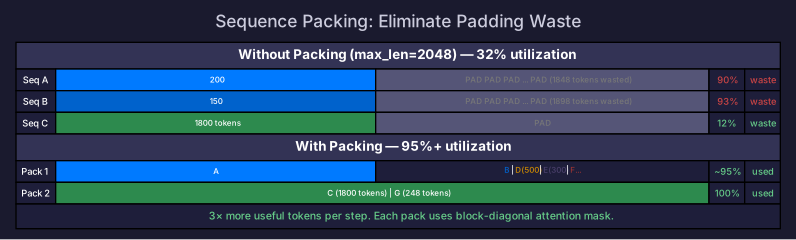
Packed batching (max_len=2048):
  Pack 1: [A₁...A₂₀₀ | B₁...B₁₅₀ | D₁...D₅₀₀ | E₁...E₃₀₀ | ...]  ← ~95% utilized
  Pack 2: [C₁...C₁₈₀₀ | F₁...F₂₄₈]                                   ← ~100% utilized

  Average utilization: ~95% ← almost no waste!
Throughput improvement: From 32% utilization to 95% → ~3× more useful tokens processed per step.
Attention Masking
Packed sequences must not attend to each other — use a block-diagonal attention mask:
Pack: [Seq A (200 tokens) | Seq B (150 tokens) | Seq C (500 tokens)]

Attention mask:
  A tokens can attend to: A tokens only
  B tokens can attend to: B tokens only
  C tokens can attend to: C tokens only

  Implemented as: document_ids = [0,0,...,0, 1,1,...,1, 2,2,...,2]
  mask[i][j] = (document_ids[i] == document_ids[j])
Most modern training frameworks (Megatron-LM, Llama training code) support this natively.
3. Packing Algorithms
| Algorithm | How it works | Packing efficiency |
|---|---|---|
| First-fit decreasing | Sort by length (longest first), pack greedily | 90-95% |
| Best-fit | Find the pack with least remaining space | 95-98% |
| Random | Random assignment with length constraint | 85-90% |
| Sorted batching | Group similar lengths, no packing | 70-85% |
First-fit decreasing is the most common — simple, fast, and achieves near-optimal packing.
4. Packing for Different Workloads
| Workload | Packing benefit | Notes |
|---|---|---|
| Pre-training (web text) | High (2-5×) | Short documents dominate, lots of padding waste |
| SFT (instruction tuning) | High (2-4×) | Conversations vary wildly in length |
| Long-context training | Low (1.1-1.3×) | Most sequences already near max_len |
| Fixed-length (evaluation) | None | All sequences same length |
Implementation
# Simple first-fit-decreasing packing
def pack_sequences(sequences, max_len):
    sorted_seqs = sorted(sequences, key=len, reverse=True)
    packs = []

    for seq in sorted_seqs:
        # Try to fit into existing pack
        placed = False
        for pack in packs:
            if sum(len(s) for s in pack) + len(seq) <= max_len:
                pack.append(seq)
                placed = True
                break
        if not placed:
            packs.append([seq])  # new pack

    return packs
For how packed data is loaded into training, see Data Loading at Scale.
Self-Check
- Calculate padding waste for a batch with sequences of lengths [200, 150, 1800, 500] at max_len=2048
- Explain block-diagonal attention masking for packed sequences
- Implement first-fit-decreasing packing
- Estimate throughput improvement from packing for a given length distribution