LoRA
Low-rank adapters — where to apply, rank selection, and why LoRA achieves near-full-fine-tuning quality with <1% trainable parameters.
LoRA (Low-Rank Adaptation) freezes the pretrained model and adds small trainable matrices to selected layers. It reduces trainable parameters by 100-1000× while achieving quality comparable to full fine-tuning.
1. The Core Idea
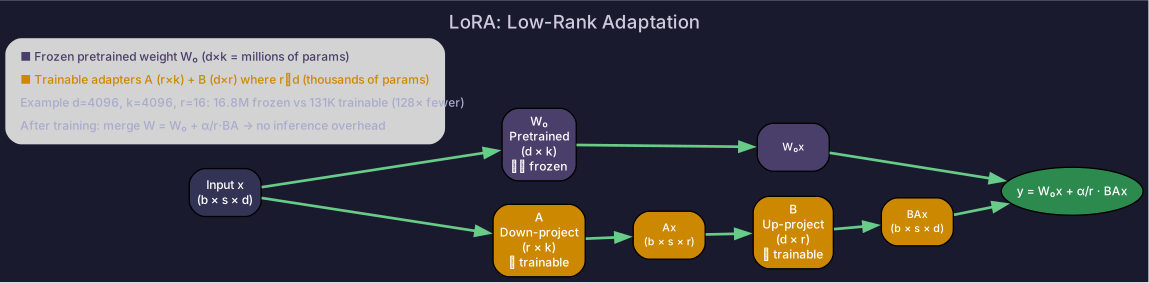
For a pretrained weight matrix , LoRA adds a low-rank update:
where , , and .
| Full fine-tune | LoRA (r=16) | |
|---|---|---|
| Trainable params (per layer, ) | M | K |
| Reduction | 1× | 128× |
| Memory for optimizer | Full 12Ψ | 12 × Ψ_adapter (tiny) |
| Training speed | Baseline | Often faster (smaller gradients) |
Why Low-Rank Works
Weight updates during fine-tuning live in a low-dimensional subspace. The pretrained model has learned the task-general representation; fine-tuning only needs to steer it — a small adjustment in a low-rank direction.
2. Where to Apply LoRA
| Target module | Effect | Recommendation |
|---|---|---|
| Q, K, V projections | Modifies attention patterns | ✅ Always include |
| Output projection | Modifies attention output mix | ✅ Include |
| FFN up/gate/down | Modifies knowledge retrieval | ✅ Include for best quality |
| Embedding | Modifies token representations | ⚠️ Usually skip |
| LM head | Modifies output distribution | ⚠️ Usually skip |
Best practice: Apply LoRA to all linear layers in attention AND FFN. This is “LoRA on all linear” — the default in modern frameworks.
from peft import LoraConfig, get_peft_model

config = LoraConfig(
    r=16,                    # rank
    lora_alpha=32,           # scaling factor (alpha/r applied to ΔW)
    target_modules=[         # apply to all attention + FFN
        "q_proj", "k_proj", "v_proj", "o_proj",
        "gate_proj", "up_proj", "down_proj",
    ],
    lora_dropout=0.05,
)
model = get_peft_model(model, config)
model.print_trainable_parameters()
# trainable params: 83,886,080 || all params: 6,738,415,616 || trainable%: 1.245%
3. Rank Selection
| Rank (r) | Trainable params | Quality | When to use |
|---|---|---|---|
| 4 | Very few | Good for simple tasks | Classification, simple format |
| 8-16 | Few | Good for most tasks | Default choice |
| 32-64 | Moderate | Near full fine-tune | Complex tasks, large domain shift |
| 128-256 | Many | ~Full fine-tune | When quality is paramount |
Rule of thumb: Start with r=16. Increase if quality is insufficient; decrease if you need fewer parameters for multi-adapter serving.
Alpha and Scaling
The actual update applied is:
The scaling ensures the LoRA contribution is consistent across different ranks. Common: (so scaling factor = 2).
4. Training Configuration
# Typical LoRA fine-tuning setup
from transformers import TrainingArguments

training_args = TrainingArguments(
    learning_rate=2e-4,       # higher LR than full fine-tune (1e-5)
    per_device_train_batch_size=4,
    gradient_accumulation_steps=4,
    num_train_epochs=3,
    bf16=True,
    optim="adamw_torch",     # only optimizes adapter params
)
Higher learning rate (10-100× vs full fine-tune) because adapter params are initialized near zero and need larger steps.
Memory Comparison
| Configuration | 7B model |
|---|---|
| Full fine-tune (BF16 + Adam) | 112 GB |
| LoRA r=16 (frozen base + adapter) | 14 GB (base) + 0.6 GB (adapter + optimizer) ≈ 15 GB |
| LoRA on 24 GB GPU | ✅ Fits easily |
5. DoRA: Weight-Decomposed Low-Rank Adaptation
DoRA decomposes the weight update into magnitude and direction components:
Where is a learnable magnitude vector. This better mimics how full fine-tuning updates weights (which change both magnitude and direction), leading to ~1-2% quality improvement over standard LoRA at the same rank.
When to use DoRA: When you need LoRA-level efficiency but slightly better quality. Supported in PEFT: LoraConfig(use_dora=True).
6. When Full Fine-Tuning Still Wins
LoRA doesn’t always match full fine-tuning:
| Scenario | LoRA quality vs full FT | Recommendation |
|---|---|---|
| Simple task adaptation (formatting, style) | 99%+ | LoRA (no reason to full FT) |
| Domain shift (medical, legal) | 95-98% | LoRA usually sufficient |
| Significant new knowledge | 90-95% | Consider higher rank or full FT |
| Pre-training on new language | 80-90% | Full FT required |
| Architecture changes (adding layers) | N/A | Full FT required |
The rule: If the task requires the model to learn fundamentally new representations (not just steer existing ones), full fine-tuning wins. LoRA works by adjusting within the subspace the model already knows; it can’t create entirely new representations.
For fine-tuning with quantized base models, see QLoRA. For serving multiple adapters on a shared base, see Multi-Adapter Serving.
7. Merging and Deployment
After training, merge LoRA weights back into the base model:
model = model.merge_and_unload()  # merge adapter into base weights
model.save_pretrained("merged_model")
# Result: standard model with no adapter overhead at inference
No inference overhead after merging — the model is the same size and speed as the original, just with different weights.
For quantized base models with LoRA adapters, see QLoRA. For serving multiple adapters on a shared base, see Multi-Adapter Serving.
Self-Check
- Explain the low-rank decomposition and why it works
- Calculate trainable parameters for LoRA r=16 on a 7B model’s attention layers
- Choose rank for a given task complexity
- Configure LoRA with PEFT library, targeting all linear layers
- Merge LoRA weights and deploy as a standard model