GPU Memory Anatomy
Where GPU memory goes during training — parameters, gradients, optimizer states, activations, and framework overhead, with exact accounting.
Understanding where GPU memory goes is the foundation of all training infrastructure decisions. This chapter gives you the complete breakdown — every byte accounted for — so you can predict memory usage before launching a single training run.
1. The Four Categories of Training Memory
Training memory splits into static (constant regardless of input) and dynamic (varies with batch size and sequence length):
| Category | Static/Dynamic | Typical share | Depends on |
|---|---|---|---|
| Model parameters | Static | 12-15% | Parameter count Ψ |
| Gradients | Static | 12-15% | Parameter count Ψ |
| Optimizer states | Static | 55-75% | Parameter count Ψ, optimizer type |
| Activations | Dynamic | 10-30% | Batch size, sequence length, model width |
| Framework overhead | Static | 2-5% | CUDA context, NCCL buffers, fragmentation |
Key insight: Optimizer states dominate training memory. For Adam/AdamW, they consume 3× the memory of the parameters themselves.
2. Model Parameters
The working copy of the model used in forward and backward passes.
| Precision | Bytes | 7B | 13B | 70B | 405B |
|---|---|---|---|---|---|
| FP32 | 4 | 28 GB | 52 GB | 280 GB | 1,620 GB |
| BF16 | 2 | 14 GB | 26 GB | 140 GB | 810 GB |
| FP8 | 1 | 7 GB | 13 GB | 70 GB | 405 GB |
Modern training uses BF16 (or FP8 on Hopper+) for the working copy, with FP32 reserved for the optimizer’s master weights.
Counting Parameters Accurately
For a Transformer with layers, hidden dim , vocab , FFN dim :
| Component | Parameters per layer | 70B (h=8192) |
|---|---|---|
| QKV projection | (or for GQA) | ~201M |
| Output projection | 67M | |
| FFN up + gate + down | (SwiGLU) | 707M |
| LayerNorm (×2) | 65K | |
| Per-layer total | ~975M | |
| 80 layers | ~78B | |
| Embedding + LM head | ~2.6B (V=128K) |
Counting Parameters: Worked Example (Llama-3.1 70B)
Architecture: , , , GQA with query heads, KV heads, (SwiGLU), no bias terms.
| Component | Formula | Count |
|---|---|---|
| Embedding | 128,256 × 8,192 = 1.050B | |
| Per-layer QKV projection | 8,192 × (64×128 + 2×8×128) = 75.5M | |
| Per-layer output projection | 64 × 128 × 8,192 = 67.1M | |
| Per-layer FFN (SwiGLU: gate + up + down) | 3 × 8,192 × 28,672 = 704.6M | |
| Per-layer RMSNorm (×2) | 2 × 8,192 = 16.4K | |
| Per-layer total | 847.2M | |
| 80 layers | 67.78B | |
| Final RMSNorm | 8.2K | |
| LM head (tied with embedding) | 0 (shared) | 0 |
| Grand total | ~68.8B |
The “70B” label is approximate — actual parameter counts vary by implementation details (bias terms, head dim rounding, tied/untied LM head).
3. Gradients
Same shape as parameters — one gradient value per parameter:
With BF16 training: 2 bytes per gradient. With FP32 gradient accumulation: 4 bytes.
Gradient accumulation doesn’t change peak gradient memory — you still hold one full set of gradients, just accumulated over multiple micro-batches before the optimizer step.
4. Optimizer States (The Dominant Cost)
Different optimizers require different additional state per parameter:
| Optimizer | States per param | Bytes/param (FP32) | 7B overhead | Notes |
|---|---|---|---|---|
| SGD | None | 0 | 0 GB | Rarely used for LLMs |
| SGD + Momentum | velocity | 4 | 28 GB | One FP32 buffer |
| Adam/AdamW | (1st moment) + (2nd moment) | 8 | 56 GB | Two FP32 buffers |
| Adam + FP32 master | master weights + + | 12 | 84 GB | Standard mixed-precision |
The Adam 12Ψ Rule
In standard BF16 mixed-precision training with AdamW, the optimizer maintains:
- FP32 master weights (4Ψ bytes) — high-precision copy for accurate updates
- FP32 first moment (4Ψ bytes) — exponential moving average of gradients
- FP32 second moment (4Ψ bytes) — EMA of squared gradients
Total optimizer overhead: 12Ψ bytes.
Why FP32 for optimizer states? Small weight updates () fall below BF16’s precision floor ( relative). FP32 is necessary to accumulate these small changes accurately. Without it, weights simply don’t update — training stalls.
The Full Static Ledger
| Component | Bytes/param | Formula | 7B | 70B |
|---|---|---|---|---|
| BF16 parameters | 2 | 14 GB | 140 GB | |
| BF16 gradients | 2 | 14 GB | 140 GB | |
| FP32 master weights | 4 | 28 GB | 280 GB | |
| FP32 Adam | 4 | 28 GB | 280 GB | |
| FP32 Adam | 4 | 28 GB | 280 GB | |
| Total | 16 | 16Ψ | 112 GB | 1,120 GB |
For a 7B model: 112 GB of static memory — already exceeds a single 80 GB GPU. This is why even “small” models need distributed training.
5. Activations (The Dynamic Cost)
Activations are intermediate tensors saved during forward pass for the backward pass. They scale with batch size and sequence length.
For a Transformer layer:
| Saved tensor | Shape | Purpose |
|---|---|---|
| Input to attention | Backward through QKV projection | |
| Q, K, V tensors | Backward through attention scores | |
| Attention weights | Backward through softmax | |
| Attention output | Backward through output projection | |
| FFN input | Backward through FFN | |
| FFN intermediate | Backward through gate/activation | |
| LayerNorm inputs | Backward through normalization |
Approximate total per layer (BF16):
For 70B (, , , ):
- Linear terms: GB
- Attention terms: GB
- Per layer: ~4.5 GB
- 80 layers: ~357 GB without activation checkpointing
Activations scale as for standard attention. This is one reason long-context training is so memory-intensive. FlashAttention removes this quadratic term. See Activation Memory Analysis for detailed formulas and mitigation strategies.
6. Framework Overhead
| Source | Typical size | Notes |
|---|---|---|
| CUDA context | 0.5-1.5 GB | Per GPU, allocated on first CUDA call |
| NCCL buffers | 0.5-2 GB | Communication scratch space |
| PyTorch allocator fragmentation | 1-5 GB | Wasted space in memory pools |
| Temporary buffers | 0.5-2 GB | Intermediate computation tensors |
Total overhead: typically 3-8 GB per GPU — significant when memory is tight.
# Check actual memory usage vs theoretical
import torch
print(f"Allocated: {torch.cuda.memory_allocated()/1e9:.1f} GB")
print(f"Reserved:  {torch.cuda.memory_reserved()/1e9:.1f} GB")
print(f"Max allocated: {torch.cuda.max_memory_allocated()/1e9:.1f} GB")
# Reserved - Allocated = fragmentation + cached blocks
7. Complete Memory Picture
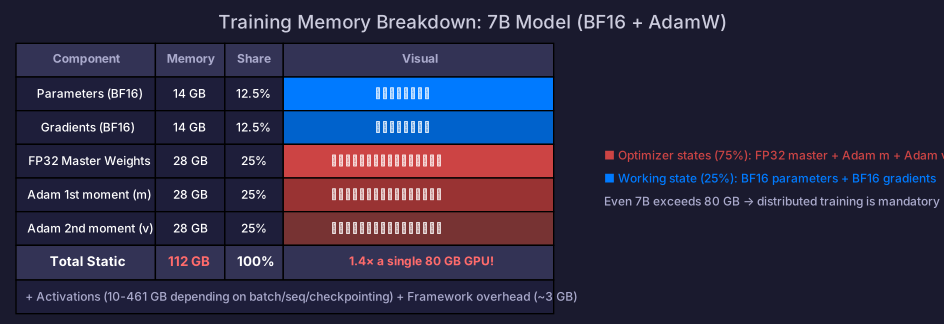
For a 7B model on a single 80 GB H100 (BF16 + AdamW, , ):
| Component | Memory |
|---|---|
| Parameters (BF16) | 14 GB |
| Gradients (BF16) | 14 GB |
| Optimizer (FP32 master + m + v) | 84 GB |
| Static subtotal | 112 GB — already OOM! |
This is why distributed training exists. Even a 7B model can’t train on a single GPU with Adam. Solutions:
- FSDP/ZeRO: Shard static memory across GPUs → 112/8 = 14 GB per GPU
- CPU offloading: Move optimizer to system RAM → only 28 GB on GPU
- 8-bit Adam: Use INT8 optimizer states → 56 GB instead of 84 GB
- SGD instead of Adam: 0 optimizer overhead → 28 GB total (but worse convergence)
For sharding strategies, see ZeRO Stage 1/2/3.
Self-Check
- Name the four categories of training memory and their approximate shares
- Calculate the 16Ψ static memory for a 13B model with Adam
- Explain why optimizer states consume 75% of static training memory
- Explain why Adam needs FP32 (precision floor argument)
- Calculate per-layer activation memory for a given architecture
- Use
torch.cuda.memory_allocated()to verify theoretical predictions