FSDP
PyTorch Fully Sharded Data Parallel — ZeRO-3 in native PyTorch, with sharding strategies, mixed precision, and practical configuration.
FSDP (Fully Sharded Data Parallel) is PyTorch’s native implementation of ZeRO-3. It shards parameters, gradients, and optimizer states across all data-parallel ranks, gathering them on-the-fly during forward and backward.
1. How FSDP Works
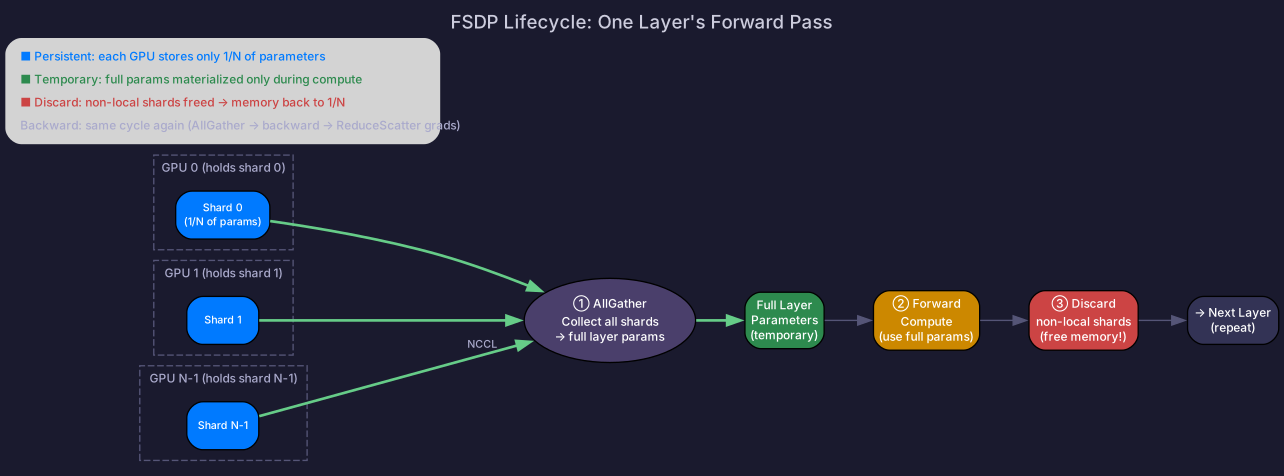
The Lifecycle of a Training Step
1. FORWARD PASS:
   For each FSDP unit (typically one Transformer layer):
     a. AllGather: Collect full parameters from all ranks
     b. Forward compute with full parameters
     c. Discard non-local parameter shards (free memory)

2. BACKWARD PASS:
   For each FSDP unit (reverse order):
     a. AllGather: Collect full parameters again (for gradient computation)
     b. Backward compute
     c. ReduceScatter: Average gradients, keep only local shard
     d. Discard non-local parameters

3. OPTIMIZER STEP:
   Each rank updates only its local parameter shard
   (using its local optimizer state shard)
Memory During Execution
| Phase | Parameters in memory | Gradients in memory |
|---|---|---|
| Idle (between steps) | Ψ/N (local shard only) | 0 |
| Forward (one layer) | Ψ/N + Ψ_layer (gathered) | 0 |
| Backward (one layer) | Ψ/N + Ψ_layer (gathered) | Ψ_layer (local only after ReduceScatter) |
| Optimizer step | Ψ/N | Ψ/N |
Peak memory: Ψ/N (shards) + Ψ_layer (one layer gathered) + activations.
2. FSDP2 (PyTorch 2.x)
PyTorch 2.x introduced FSDP2 with a cleaner API:
import torch
from torch.distributed._composable.fsdp import fully_shard, MixedPrecisionPolicy

# Define mixed precision
mp_policy = MixedPrecisionPolicy(
    param_dtype=torch.bfloat16,
    reduce_dtype=torch.bfloat16,
)

# Apply FSDP to each Transformer layer
for layer in model.transformer.layers:
    fully_shard(layer, mp_policy=mp_policy)

# Apply FSDP to the whole model (outermost wrapper)
fully_shard(model, mp_policy=mp_policy)

# Training loop — same as regular PyTorch
optimizer = torch.optim.AdamW(model.parameters(), lr=1e-4)
for batch in dataloader:
    loss = model(batch)
    loss.backward()
    optimizer.step()
    optimizer.zero_grad()
Key Differences: FSDP1 vs FSDP2
| FSDP1 (legacy) | FSDP2 | |
|---|---|---|
| API | FullyShardedDataParallel(module) | fully_shard(module) |
| Composability | Wraps module | Composable with TP, CP, PP |
| Mixed precision | MixedPrecision class | MixedPrecisionPolicy |
| Activation checkpointing | Separate wrapper | torch.utils.checkpoint |
| torch.compile | Limited | Full support |
3. Sharding Strategies
| Strategy | What’s sharded | Per-GPU memory | Communication |
|---|---|---|---|
NO_SHARD | Nothing (DDP equivalent) | 16Ψ | AllReduce gradients |
SHARD_GRAD_OP | Gradients + optimizer (ZeRO-2) | 2Ψ + 14Ψ/N | ≈ AllReduce |
FULL_SHARD | Everything (ZeRO-3) | 16Ψ/N | 3× AllReduce |
FULL_SHARD is the default and most commonly used — it’s the whole point of FSDP.
4. FSDP Wrapping Granularity
You control which modules form an “FSDP unit” — the granularity of gather/scatter:
# Fine-grained: each Transformer layer is an FSDP unit
for layer in model.layers:
    fully_shard(layer)  # parameters gathered/scattered per layer

# Coarse-grained: entire model is one FSDP unit
fully_shard(model)  # all parameters gathered at once — huge memory spike!
Per-layer wrapping is standard: only one layer’s worth of parameters is fully materialized at a time.
Memory Impact of Wrapping Granularity
| Wrapping | Peak param memory | Notes |
|---|---|---|
| Per-layer (standard) | Ψ/N + Ψ/L (one layer) | Minimal peak |
| Per-block (2 layers) | Ψ/N + 2Ψ/L | Slightly higher, fewer AllGathers |
| Whole model | Ψ (full model!) | Defeats the purpose of FSDP |
5. FSDP + Tensor Parallelism
FSDP and TP compose naturally in PyTorch 2.x:
from torch.distributed.tensor.parallel import parallelize_module

# Step 1: Apply TP within each node
for layer in model.layers:
    parallelize_module(layer, tp_mesh, tp_plan)

# Step 2: Apply FSDP across nodes
for layer in model.layers:
    fully_shard(layer, mp_policy=mp_policy)
fully_shard(model, mp_policy=mp_policy)
The combination: TP splits computation within a node (NVLink), FSDP shards memory across nodes (InfiniBand).
6. Common FSDP Pitfalls
| Pitfall | Symptom | Fix |
|---|---|---|
| Wrapping too coarsely | OOM on AllGather (full model materialized) | Wrap per-layer |
| Not wrapping shared parameters | Incorrect gradients, training diverges | Use ignored_modules or handle manually |
| Mixed precision mismatch | Silently slower (FP32 compute) or NaN | Explicitly set MixedPrecisionPolicy |
| Forgetting to shard outermost model | Parameters not sharded, full memory | Always fully_shard(model) at the end |
| Saving/loading checkpoints wrong | Can’t resume from different GPU count | Use torch.distributed.checkpoint |
For activation checkpointing with FSDP, see Activation Checkpointing. For ZeRO stages in DeepSpeed (alternative to FSDP), see ZeRO Stage 1/2/3.
Self-Check
- Explain the AllGather → compute → discard lifecycle of one FSDP forward layer
- Compare FSDP wrapping per-layer vs whole-model and the memory impact
- Write FSDP2 setup code for a Transformer model with mixed precision
- Explain how FSDP composes with TP (which dimension each handles)
- Choose between FSDP
FULL_SHARDvsSHARD_GRAD_OPfor a given scenario