ZeRO Stage 1/2/3
Partitioning optimizer states, gradients, and parameters across data-parallel ranks — how ZeRO eliminates the memory wall without changing model semantics.
ZeRO (Zero Redundancy Optimizer) is the single most important memory optimization for training. It eliminates redundant memory across data-parallel ranks by sharding optimizer states, gradients, and parameters — without changing model semantics or convergence.
1. The Redundancy Problem
In standard data parallelism, every GPU holds a complete copy of everything:
| Component | Per GPU | 8 GPUs total | Redundancy |
|---|---|---|---|
| Parameters (BF16) | 14 GB | 112 GB | 8× |
| Gradients (BF16) | 14 GB | 112 GB | 8× |
| Optimizer (FP32) | 84 GB | 672 GB | 8× |
| Total | 112 GB | 896 GB | 8× |
For a 7B model on 8 GPUs: 896 GB of aggregate memory, but only 112 GB of unique data. 784 GB is pure waste.
2. ZeRO Stage 1: Shard Optimizer States
What’s sharded: Optimizer states (, , master weights) — each GPU holds 1/N of the optimizer.
Communication added: AllGather the updated parameters after each optimizer step.
| Before (standard DP) | After (ZeRO-1) |
|---|---|
| Per GPU: 2Ψ + 2Ψ + 12Ψ = 16Ψ | Per GPU: 2Ψ + 2Ψ + 12Ψ/N |
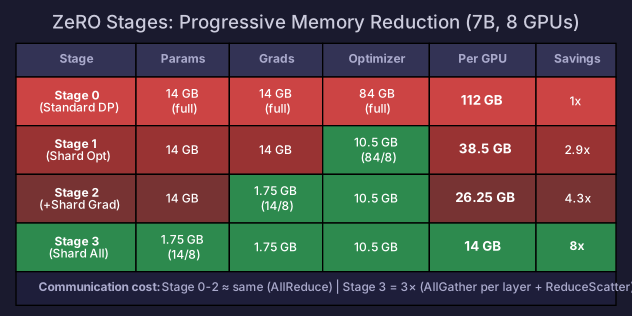
| 7B, 8 GPUs: 112 GB per GPU | 7B, 8 GPUs: 14 + 14 + 10.5 = 38.5 GB |
Memory savings: 112 → 38.5 GB per GPU (2.9× reduction). Extra communication: One AllGather of parameters per step (~14 GB).
Why Optimizer First?
Optimizer states are 75% of training memory but are only needed during the optimizer step (once per training step). During forward and backward, they’re idle. Sharding them is high-ROI with minimal communication cost.
Worked Example: 13B Model on 8 GPUs
Parameters: 13B. Static memory = 16 \ 13B = 208 GB.
| Component | Stage 0 (DDP) | Stage 1 | Stage 2 | Stage 3 |
|---|---|---|---|---|
| Params (BF16) | 26 GB | 26 GB | 26 GB | 26/8 = 3.25 GB |
| Grads (BF16) | 26 GB | 26 GB | 26/8 = 3.25 GB | 3.25 GB |
| Optimizer (FP32) | 156 GB | 156/8 = 19.5 GB | 19.5 GB | 19.5 GB |
| Per GPU | 208 GB | 71.5 GB | 48.75 GB | 26 GB |
| Fits on 80 GB? | No | Yes (tight) | Yes | Yes (plenty) |
- Stage 0: 208 GB per GPU — doesn’t fit. Need at least 3 GPUs just for static memory.
- Stage 1: 71.5 GB — fits on 80 GB, with 8.5 GB left for activations.
- Stage 2: 48.75 GB — comfortable, room for larger batch size.
- Stage 3: 26 GB — maximum flexibility for batch size and sequence length.
3. ZeRO Stage 2: + Shard Gradients
What’s sharded: Optimizer states AND gradients.
Each GPU accumulates gradients only for its assigned parameter partition. After backward, a ReduceScatter (instead of AllReduce) distributes the averaged gradient shards.
| ZeRO-1 | ZeRO-2 | |
|---|---|---|
| Per GPU | 2Ψ + 2Ψ + 12Ψ/N | 2Ψ + 2Ψ/N + 12Ψ/N |
| 7B, 8 GPUs | 38.5 GB | 14 + 1.75 + 10.5 = 26.25 GB |
Communication: Same as standard DP (ReduceScatter + AllGather ≈ AllReduce). No extra communication vs ZeRO-1!
4. ZeRO Stage 3: + Shard Parameters
What’s sharded: Everything — optimizer states, gradients, AND parameters.
Each GPU holds only 1/N of the parameters. Before each layer’s forward/backward, the full parameters are gathered (AllGather), used, and discarded.
| ZeRO-2 | ZeRO-3 | |
|---|---|---|
| Per GPU | 2Ψ + 2Ψ/N + 12Ψ/N | 2Ψ/N + 2Ψ/N + 12Ψ/N = 16Ψ/N |
| 7B, 8 GPUs | 26.25 GB | 112/8 = 14 GB |
Communication: AllGather parameters before each layer (forward AND backward) + ReduceScatter gradients. This is 1.5× the communication of standard DP.
Breaking it down:
- DDP (standard DP): AllReduce = 2Ψ bytes per step
- ZeRO-3: Forward AllGather (Ψ) + Backward AllGather (Ψ) + ReduceScatter (Ψ) = 3Ψ bytes per step
- Ratio: 3Ψ / 2Ψ = 1.5×
The ZeRO Stages Summary
| Stage | Shards | Memory per GPU | Communication vs DP | Best for |
|---|---|---|---|---|
| 0 (DP) | Nothing | 16Ψ | 1× (AllReduce) | Small models that fit |
| 1 | Optimizer | 4Ψ + 12Ψ/N | ~1× | Most training (low overhead) |
| 2 | + Gradients | 2Ψ + 14Ψ/N | 1× | Same comm as DP, less memory |
| 3 | + Parameters | 16Ψ/N | ~1.5× | Large models that don’t fit otherwise |
5. DeepSpeed ZeRO Configuration
# ZeRO Stage 1 (most common)
ds_config = {
    "zero_optimization": {
        "stage": 1,
    },
    "bf16": {"enabled": True},
    "optimizer": {
        "type": "AdamW",
        "params": {"lr": 1e-4, "weight_decay": 0.01}
    }
}

# ZeRO Stage 2
ds_config["zero_optimization"] = {
    "stage": 2,
    "allgather_bucket_size": 5e8,       # bucket size for AllGather
    "reduce_scatter": True,              # use ReduceScatter (always True)
    "reduce_bucket_size": 5e8,
}

# ZeRO Stage 3
ds_config["zero_optimization"] = {
    "stage": 3,
    "param_persistence_threshold": 1e5,  # params < this stay replicated
    "prefetch_bucket_size": 5e7,         # prefetch next layer's params
    "sub_group_size": 1e9,               # partition granularity
}
Stage Selection Guide
| Scenario | Recommended | Why |
|---|---|---|
| Model fits with standard DP | ZeRO-0 or 1 | Minimal overhead |
| OOM with standard DP, fits with optimizer sharding | ZeRO-1 | Best memory/comm tradeoff |
| Still OOM, or want larger batch size | ZeRO-2 | Same comm as DP, less memory |
| Model doesn’t fit even with sharded optimizer | ZeRO-3 | Only option, 3× comm cost |
| Extremely large model (>100B per GPU) | ZeRO-3 + offloading | See CPU & NVMe Offloading |
6. ZeRO vs Tensor Parallelism
Both reduce per-GPU memory, but they work differently:
| ZeRO-3 | Tensor Parallelism | |
|---|---|---|
| What’s split | Full copies, gathered on-demand | Actual matrix dimensions |
| Communication | AllGather per layer (parameter size) | AllReduce per layer (activation size) |
| Compute efficiency | Each GPU does full layer compute | Each GPU does partial layer compute |
| Network requirement | Can use InfiniBand (lower BW) | Needs NVLink (high BW, low latency) |
| Max practical degree | Hundreds of GPUs | 8 GPUs (NVLink group) |
In practice: Use TP within a node (NVLink) and ZeRO across nodes (InfiniBand). They’re complementary, not competing.
For PyTorch’s native ZeRO-3 implementation, see FSDP.
Self-Check
- Calculate per-GPU memory for each ZeRO stage for a 13B model on 16 GPUs
- Explain why sharding optimizer states first is highest-ROI
- Compare communication overhead of ZeRO stages 1, 2, 3 vs standard DP
- Choose the right ZeRO stage for a given model/cluster configuration
- Explain why ZeRO-3 and TP are complementary (not competing)