Activation Memory Analysis
What is saved for backward, per-layer cost formulas, attention's O(s²) contribution, and strategies to reduce activation memory.
Activations are the intermediate tensors saved during forward pass for backward computation. Unlike static memory (parameters + optimizer), activation memory scales with batch size and sequence length — it’s the “variable cost” that determines your maximum batch size and sequence length.
1. What Gets Saved and Why
PyTorch’s autograd saves tensors needed for gradient computation. For each operation , the backward pass needs either , , or both:
| Operation | Saved for backward | Why |
|---|---|---|
| Linear () | Input | , |
| ReLU () | Boolean mask () | Gradient is 0 or pass-through |
| SiLU/GELU | Input | Non-trivial derivative |
| Softmax | Output | |
| LayerNorm | Input , mean, variance | Needs original statistics |
| Dropout | Binary mask | Same mask applied in backward |
| Attention () | Q, K, V, attention weights | Full chain rule through softmax + matmul |
2. Per-Layer Activation Memory
Detailed Breakdown for One Transformer Layer
With hidden dim , sequence length , batch size , attention heads , FFN dim , all in BF16 (2 bytes per element unless noted):
| Tensor | Shape | Bytes | 70B example |
|---|---|---|---|
| Self-Attention | |||
| LayerNorm 1 input | 67 MB | ||
| QKV projection input | 67 MB | ||
| Q, K, V tensors | 201 MB | ||
| Attention weights (softmax output) | 2,147 MB | ||
| Attention dropout mask | (1 byte/elem) | 1,074 MB | |
| Output projection input | 67 MB | ||
| FFN | |||
| LayerNorm 2 input | 67 MB | ||
| FFN gate+up input | 67 MB | ||
| Gate output (for SwiGLU backward) | 235 MB | ||
| Up projection output | 235 MB | ||
| Down projection input | 235 MB | ||
| Per-layer total | ~4.5 GB |
70B: , , , ,
Note: The exact tensors saved depend on the autograd implementation. The table above is the standard set for a pre-norm Transformer with SwiGLU. FlashAttention changes this significantly — see below.
Per-Layer Formula
The first two terms scale linearly with sequence length. The third term — attention weights plus dropout mask — scales quadratically.
The Attention Quadratic Term
The attention scores tensor has shape . This quadratic scaling is the dominant memory cost for long sequences:
| Sequence length | Attention + mask per layer (64 heads) | 80 layers |
|---|---|---|
| 2,048 | 0.8 GB | 64 GB |
| 4,096 | 3.2 GB | 258 GB |
| 8,192 | 12.9 GB | 1,030 GB |
| 32,768 | 206 GB | 16,500 GB |
| 131,072 | 3,300 GB | 264,000 GB |
This is why long-context training is impossible without FlashAttention — attention activations alone would exceed entire cluster memory.
FlashAttention eliminates the activation storage by recomputing attention during backward. See Flash Attention.
3. Total Activation Memory
General Formula
With FlashAttention, the term drops to approximately (only Q, K, V and small row-max/sum statistics are saved instead of the full matrix).
Practical Numbers (with FlashAttention, no checkpointing)
| Model | Layers | Per-layer (b=1, s=4K) | Total | ||
|---|---|---|---|---|---|
| 7B (Llama-3.1) | 4,096 | 14,336 | 32 | ~0.6 GB | ~19 GB |
| 13B | 5,120 | 13,824 | 40 | ~0.8 GB | ~33 GB |
| 70B (Llama-3.1) | 8,192 | 28,672 | 80 | ~1.2 GB | ~99 GB |
Still large. 99 GB for 70B with FlashAttention and batch=1 — this is why activation checkpointing is essential at scale.
Without FlashAttention (Standard Attention)
| Model | Per-layer (b=1, s=4K) | Total | Ratio vs FlashAttention |
|---|---|---|---|
| 7B | ~1.4 GB | ~46 GB | 2.4× |
| 70B | ~4.5 GB | ~357 GB | 3.6× |
4. Reducing Activation Memory
Strategy 1: Activation Checkpointing (Recomputation)
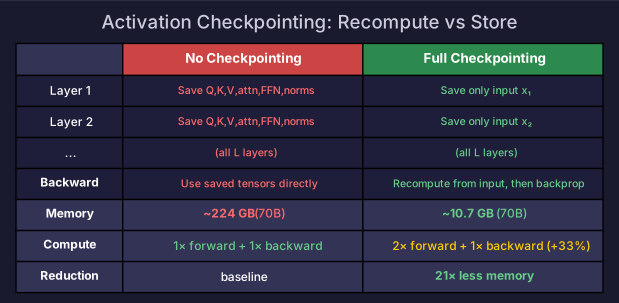
Instead of saving all intermediate tensors, save only the input to each layer and recompute everything during backward:
| Approach | Saved per layer | Memory | Extra compute |
|---|---|---|---|
| No checkpointing | All tensors | GB (70B, standard) | 0% |
| Full checkpointing | Layer input only () | MB (70B) | ~33% |
| Selective checkpointing | Cheap tensors only | ~40-60% of full | ~10-15% |
Full checkpointing for 70B: GB — down from 357 GB (standard) or 99 GB (FlashAttention). A 66× or 18× reduction at the cost of 33% extra compute.
from torch.utils.checkpoint import checkpoint

class TransformerLayer(nn.Module):
    def forward(self, x):
        # Checkpoint this layer — only input x is saved
        return checkpoint(self._forward, x, use_reentrant=False)

    def _forward(self, x):
        # Everything here is recomputed during backward
        h = self.attention(self.norm1(x)) + x
        return self.ffn(self.norm2(h)) + h
Strategy 2: FlashAttention
Eliminates the attention activation:
| Standard attention | FlashAttention | |
|---|---|---|
| Saved for backward | Full attention matrix + dropout mask | Only Q, K, V + row-max/sum stats |
| Memory per layer (70B, s=4K) | 3.2 GB (attention only) | ~0.2 GB (Q,K,V stats) |
| Impact | Dominant cost at long sequences | Removes the quadratic term |
For details on how FlashAttention achieves this, see FlashAttention v1 and v2.
Strategy 3: Sequence Parallelism
Split the sequence dimension across TP ranks for LayerNorm and Dropout regions:
Each TP rank handles tokens for non-attention operations. Combined with TP, this reduces activation memory proportionally.
See Sequence Parallelism for details.
Strategy 4: Reduce Batch Size + Gradient Accumulation
Activation memory scales linearly with micro-batch size:
Use micro-batch with gradient accumulation steps to achieve effective batch . Same training semantics, but less activation memory.
5. Activation Memory Budget in Practice
For 70B, TP=8, FSDP, FlashAttention enabled:
| Config | Parameters | Optimizer | Activations | Total per GPU |
|---|---|---|---|---|
| No checkpointing, b=1 | 17.5 GB | 13.1 GB | ~12 GB | ~46 GB |
| Full checkpointing, b=1 | 17.5 GB | 13.1 GB | ~0.7 GB | ~34 GB |
| Full checkpointing, b=4 | 17.5 GB | 13.1 GB | ~2.7 GB | ~36 GB |
| Selective checkpointing, b=2 | 17.5 GB | 13.1 GB | ~5 GB | ~39 GB |
Activation values are approximate — TP=8 reduces some activations (FFN) but not all (LayerNorm is replicated without SP).
Checkpointing buys you either more batch size or more sequence length within the same GPU memory.
Self-Check
- Name the tensors saved for backward in a Transformer layer and why each is needed
- Calculate per-layer activation memory for a given architecture (with and without FlashAttention)
- Explain the attention activation problem and how FlashAttention solves it
- Calculate activation memory with full checkpointing vs none
- Determine max batch size given a fixed memory budget after accounting for activations
- Combine checkpointing + FlashAttention + sequence parallelism for a complete activation strategy