Naive Attention Kernel
Standard attention with full N×N materialization — why it's memory-bound, where the bottleneck is, and why it breaks at long sequences.
Before understanding FlashAttention, you must understand what it fixes. Standard attention materializes the full attention matrix in HBM — creating an memory bottleneck that makes long-context serving impossible without algorithmic innovation.
1. Standard Attention: Step by Step
For a single head with query , key , value all of shape :
Step 1: S = Q × K^T              → (S, dk) × (dk, S) = (S, S)    [GEMM, write to HBM]
Step 2: S = S / sqrt(dk)          → (S, S)                         [element-wise, read+write HBM]
Step 3: S = S + mask               → (S, S)                         [element-wise, read+write HBM]
Step 4: P = softmax(S, dim=-1)    → (S, S)                         [reduction + element-wise, read+write HBM]
Step 5: O = P × V                 → (S, S) × (S, dk) = (S, dk)    [GEMM, read S×S from HBM]
The Memory Problem
The attention matrix has elements. For multi-head attention with batch:
| Sequence length | Attention matrix (B=1, Nh=32, FP16) | vs H100 memory |
|---|---|---|
| S = 2,048 | 256 MB | Fits easily |
| S = 8,192 | 4 GB | ~5% of HBM |
| S = 32,768 | 64 GB | 80% of HBM |
| S = 131,072 | 1 TB | Doesn’t fit |
At 128K context, the attention matrix alone exceeds GPU memory. This is why naive attention cannot serve long-context models.
2. HBM Traffic Analysis
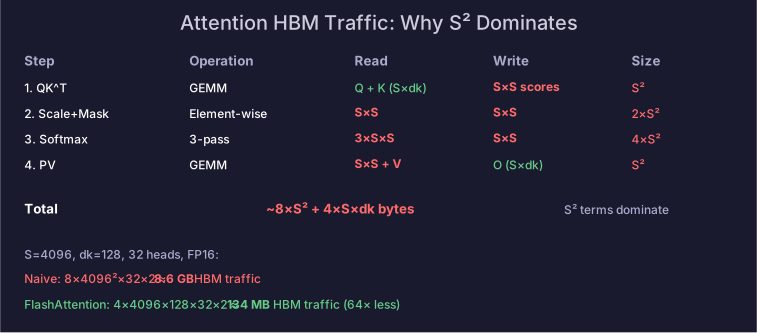
Count every byte read from and written to HBM:
| Step | Operation | HBM reads | HBM writes |
|---|---|---|---|
| QK^T | GEMM | (Q and K) | (scores) |
| Scale | Element-wise | ||
| Mask | Element-wise | (scores) + (mask) | |
| Softmax | Reduction + normalize | (3 passes) | |
| PV | GEMM | (P) + (V) | (O) |
Total HBM traffic: ~ bytes (FP16). The terms dominate.
For S=4096, dk=128: MB per head. With 32 heads: 7.5 GB of HBM traffic just for attention.
Arithmetic Intensity
With H100’s ops:byte ratio of 295, naive attention is severely memory-bound (AI = 37 << 295). The GPU spends most of its time reading and writing the attention matrix, not computing.
3. Naive CUDA Implementation
// Step 1: QK^T
// Use cuBLAS: cublasSgemm(S, S, dk, Q, K^T, scores)

// Step 2-4: Scale + Mask + Softmax (fused for fewer HBM trips)
__global__ void scaleMaskSoftmax(float* scores, float* mask, int S, float scale) {
    int row = blockIdx.x;
    int tid = threadIdx.x;

    // Scale and mask
    for (int j = tid; j < S; j += blockDim.x) {
        scores[row * S + j] = scores[row * S + j] * scale + mask[row * S + j];
    }
    __syncthreads();

    // Online softmax (single pass for max + sum)
    float m = -INFINITY, s = 0.0f;
    for (int j = tid; j < S; j += blockDim.x) {
        float val = scores[row * S + j];
        float new_m = fmaxf(m, val);
        s = s * expf(m - new_m) + expf(val - new_m);
        m = new_m;
    }
    // Reduce m, s across block...
    __syncthreads();

    // Normalize
    for (int j = tid; j < S; j += blockDim.x) {
        scores[row * S + j] = expf(scores[row * S + j] - m) / s;
    }
}

// Step 5: PV
// Use cuBLAS: cublasSgemm(S, dk, S, P, V, output)
Even with fused scale+mask+softmax, we still:
- Materialize the S×S matrix in HBM after QK^T
- Read it back for softmax
- Read it again for PV multiplication
The S×S matrix is written once and read twice — 3 complete passes over an tensor.
4. Why This Can’t Be Fixed Without Algorithmic Change
You might think: “just fuse everything into one kernel.” But:
- QK^T is a GEMM that produces the output
- Softmax requires the entire row to compute (needs global max and sum)
- PV is a GEMM that reads the attention weights
You can’t fuse two GEMMs with a softmax between them using standard approaches — the softmax needs the complete row before PV can start.
FlashAttention’s insight: Use tiling to break this dependency. Process Q in tiles, compute partial attention scores, use online softmax to maintain running statistics, and accumulate the output — all without ever writing the full matrix.
This is covered in the next two chapters.
5. When Naive Attention Is Fine
Despite its limitations, naive attention is used when:
| Scenario | Why naive is OK |
|---|---|
| Short sequences (S < 2K) | S×S matrix is small (< 32 MB), fits easily |
| Profiling/debugging | Easier to understand, debug, and verify correctness |
| Non-LLM models | Vision (ViT) with S=197 patches — S² is tiny |
| Reference implementation | Gold standard for checking FlashAttention correctness |
For LLM inference with S > 4K, FlashAttention is mandatory.
Self-Check
- Calculate the attention matrix size for given B, Nh, S in FP16
- Count the total HBM reads and writes for standard 5-step attention
- Calculate arithmetic intensity and explain why naive attention is memory-bound
- Explain why you can’t simply “fuse” QK^T + softmax + PV into one kernel
- Explain when naive attention is acceptable vs when FlashAttention is required