CUDA Memory Model
Registers, shared memory, L1/L2 cache, global memory — how each level works, when to use it, and the access patterns that make or break kernel performance.
A kernel’s performance is almost always determined by how it accesses memory, not how it computes. This chapter maps every CUDA memory type to hardware, explains access rules, and shows how the right memory choice can make a kernel 10–100× faster.
1. Memory Hierarchy Overview
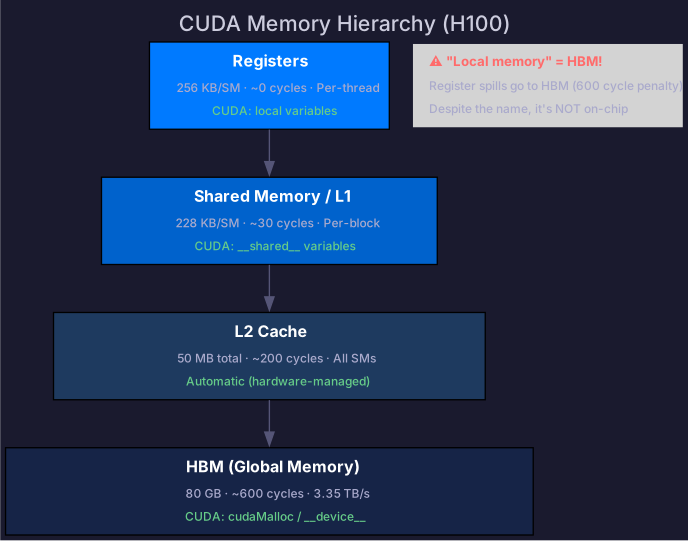
CUDA exposes a software memory model that maps to hardware memory:
| CUDA memory type | Declaration | Hardware location | Scope | Lifetime | Latency | Bandwidth |
|---|---|---|---|---|---|---|
| Registers | Local variables | SM register file | Per-thread | Kernel | ~0 cycles | Highest |
| Local memory | Spilled registers | HBM (!) | Per-thread | Kernel | ~600 cycles | Low |
| Shared memory | __shared__ | SM on-chip SRAM | Per-block | Kernel | ~30 cycles | ~19 TB/s aggregate |
| L1 cache | Automatic | SM on-chip SRAM | Per-SM | Dynamic | ~30 cycles | Shared with smem |
| L2 cache | Automatic | On-chip | Global | Dynamic | ~200 cycles | ~9 TB/s |
| Global memory | __device__ / cudaMalloc | HBM | Global | Application | ~600 cycles | 3.35 TB/s (H100) |
| Constant memory | __constant__ | HBM + cache | Global | Application | ~1-600 cycles | Cached |
| Texture memory | Texture objects | HBM + cache | Global | Application | ~1-600 cycles | Spatial locality |
⚠️ CRITICAL: “Local memory” is the most misleading name in CUDA. It is NOT local to the SM — it lives in HBM and is as slow as global memory. It’s called “local” because it’s per-thread scope. When your kernel uses too many registers, the compiler spills to local memory — a silent performance killer.
2. Registers: The Fastest Storage
Every thread has its own registers — the fastest storage available.
__global__ void kernel() {
    float a = 1.0f;  // stored in a register
    float b = 2.0f;  // another register
    float c = a + b;  // computed using register ALU, result in register
}
Register Budget
| GPU | Registers per SM | Registers per thread (max) |
|---|---|---|
| H100 | 65,536 (256 KB) | 255 |
| A100 | 65,536 (256 KB) | 255 |
The tradeoff: more registers per thread → fewer threads can run simultaneously (lower occupancy). The compiler decides how many registers each kernel uses.
# Check register usage at compile time
nvcc -Xptxas -v kernel.cu
# Output: "Used 32 registers, 0 bytes shared memory"
Register Spilling
When a kernel needs more registers than available, the compiler spills to local memory (HBM):
High register usage → spill to local memory → 600-cycle penalty per accessHow to reduce register pressure:
- Simplify expressions (fewer temporaries)
- Use
__launch_bounds__(maxThreadsPerBlock, minBlocksPerSM)to hint the compiler - Trade registers for shared memory (store intermediates explicitly)
3. Shared Memory: Programmer-Managed Cache
Shared memory is fast on-chip SRAM shared by all threads in a block. It’s like an L1 cache that you manage.
Declaration and Usage
__global__ void kernel() {
    // Static allocation (size known at compile time)
    __shared__ float tile[256];

    // Dynamic allocation (size specified at launch)
    extern __shared__ float dynamicTile[];

    // Load data cooperatively
    tile[threadIdx.x] = globalData[blockIdx.x * 256 + threadIdx.x];
    __syncthreads();  // MUST sync before reading others' writes

    // Use shared data (fast — ~30 cycles)
    float val = tile[threadIdx.x] + tile[255 - threadIdx.x];
}

// Launch with dynamic shared memory
kernel<<<grid, block, sharedMemBytes>>>(args);
When to Use Shared Memory
| Use case | Why |
|---|---|
| Data reuse within a block | Load from HBM once, use multiple times from shared memory |
| Inter-thread communication | Threads in a block can read each other’s data |
| Tiling for matrix operations | Load a tile, compute, repeat — the basis of fast GEMM |
| Reduction within a block | Accumulate values from all threads |
Bank Conflicts
Shared memory is divided into 32 banks (one per warp lane). If multiple threads in a warp access the same bank (but different addresses), accesses are serialized:
// NO conflict: each thread accesses a different bank
shared[threadIdx.x] = val;  // thread 0→bank 0, thread 1→bank 1, ...

// 2-way conflict: threads 0 and 16 both access bank 0
shared[threadIdx.x * 2] = val;  // thread 0→bank 0, thread 1→bank 2, ..., thread 16→bank 0!

// BROADCAST (no conflict): all threads read the SAME address
float val = shared[0];  // all threads read bank 0, address 0 — broadcast
Bank index = (address / 4 bytes) % 32
Fix: Pad shared memory arrays to shift bank alignment:
__shared__ float tile[32][33]; // 33 instead of 32 — avoids column-access conflictsShared Memory vs L1 Cache
On modern GPUs (Ampere+), shared memory and L1 cache share the same physical SRAM. You can configure the split:
// Prefer more shared memory
cudaFuncSetAttribute(kernel, cudaFuncAttributePreferredSharedMemoryCarveout, 100);

// Or set at device level
cudaDeviceSetCacheConfig(cudaFuncCachePreferShared);
H100: 228 KB per SM, configurable between shared memory and L1.
L2 Cache
The L2 cache (50 MB on H100) sits between all SMs and HBM. It’s hardware-managed — you don’t control what gets cached.
L2 matters for:
- Inter-block communication: if one block writes data that another block reads shortly after, it may hit L2 instead of going to HBM
- Repeated global reads: data accessed by multiple blocks may stay in L2
- Residency control (Hopper+):
cudaAccessPolicyWindowlets you hint which data should stay in L2
// Hopper: set L2 persistence for frequently accessed data
cudaAccessPolicyWindow window;
window.base_ptr = d_weights;
window.num_bytes = weightSize;
window.hitRatio = 1.0f;
window.hitProp = cudaAccessPropertyPersisting;
window.missProp = cudaAccessPropertyStreaming;
cudaCtxSetAccessPolicyWindow(&window);
4. Global Memory: The Main Storage
Global memory is HBM — large, slow, and the bottleneck for most kernels.
Allocation and Access
float* d_data;
cudaMalloc(&d_data, N * sizeof(float));       // allocate
cudaMemcpy(d_data, h_data, size, cudaMemcpyHostToDevice);  // copy to GPU
cudaFree(d_data);                              // free
Coalesced Access: The #1 Optimization
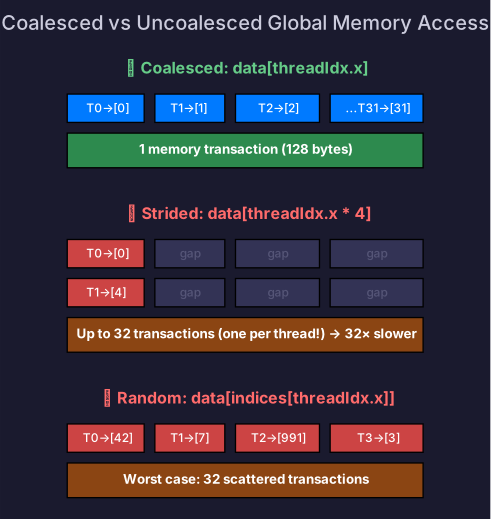
When threads in a warp access consecutive memory addresses, the hardware combines them into a single transaction:
// COALESCED: threads 0-31 access addresses 0-31 (one 128-byte transaction)
float val = data[threadIdx.x];  // ✅ Fast

// STRIDED: threads 0-31 access addresses 0, stride, 2*stride, ...
float val = data[threadIdx.x * stride];  // ❌ Multiple transactions if stride > 1

// RANDOM: each thread accesses a random address
float val = data[indices[threadIdx.x]]; // ❌ Worst case: 32 separate transactionsCoalesced: 1 transaction for 32 threads (128 bytes). Uncoalesced: up to 32 transactions. That’s 32× slower.
Structure of Arrays (SoA) vs Array of Structures (AoS)
// AoS: BAD for GPU (strided access within a warp)
struct Particle { float x, y, z, w; };
Particle particles[N];
// Thread i accesses particles[i].x → stride of 16 bytes between threads

// SoA: GOOD for GPU (coalesced access)
float x[N], y[N], z[N], w[N];
// Thread i accesses x[i] → consecutive addresses → coalescedRule: Always prefer SoA layout for GPU data.
5. Constant and Texture Memory
Constant Memory
__constant__ float coefficients[256];  // 64 KB max total

// Set from host
cudaMemcpyToSymbol(coefficients, hostData, 256 * sizeof(float));- Read-only from device, written from host
- Cached — very fast when all threads read the same address (broadcast)
- Slow when threads read different addresses (serialized)
Best for: model hyperparameters, lookup tables, filter weights.
Texture Memory
Optimized for 2D spatial locality (nearby pixels). Rarely used in AI workloads — shared memory and global memory with coalescing are usually better.
6. Memory Access Patterns Cheat Sheet
| Pattern | Memory type | When to use |
|---|---|---|
| Each thread computes with its own data | Registers | Always (compiler default) |
| Threads in a block share data | Shared memory | Tiling, reduction, transpose |
| All threads read same constant | Constant memory | Hyperparameters, small lookup tables |
| Sequential global access | Global (coalesced) | Input/output arrays, SoA layout |
| Random global access | Global (uncoalesced) | Avoid! Restructure data or use shared memory |
7. Unified Memory (Managed Memory)
Unified Memory simplifies GPU programming by providing a single address space accessible from both CPU and GPU:
float* data;
cudaMallocManaged(&data, N * sizeof(float));

// CPU writes
for (int i = 0; i < N; i++) data[i] = i;

// GPU reads — driver automatically migrates pages
kernel<<<grid, block>>>(data, N);
cudaDeviceSynchronize();

// CPU reads result — driver migrates back
printf("%f\n", data[0]);

cudaFree(data);
How it works: The CUDA driver uses page faults to migrate data between CPU and GPU on demand. When the GPU accesses a page that’s in CPU memory, a page fault triggers migration.
Performance: Page fault migration adds latency. For performance-critical code, use explicit cudaMemcpy or prefetch hints:
cudaMemPrefetchAsync(data, size, deviceId, stream); // pre-migrate before kernelWhen to use:
- Prototyping and debugging (simpler code)
- Complex data structures with irregular access (hard to predict which data GPU needs)
- Oversubscription (data larger than GPU memory — driver pages in/out)
When NOT to use:
- Production AI kernels (explicit memory management is faster)
- Latency-sensitive inference (page faults add unpredictable latency)
cudaMemcpy Patterns
| Direction | Constant | Use |
|---|---|---|
cudaMemcpyHostToDevice | CPU → GPU | Send input data before kernel |
cudaMemcpyDeviceToHost | GPU → CPU | Retrieve results after kernel |
cudaMemcpyDeviceToDevice | GPU → GPU | Copy between GPU buffers |
cudaMemcpyDefault | Auto-detect | Works with unified memory |
For async transfers (requires pinned host memory):
cudaMallocHost(&h_data, size);  // pinned memory
cudaMemcpyAsync(d_data, h_data, size, cudaMemcpyHostToDevice, stream);
Self-Check
- Name all CUDA memory types and their hardware locations
- Explain why “local memory” is misleadingly named (it’s in HBM)
- Explain register spilling and how to detect it
- Write a kernel that uses shared memory with
__syncthreads() - Explain bank conflicts and how padding fixes them
- Explain coalesced vs uncoalesced access and the performance difference
- Explain SoA vs AoS and why SoA is preferred for GPUs
- Explain Unified Memory and when to use it vs explicit cudaMemcpy
- Name the four cudaMemcpy direction constants