Warp Execution & Scheduling
How warps are formed, scheduled, and executed — SIMT model, warp divergence costs, latency hiding through occupancy, and warp-level primitives.
Understanding warp execution is the key to understanding GPU performance. The GPU doesn’t see individual threads — it sees warps. Every performance optimization, from avoiding divergence to maximizing occupancy, operates at the warp level.
1. Warp Formation and Scheduling
How Warps Are Formed
When a block is assigned to an SM, its threads are partitioned into warps of 32:
Block (256 threads)
├── Warp 0:  threads   0 –  31
├── Warp 1:  threads  32 –  63
├── Warp 2:  threads  64 –  95
├── Warp 3:  threads  96 – 127
├── Warp 4:  threads 128 – 159
├── Warp 5:  threads 160 – 191
├── Warp 6:  threads 192 – 223
└── Warp 7:  threads 224 – 255
Grouping is by consecutive threadIdx — you cannot choose which threads form a warp.
Warp Schedulers
Each SM has multiple warp schedulers (4 on H100). Every cycle, each scheduler:
- Checks which warps are ready (instruction and data available)
- Selects one ready warp
- Issues its next instruction
If a warp is waiting for memory (stalled), the scheduler immediately switches to another ready warp — zero-cost context switching. This is how GPUs hide memory latency without caches.
Cycle 1: Scheduler picks Warp 0 → issues load instruction (takes 600 cycles)
Cycle 2: Warp 0 stalled → Scheduler picks Warp 1 → issues compute
Cycle 3: Warp 1 ready  → Scheduler picks Warp 1 → issues compute
...
Cycle 600: Warp 0's data arrives → Scheduler picks Warp 0 → resumes
Key insight: The GPU hides latency by having more warps than execution units. While some warps wait for data, others compute. This is why occupancy matters.
2. SIMT: Single Instruction, Multiple Threads
All 32 threads in a warp execute the same instruction each cycle, but each thread has its own:
- Register file (private data)
- Program counter (since Volta — independent thread scheduling)
- Predicate registers (for masking)
SIMT vs SIMD
| Property | SIMD (CPU AVX-512) | SIMT (GPU warp) |
|---|---|---|
| Width | 8-16 elements | 32 threads |
| Branching | Must process all elements same way | Can diverge (with penalty) |
| Programming | Explicit vector instructions | Write scalar code, hardware parallelizes |
| Memory access | Fixed stride | Each thread can access different address |
SIMT is more flexible — you write code as if for a single thread, and the hardware runs 32 copies. But that flexibility comes with the divergence penalty.
3. Warp Divergence: The Performance Tax
What Happens
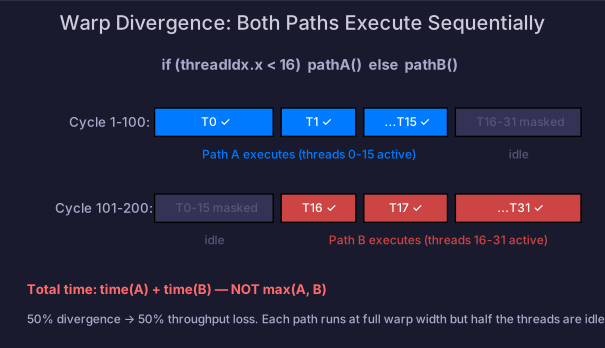
When threads in a warp take different branches, both paths execute sequentially:
if (threadIdx.x % 2 == 0) {
    a = computeA();  // Even threads: active, odd threads: masked
} else {
    b = computeB();  // Odd threads: active, even threads: masked
}
// Total time: time(A) + time(B), not max(time(A), time(B))
Measuring the Cost
| Divergence pattern | Active threads | Throughput |
|---|---|---|
| No divergence (all same path) | 32/32 | 100% |
| 50% divergence (half each way) | 16/32 per path | 50% |
| Full divergence (32 different paths) | 1/32 per path | 3% |
Mitigation Strategies
1. Align branches with warp boundaries:
// BAD: divergence within every warp
if (threadIdx.x % 2 == 0) { ... }

// GOOD: entire warps take the same path
if (threadIdx.x / 32 < 4) { ... }  // warps 0-3 take one path, warps 4-7 take another
2. Predication for short branches: The compiler may convert short if-else into predicated instructions (both paths execute, results selected by predicate). No warp serialization.
3. Data reorganization: Sort data so threads in a warp process similar items (e.g., sort by class before classification).
Volta+ Independent Thread Scheduling
Before Volta, all threads in a warp shared a single program counter — diverged threads were strictly serialized. Since Volta (V100, 2017), each thread has its own program counter, enabling:
- Finer-grained reconvergence: threads can rejoin after divergence without waiting for the entire warp
- Better interleaving: the scheduler can interleave instructions from diverged paths
- Starvation-free execution: no thread is permanently masked
In practice, this means divergence is less catastrophic on modern GPUs — but it’s still a performance loss and should be minimized.
4. Occupancy: Keeping the GPU Busy
Occupancy = active warps per SM / maximum warps per SM.
Higher occupancy → more warps available for the scheduler → better latency hiding.
What Limits Occupancy
| Resource | Limit (H100) | How it limits occupancy |
|---|---|---|
| Threads per SM | 2048 (64 warps) | Hard ceiling |
| Threads per block | 1024 | Block size caps warps per block |
| Registers per SM | 65,536 | More registers/thread → fewer threads fit |
| Shared memory per SM | 228 KB | More smem/block → fewer blocks fit |
Example Calculation
A kernel uses 64 registers/thread and 16 KB shared memory/block, with 256 threads/block:
- Warps per block: 256 / 32 = 8
- Blocks limited by registers: 65,536 / (64 × 256) = 4 blocks
- Blocks limited by shared mem: 228 KB / 16 KB = 14 blocks
- Blocks limited by threads: 2048 / 256 = 8 blocks
- Actual blocks per SM: min(4, 14, 8) = 4 blocks (register-limited)
- Occupancy: 4 × 8 warps = 32 active warps / 64 max = 50%
Using the Occupancy Calculator
# NVIDIA provides an occupancy calculator spreadsheet and API
nvcc --ptxas-options=-v kernel.cu  # shows register/shared memory usage
// Programmatic occupancy query
int minGridSize, bestBlockSize;
cudaOccupancyMaxPotentialBlockSize(&minGridSize, &bestBlockSize, kernel, 0, 0);Is Higher Always Better?
Not always. Some kernels achieve peak performance at 50% occupancy because they’re compute-bound (every thread is busy computing, not waiting for memory). The goal is to have enough occupancy to hide memory latency — beyond that, more occupancy doesn’t help.
Rule of thumb: Aim for ≥50% occupancy. If a kernel is compute-bound, even 25% may be sufficient. Profile to confirm.
5. Latency Hiding: The Full Picture
The GPU hides latency at multiple levels:
| Level | Mechanism | Latency hidden |
|---|---|---|
| Warp-level | Scheduler switches between warps | Memory latency (~600 cycles) |
| Instruction-level | Independent instructions in a warp execute while earlier ones wait | Short dependency chains |
| Thread-level | More threads per SM = more warps to switch between | All stalls |
The formula for how many warps are needed to hide memory latency:
In practice, instruction-level parallelism reduces this — 20-40 active warps typically suffice.
Self-Check
- Explain how warps are formed from block threads
- Explain how warp schedulers hide memory latency
- Calculate the performance cost of 50% warp divergence
- Name three strategies to minimize divergence
- Calculate occupancy given register and shared memory usage
- Explain why 50% occupancy can be sufficient for compute-bound kernels
- Explain the relationship between occupancy and latency hiding