AI Compilers
Triton, TVM, XLA, torch.compile — when hand-writing kernels doesn't scale, compilers automate tiling, fusion, and scheduling.
Writing optimal CUDA kernels by hand is powerful but doesn’t scale — every new operation, every shape change, every hardware generation requires re-optimization. AI compilers automate the tedious parts (tiling, fusion, scheduling) while letting experts focus on algorithmic innovation.
1. Why Compilers?
| Approach | Pros | Cons |
|---|---|---|
| Hand-written CUDA | Maximum performance, full control | Weeks per kernel, hardware-specific, hard to maintain |
| cuBLAS/cuDNN | Near-optimal for standard ops | No custom fusion, limited to supported ops |
| AI Compiler | Custom fusion, auto-tuning, portable | 80-95% of hand-tuned, compilation overhead |
The 80/20 rule: Compilers handle the 80% of operations that are “standard optimizable” (element-wise, reduction, simple GEMM variants). The 20% that need custom algorithms (FlashAttention, custom routing) still require hand-written kernels.
2. Triton: Python GPU Kernels
Triton lets you write GPU kernels in Python with block-level abstractions — no shared memory management, no warp-level thinking, no bank conflict debugging.
How It Works
import triton
import triton.language as tl

@triton.jit
def add_kernel(x_ptr, y_ptr, out_ptr, N, BLOCK: tl.constexpr):
    pid = tl.program_id(0)  # block index
    offsets = pid * BLOCK + tl.arange(0, BLOCK)
    mask = offsets < N

    x = tl.load(x_ptr + offsets, mask=mask)
    y = tl.load(y_ptr + offsets, mask=mask)
    tl.store(out_ptr + offsets, x + y, mask=mask)

# Launch
add_kernel[(N // 256,)](x, y, out, N, BLOCK=256)
What Triton Handles Automatically
| Manual in CUDA | Automatic in Triton |
|---|---|
| Shared memory allocation | Compiler decides when to use SRAM |
| Bank conflict avoidance | Compiler inserts padding/swizzle |
| Memory coalescing | Compiler reorders accesses |
| Warp-level primitives | Block-level abstraction hides warps |
| Register allocation | Compiler manages registers |
| Tiling loop structure | You define block size, compiler tiles |
Triton for Fused Kernels
Where Triton shines — custom fused operations:
@triton.jit
def fused_residual_layernorm(x_ptr, res_ptr, gamma_ptr, beta_ptr, out_ptr,
                              N, eps, BLOCK: tl.constexpr):
    row = tl.program_id(0)
    cols = tl.arange(0, BLOCK)
    mask = cols < N

    x = tl.load(x_ptr + row * N + cols, mask=mask)
    res = tl.load(res_ptr + row * N + cols, mask=mask)
    gamma = tl.load(gamma_ptr + cols, mask=mask)
    beta = tl.load(beta_ptr + cols, mask=mask)

    # Fused: residual + layernorm
    h = x + res
    mean = tl.sum(h, axis=0) / N
    var = tl.sum((h - mean) * (h - mean), axis=0) / N
    norm = (h - mean) / tl.sqrt(var + eps)
    out = norm * gamma + beta

    tl.store(out_ptr + row * N + cols, out, mask=mask)
Performance
Triton typically achieves 80-95% of hand-tuned CUDA for standard patterns. For GEMM specifically, Triton’s auto-tuner can reach 90%+ of cuBLAS by searching tile sizes, number of pipeline stages, and warp configurations.
3. torch.compile (TorchInductor)
PyTorch’s built-in compiler — captures the Python computation graph and generates optimized code.
How It Works
@torch.compile(mode="reduce-overhead")
def forward(x, weight, bias):
    h = x @ weight + bias
    h = torch.nn.functional.gelu(h)
    h = torch.nn.functional.dropout(h, p=0.1)
    return h
Under the hood:
- TorchDynamo: captures Python bytecode into a graph (handles control flow, dynamic shapes)
- TorchInductor: compiles the graph into optimized Triton kernels (or C++/CUDA)
- Auto-fusion: identifies element-wise operation chains and fuses them
- CUDA Graphs: wraps the compiled graph for reduced launch overhead
Compilation Modes
| Mode | Effect | Use case |
|---|---|---|
default | Balanced optimization | General training |
reduce-overhead | CUDA Graphs for minimal launch overhead | Inference, repetitive training steps |
max-autotune | Search over multiple kernel implementations | Final deployment optimization |
What torch.compile Handles Well
- ✅ Element-wise fusion (residual + activation + dropout)
- ✅ Pointwise operations with broadcasting
- ✅ Simple reductions (sum, mean, norm)
- ✅ Standard GEMM (delegates to cuBLAS)
What It Doesn’t Handle
- ❌ Custom attention patterns (use FlashAttention directly)
- ❌ Dynamic shapes that change every iteration (recompilation each time)
- ❌ Complex control flow dependent on tensor values
- ❌ Operations not in the supported op list
4. XLA (Accelerated Linear Algebra)
Google’s compiler, primarily used with JAX and TensorFlow. Compiles entire computation graphs into optimized HLO (High-Level Optimizer) IR.
Key Differences from TorchInductor
| TorchInductor | XLA | |
|---|---|---|
| Primary framework | PyTorch | JAX, TensorFlow |
| Compilation unit | Individual ops / subgraphs | Entire program |
| Target hardware | NVIDIA GPUs | GPUs, TPUs, CPUs |
| Fusion strategy | Op-by-op | Whole-program optimization |
| Dynamic shapes | Supported (with recompilation) | Requires static shapes (JIT traces) |
XLA’s whole-program optimization can find fusion opportunities that op-level compilers miss — but requires static shapes and JAX’s functional programming style.
5. TVM (Tensor Virtual Machine)
An open-source compiler framework for deploying ML models across diverse hardware:
| Feature | What it does |
|---|---|
| Auto-scheduling | Automatically finds optimal loop tiling, parallelization, vectorization |
| Hardware targets | CUDA, Metal, Vulkan, CPU (LLVM), custom accelerators |
| Model import | ONNX, TensorFlow, PyTorch models |
| Use case | Edge deployment, cross-platform optimization |
TVM is less commonly used for NVIDIA GPU training (where Triton/torch.compile dominate) but important for edge deployment where you need to compile models for diverse hardware.
6. When to Use What
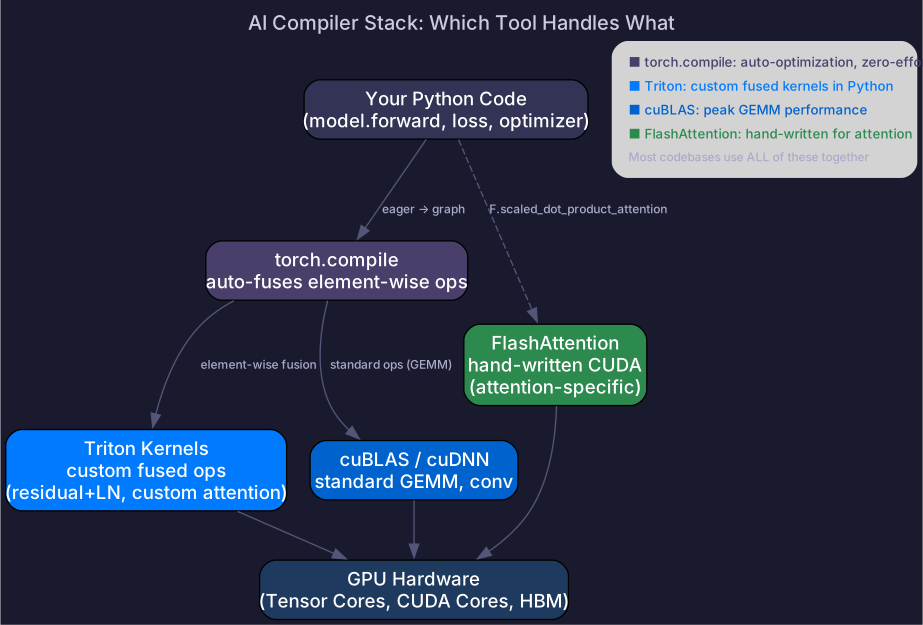
| Scenario | Best tool |
|---|---|
| Standard training loop | torch.compile (zero effort, good speedup) |
| Custom fused kernel | Triton (Python-level GPU programming) |
| Maximum GEMM performance | cuBLAS (still the gold standard) |
| Custom attention variant | Hand-written CUDA or Triton |
| JAX / TPU training | XLA |
| Edge deployment | TVM or TensorRT |
| Production inference | TensorRT-LLM (NVIDIA’s serving compiler) |
The Typical AI Infra Stack
Application (Python)
  → torch.compile (auto-fuses element-wise ops)
    → Triton (custom fused kernels where needed)
      → cuBLAS/cuDNN (standard GEMM/conv)
        → FlashAttention (hand-written CUDA for attention)
Most codebases use all of these together — different tools for different operations.
Self-Check
- Explain why AI compilers exist (hand-written CUDA doesn’t scale)
- Write a simple Triton kernel and explain what the compiler handles automatically
- Explain what torch.compile does under the hood (Dynamo → Inductor → Triton)
- Explain the three torch.compile modes and when to use each
- Explain when to use Triton vs cuBLAS vs hand-written CUDA
- Explain XLA’s whole-program optimization advantage over op-level compilers