Operator Fusion
Eliminating intermediate tensors by combining multiple operations into a single kernel — the principle behind FlashAttention, fused LayerNorm, and every fast AI kernel.
Most individual operations in an LLM (LayerNorm, activation, residual add, dropout, softmax) are memory-bound — they read data from HBM, do a tiny computation, and write back. Operator fusion combines multiple such operations into a single kernel, eliminating the intermediate HBM reads and writes. This is the most impactful optimization in AI inference.
1. Why Fusion Matters
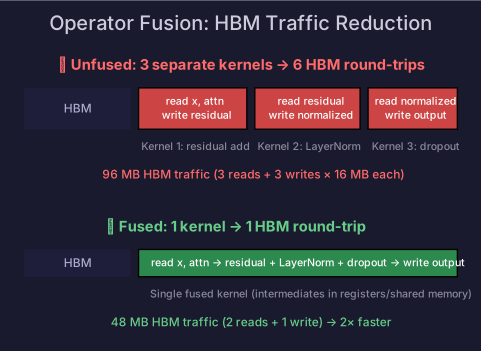
Consider a residual + LayerNorm:
# Unfused (PyTorch eager mode): 3 HBM round-trips
residual = x + attn_output        # Read x, attn_output → Write residual
normalized = layer_norm(residual)  # Read residual → Write normalized
output = dropout(normalized)       # Read normalized → Write output
Each operation reads from and writes to HBM. For in FP16:
- Each tensor: MB
- Three operations: 3 reads + 3 writes = 6 × 16 MB = 96 MB of HBM traffic
# Fused: 1 HBM round-trip
output = fused_residual_layernorm_dropout(x, attn_output)
# Read x, attn_output → compute all three → Write output
Fused: 2 reads + 1 write = 3 × 16 MB = 48 MB. 2× less HBM traffic → 2× faster for these memory-bound operations.
2. Fusion Patterns in AI
Pattern 1: Element-wise Fusion
Combine operations that process each element independently:
Residual add + Bias + Activation + Dropout
→ One kernel: output[i] = dropout(activation(x[i] + bias[i] + residual[i]))
This is the simplest fusion — each thread computes the entire chain for its element. No inter-thread communication needed.
Pattern 2: Reduction + Element-wise
Combine a reduction (like computing mean/variance for LayerNorm) with element-wise operations:
LayerNorm:
  Pass 1: mean = reduce_mean(x)           ← reduction
  Pass 2: var = reduce_variance(x, mean)   ← reduction
  Pass 3: y = (x - mean) / sqrt(var) * γ + β  ← element-wise
→ Fused: one kernel with shared-memory reductions + normalization
Pattern 3: GEMM + Epilogue
Combine matrix multiplication with the operation that follows:
Linear + Bias + ReLU:
  y = ReLU(x @ W + b)
→ GEMM computes y = x @ W, then EACH thread applies + b and ReLU
  before writing to HBM (epilogue fusion)
CUTLASS makes this easy with custom epilogue functors. cuBLAS supports some built-in epilogues (cublasLtMatmulDescSetAttribute).
Pattern 4: Attention Fusion (FlashAttention)
The most impactful fusion in AI — combine Q×K^T, scaling, masking, softmax, and ×V into a single kernel that never materializes the S×S attention matrix:
Unfused:
  scores = Q @ K^T / sqrt(dk)    ← GEMM, writes S×S to HBM
  scores = mask(scores)           ← element-wise, reads+writes S×S
  attn = softmax(scores)          ← reduction + element-wise
  output = attn @ V               ← GEMM, reads S×S
  Total HBM: O(S²) ← doesn't fit for S=128K

Fused (FlashAttention):
  Process in tiles: for each Q tile, iterate over K/V tiles
  Compute scores, softmax, and output — all in SRAM
  Total HBM: O(S) ← fits for any sequence length
FlashAttention isn’t just fusion — it’s a complete algorithmic redesign that uses online softmax to avoid materializing the attention matrix. Covered in depth in the Attention Kernels section.
3. What Can and Cannot Be Fused
Fusible ✅
| Pattern | Example | Why fusible |
|---|---|---|
| Element-wise chain | bias + activation + dropout | Same element, no communication |
| Reduction + normalize | LayerNorm, RMSNorm | Shared memory reduction within a block |
| GEMM + epilogue | Linear + bias + activation | Epilogue runs on GEMM output in registers |
| Softmax + cross-entropy | Training loss | Avoids writing softmax output |
Not Fusible ❌
| Pattern | Example | Why not |
|---|---|---|
| Two large GEMMs | Q projection → K projection | Each is a separate matmul with different weights |
| Operations with different parallelism | Reduce along dim 0 → broadcast along dim 1 | Different thread mappings |
| Data-dependent shapes | Dynamic routing in MoE | Cannot predict memory access pattern |
Partially Fusible ⚠️
| Pattern | Example | How |
|---|---|---|
| GEMM + GEMM | QKV projection | Fuse into one GEMM: [Q,K,V] = X @ [Wq,Wk,Wv] |
| Attention + FFN | Transformer block | Too complex — fuse components within, not across |
4. How Fusion Is Implemented
Manual (CUDA)
Write a custom fused kernel:
__global__ void fused_residual_layernorm(
    float* x, float* residual, float* gamma, float* beta,
    float* output, int N) {

    __shared__ float smean, svar;
    int tid = threadIdx.x;

    // Step 1: Residual add (element-wise)
    float val = x[blockIdx.x * N + tid] + residual[blockIdx.x * N + tid];

    // Step 2: Compute mean (reduction)
    float sum = block_reduce_sum(val);
    if (tid == 0) smean = sum / N;
    __syncthreads();

    // Step 3: Compute variance (reduction)
    float diff = val - smean;
    float var_sum = block_reduce_sum(diff * diff);
    if (tid == 0) svar = var_sum / N;
    __syncthreads();

    // Step 4: Normalize + scale + shift (element-wise)
    float norm = (val - smean) / sqrtf(svar + 1e-5f);
    output[blockIdx.x * N + tid] = norm * gamma[tid] + beta[tid];
}
One kernel, one HBM read, one HBM write. No intermediate tensors.
Automatic (torch.compile / Triton)
@torch.compile  # automatically fuses element-wise operations
def fused_fn(x, residual, gamma, beta):
    h = x + residual
    mean = h.mean(dim=-1, keepdim=True)
    var = h.var(dim=-1, keepdim=True)
    return gamma * (h - mean) / torch.sqrt(var + 1e-5) + beta
torch.compile with TorchInductor generates fused Triton kernels automatically. It handles element-wise fusion well, but complex patterns (like FlashAttention) still need manual implementation.
Triton (Python GPU Kernels)
@triton.jit
def fused_kernel(x_ptr, res_ptr, out_ptr, N, BLOCK: tl.constexpr):
    row = tl.program_id(0)
    cols = tl.arange(0, BLOCK)

    x = tl.load(x_ptr + row * N + cols)
    res = tl.load(res_ptr + row * N + cols)

    h = x + res  # fused residual
    mean = tl.sum(h) / N
    var = tl.sum((h - mean) ** 2) / N
    norm = (h - mean) / tl.sqrt(var + 1e-5)

    tl.store(out_ptr + row * N + cols, norm)
Triton lets you write fused kernels in Python — much easier than CUDA but with some performance overhead.
5. Measuring Fusion Benefit
The benefit of fusion = eliminated HBM traffic / total runtime.
For memory-bound operations (AI < 10):
- Fusion that eliminates one intermediate tensor: ~30-50% speedup
- Fusion that eliminates two: ~50-70% speedup
- FlashAttention (eliminates O(S²) tensor): ~2-4× speedup
For compute-bound operations (GEMM):
- Epilogue fusion: ~5-10% speedup (the intermediate write is a small fraction of total time)
Rule of thumb: Fusion helps most when the fused operations are individually memory-bound. Fusing two compute-bound operations gives minimal benefit.
Self-Check
- Calculate HBM traffic for unfused vs fused residual + LayerNorm + dropout
- Name the four fusion patterns and give an example of each
- Explain why FlashAttention is the most impactful fusion in AI
- Explain what can and cannot be fused (and why)
- Write a fused residual + LayerNorm kernel in CUDA or Triton
- Explain when
torch.compilecan auto-fuse and when manual fusion is needed