Synchronization & Atomic Operations
Thread synchronization at block and warp levels, memory fences, atomic operations, and how to coordinate parallel threads safely.
Parallel threads that read and write shared data need coordination. Without proper synchronization, you get race conditions — intermittent bugs that produce wrong results silently. This chapter covers every synchronization mechanism CUDA provides, from block-level barriers to lock-free atomic operations.
1. The Synchronization Hierarchy
CUDA provides synchronization at three levels, matching the thread hierarchy:
| Level | Mechanism | Scope | Cost |
|---|---|---|---|
| Warp | Implicit lockstep (pre-Volta), __syncwarp() | 32 threads | ~1 cycle |
| Block | __syncthreads() | All threads in block | ~20-50 cycles |
| Grid | Kernel boundary, atomics, cooperative groups | All blocks | ~1000+ cycles |
No inter-block synchronization within a kernel (except atomics on global memory). If you need all blocks to synchronize, launch a new kernel.
2. Block Synchronization: __syncthreads()
The most commonly used barrier — all threads in a block wait until every thread reaches this point.
When It’s Required
__shared__ float tile[256];

// Phase 1: Write to shared memory
tile[threadIdx.x] = compute(input[idx]);

__syncthreads();  // ← REQUIRED: ensure all writes complete

// Phase 2: Read from shared memory (may read other threads' data)
float val = tile[255 - threadIdx.x];  // safe: all writes visible
Without __syncthreads(), thread 0 might read tile[255] before thread 255 has written it → race condition.
Rules
- All threads must reach the same
__syncthreads()— if some threads skip it (due to conditional), the kernel hangs or produces undefined behavior:
// ❌ WRONG: conditional syncthreads — not all threads reach it
if (threadIdx.x < 128) {
    __syncthreads();  // deadlock: threads 128-255 never arrive
}

// ✅ CORRECT: all threads reach syncthreads, some just skip the work
__syncthreads();
if (threadIdx.x < 128) {
    // do work
}- Two syncs for read-after-write patterns — classic tiled GEMM pattern:
// Load tile
tile[threadIdx.x] = data[idx];
__syncthreads();  // sync 1: all loads complete

// Compute with tile
result += tile[...];
__syncthreads();  // sync 2: all computes done before loading next tile
Performance Cost
__syncthreads() costs ~20-50 cycles. In a tiled GEMM with 128 iterations along K, that’s 256 syncs × ~30 cycles = ~7,680 cycles of pure synchronization. This is why minimizing sync frequency matters for performance.
3. Warp Synchronization
Pre-Volta: Implicit Lockstep
Before Volta (2017), all threads in a warp executed in perfect lockstep. No explicit sync was needed within a warp — if thread 0 wrote to shared memory, thread 1 could immediately read it.
Volta+: Explicit Warp Sync
Since Volta, threads in a warp can have independent program counters. You must explicitly synchronize:
// Write to shared memory
shared[threadIdx.x % 32] = val;

// ❌ Pre-Volta: this just worked
// ✅ Volta+: explicit sync required
__syncwarp();  // or __syncwarp(mask) for a subset

float neighbor = shared[(threadIdx.x + 1) % 32];
__syncwarp(mask)
Synchronize a subset of threads in a warp:
unsigned mask = 0x0000FFFF;  // only threads 0-15
__syncwarp(mask);  // only these threads must reach this point
Useful when you know only some threads are active (e.g., after a conditional branch).
4. Memory Fences
__syncthreads() ensures all threads reach a barrier. Memory fences ensure memory writes are visible to other threads at different scopes.
Three Fence Levels
__threadfence_block();   // writes visible to all threads in same block
__threadfence();         // writes visible to all threads in the device
__threadfence_system();  // writes visible to CPU and other GPUs
When Fences Are Needed
Scenario: A producer block writes data, sets a flag. A consumer block reads the flag, then reads the data.
// Producer block
data[idx] = result;
__threadfence();        // ensure data is visible before flag
flag[blockIdx.x] = 1;  // signal completion

// Consumer block (different block!)
while (flag[producer_id] == 0);  // spin-wait for flag
__threadfence();                  // ensure we see the data
float val = data[idx];            // safe to read
Without __threadfence(), the consumer might see flag=1 but read stale data — the GPU can reorder memory operations.
In practice: Avoid inter-block communication via flags. It’s fragile and hard to debug. Prefer kernel boundaries or atomics.
5. Atomic Operations
Atomics perform read-modify-write as a single indivisible operation — no other thread can see an intermediate state.
Common Atomics
atomicAdd(&counter, 1);      // counter += 1
atomicMin(&min_val, val);     // min_val = min(min_val, val)
atomicMax(&max_val, val);     // max_val = max(max_val, val)
atomicExch(&addr, new_val);   // swap addr with new_val
atomicCAS(&addr, expected, desired);  // compare-and-swap
Use Cases
| Use case | Atomic | Example |
|---|---|---|
| Global counter | atomicAdd | Count elements matching a condition |
| Global reduction | atomicAdd | Aggregate partial sums from all blocks |
| Histogram | atomicAdd | Increment bin counts |
| Lock-free queue | atomicCAS | Producer-consumer across blocks |
| Global min/max | atomicMin/Max | Find global extremes |
Performance
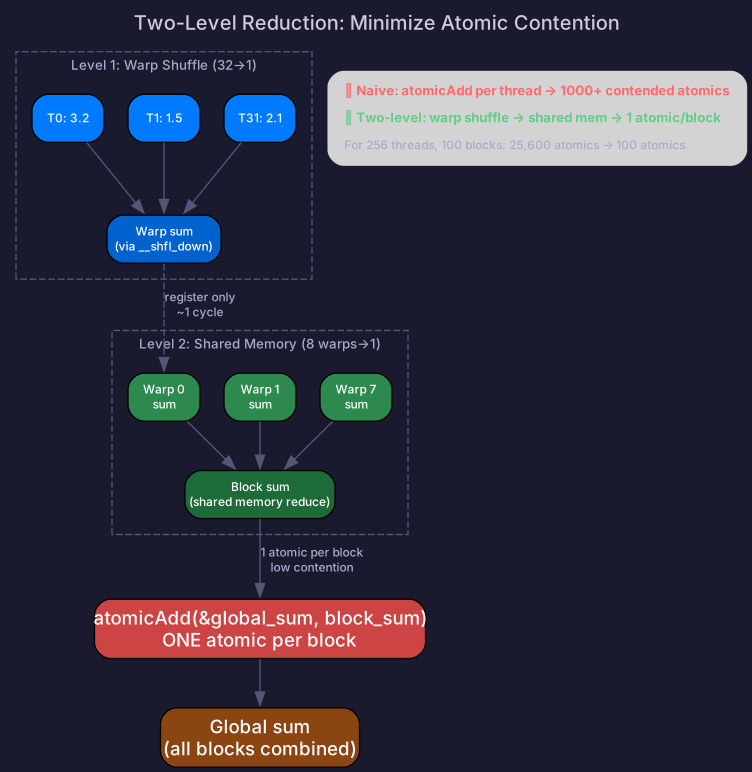
Atomics are slow when contended — many threads updating the same address serialize:
// ❌ High contention: all threads atomic to same address
atomicAdd(&global_sum, local_val);  // 1000+ threads → serialized

// ✅ Two-level reduction: reduce within block first, then one atomic per block
__shared__ float block_sum;
// ... reduce within block using shared memory ...
if (threadIdx.x == 0) {
    atomicAdd(&global_sum, block_sum);  // one atomic per block → low contention
}Rule: Always reduce contention by doing local (warp/block) reduction first, then a single atomic per block.
Supported Types
| Type | atomicAdd | atomicMin/Max | atomicCAS |
|---|---|---|---|
int | ✅ | ✅ | ✅ |
unsigned int | ✅ | ✅ | ✅ |
float | ✅ (since Volta) | ❌ | ❌ |
double | ✅ (since Volta, slow) | ❌ | ❌ |
__half | ✅ (since Turing) | ❌ | ❌ |
For unsupported types, use atomicCAS to implement custom atomics:
// Custom atomicMax for float using CAS loop
__device__ float atomicMaxFloat(float* addr, float val) {
    int* addr_as_int = (int*)addr;
    int old = *addr_as_int, assumed;
    do {
        assumed = old;
        old = atomicCAS(addr_as_int, assumed,
                        __float_as_int(fmaxf(val, __int_as_float(assumed))));
    } while (assumed != old);
    return __int_as_float(old);
}
6. Cooperative Groups (Advanced)
Cooperative Groups provide a flexible, type-safe synchronization API that generalizes beyond fixed block/warp boundaries:
#include <cooperative_groups.h>
namespace cg = cooperative_groups;

__global__ void kernel() {
    // Thread block group
    cg::thread_block block = cg::this_thread_block();
    block.sync();  // same as __syncthreads()

    // Warp-level group
    cg::thread_block_tile<32> warp = cg::tiled_partition<32>(block);
    float sum = cg::reduce(warp, val, cg::plus<float>());  // warp reduce

    // Arbitrary partition
    cg::thread_block_tile<16> half_warp = cg::tiled_partition<16>(block);
    half_warp.sync();
}
Cooperative Groups are the modern way to write synchronization code — they’re more explicit and less error-prone than raw __syncthreads() / __syncwarp().
Self-Check
- Explain when
__syncthreads()is required and the “all threads must reach” rule - Explain why two syncs are needed in tiled GEMM (load sync + compute sync)
- Explain the difference between
__syncthreads()and__syncwarp() - Explain when
__threadfence()is needed vs__syncthreads() - Implement a two-level reduction using shared memory + one atomic per block
- Implement a custom atomic using
atomicCAS