CUDA Programming Model
Threads, warps, blocks, grids — how CUDA maps code to GPU hardware, kernel launch syntax, and thread indexing.
CUDA is the bridge between your algorithm and the GPU hardware. This chapter covers the fundamental execution model — how millions of threads are organized, launched, and scheduled — which is essential for understanding why kernels are fast or slow.
1. The Heterogeneous Model: CPU + GPU
CUDA programs run on a heterogeneous system: the CPU (Host) handles control logic and serial code, the GPU (Device) handles massively parallel computation. Think of it as a factory — the CPU is the manager who issues instructions, the GPU is a workshop with thousands of workers who execute in parallel.
Execution Flow
CPU: Initialize data
CPU → GPU: cudaMemcpy (transfer data to GPU)
CPU → GPU: kernel<<<grid, block>>>() (launch computation)
GPU: Thousands of threads execute in parallel
GPU → CPU: cudaMemcpy (transfer results back)
CPU: Post-processing
Every CUDA program follows this pattern: allocate → transfer → compute → transfer back → free.
Function Qualifiers
| Qualifier | Runs on | Called from | Purpose |
|---|---|---|---|
__global__ | GPU | CPU (or GPU dynamic parallelism) | Kernel entry point |
__device__ | GPU | GPU | Helper function called from kernels |
__host__ | CPU | CPU | Regular CPU function (default) |
// Can combine: compile for both CPU and GPU
__host__ __device__ float square(float x) {
    return x * x;
}
2. Thread Hierarchy: Grid → Block → Thread
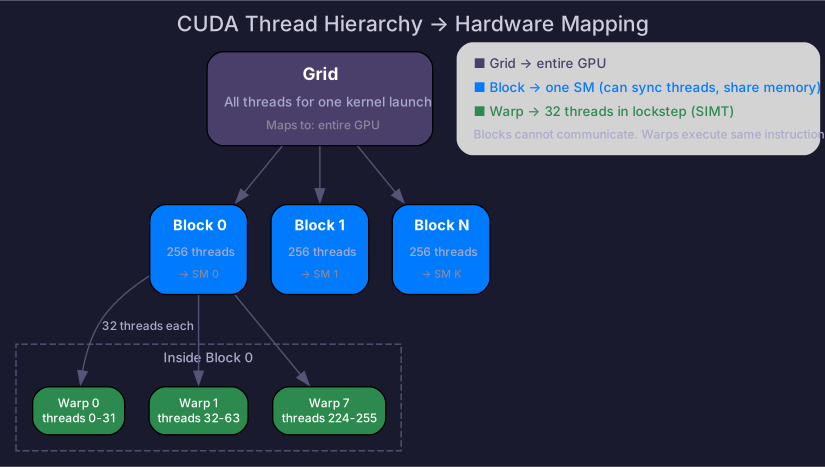
CUDA organizes threads in a three-level hierarchy that maps directly to hardware:
Kernel Launch
└── Grid (all threads for this kernel)
    ├── Block 0
    │   ├── Thread 0, 1, 2, ... 255
    │   └── (scheduled onto one SM)
    ├── Block 1
    │   ├── Thread 0, 1, 2, ... 255
    │   └── (scheduled onto one SM)
    └── Block N
└── ...| Level | Hardware mapping | Size limit | Can synchronize? |
|---|---|---|---|
| Grid | Entire GPU | Up to 2³¹ - 1 blocks | No (across blocks) |
| Block | One SM | Up to 1024 threads | Yes (__syncthreads()) |
| Thread | One CUDA Core | — | — |
| Warp (implicit) | 32 consecutive threads in a block | Always 32 | Lockstep (SIMT) |
Key constraint: Threads within a block can synchronize and share memory. Threads in different blocks cannot communicate (except through global memory with atomics).
Dimensions
Grids and blocks can be 1D, 2D, or 3D:
// 1D: process a vector
dim3 grid(numBlocks);
dim3 block(256);

// 2D: process a matrix
dim3 grid(width / 16, height / 16);
dim3 block(16, 16);  // 256 threads total

// 3D: process a volume
dim3 grid(X/8, Y/8, Z/8);
dim3 block(8, 8, 8);  // 512 threads total
3. Thread Indexing
Every thread knows its position through built-in variables:
| Variable | Meaning |
|---|---|
threadIdx.x/y/z | Thread index within its block |
blockIdx.x/y/z | Block index within the grid |
blockDim.x/y/z | Number of threads per block (in each dimension) |
gridDim.x/y/z | Number of blocks in the grid (in each dimension) |
1D Global Index
int idx = blockIdx.x * blockDim.x + threadIdx.x;For grid of 4 blocks, 256 threads each:
- Block 0, Thread 0 → idx = 0
- Block 0, Thread 255 → idx = 255
- Block 1, Thread 0 → idx = 256
- Block 3, Thread 255 → idx = 1023
2D Global Index (for matrices)
int row = blockIdx.y * blockDim.y + threadIdx.y;
int col = blockIdx.x * blockDim.x + threadIdx.x;
int idx = row * width + col;  // linear index into row-major matrix
Grid-Stride Loop
When there are more data elements than threads, use a grid-stride loop:
__global__ void add(float* a, float* b, float* c, int N) {
    int idx = blockIdx.x * blockDim.x + threadIdx.x;
    int stride = blockDim.x * gridDim.x;  // total number of threads

    for (int i = idx; i < N; i += stride) {
        c[i] = a[i] + b[i];
    }
}
This pattern handles any data size with any grid configuration — essential for production kernels.
4. Kernel Launch Syntax
// Triple angle brackets: <<<grid_size, block_size, shared_mem, stream>>>
kernel<<<numBlocks, threadsPerBlock>>>(args...);

// With shared memory and stream
kernel<<<grid, block, sharedMemBytes, stream>>>(args...);
Complete Example: Vector Addition
__global__ void vecAdd(float* A, float* B, float* C, int N) {
    int i = blockIdx.x * blockDim.x + threadIdx.x;
    if (i < N) {
        C[i] = A[i] + B[i];
    }
}

int main() {
    int N = 1000000;
    float *d_A, *d_B, *d_C;

    // Allocate GPU memory
    cudaMalloc(&d_A, N * sizeof(float));
    cudaMalloc(&d_B, N * sizeof(float));
    cudaMalloc(&d_C, N * sizeof(float));

    // Copy input to GPU
    cudaMemcpy(d_A, h_A, N * sizeof(float), cudaMemcpyHostToDevice);
    cudaMemcpy(d_B, h_B, N * sizeof(float), cudaMemcpyHostToDevice);

    // Launch kernel
    int threadsPerBlock = 256;
    int numBlocks = (N + threadsPerBlock - 1) / threadsPerBlock;
    vecAdd<<<numBlocks, threadsPerBlock>>>(d_A, d_B, d_C, N);

    // Copy result back
    cudaMemcpy(h_C, d_C, N * sizeof(float), cudaMemcpyDeviceToHost);

    // Free GPU memory
    cudaFree(d_A); cudaFree(d_B); cudaFree(d_C);
}
Block Size Selection
| Block size | Pros | Cons |
|---|---|---|
| 32 (1 warp) | Simple, no intra-block sync needed | Low occupancy on most GPUs |
| 128 | Good balance, 4 warps | — |
| 256 | Most common default, 8 warps | — |
| 512 | Higher occupancy potential | More register pressure |
| 1024 (max) | Maximum threads per block | Severe register/shared memory pressure |
Rule of thumb: Start with 256 threads per block. Profile and adjust only if occupancy analysis shows a better option.
5. Warps and Synchronization
Warps: 32 Threads in Lockstep
The GPU groups every 32 consecutive threads in a block into a warp — the actual unit of execution. All 32 threads execute the same instruction each cycle (SIMT). If threads in a warp take different branches, both paths execute sequentially with masked threads — warp divergence.
Warps, divergence, occupancy, and scheduling are covered in depth in Warp Execution & Scheduling.
Block-Level Synchronization
Threads within a block can synchronize using __syncthreads():
__shared__ float tile[256];
tile[threadIdx.x] = globalData[idx];  // all threads write
__syncthreads();                       // WAIT: all threads must reach here
float val = tile[255 - threadIdx.x]; // safe to read others' dataRules:
- All threads in the block must reach the same
__syncthreads()call (no conditional sync) - Only works within a block — there is no synchronization between blocks (except kernel completion)
- Needed whenever one thread reads data written by another thread in the same block
6. Error Handling
CUDA operations are asynchronous — errors may not appear immediately. Always check.
The CUDA_CHECK Macro (Use This Everywhere)
#define CUDA_CHECK(call) do { \
    cudaError_t err = call; \
    if (err != cudaSuccess) { \
        fprintf(stderr, "CUDA error at %s:%d: %s\n", \
                __FILE__, __LINE__, cudaGetErrorString(err)); \
        exit(EXIT_FAILURE); \
    } \
} while(0)

// Usage:
CUDA_CHECK(cudaMalloc(&d_A, size));
CUDA_CHECK(cudaMemcpy(d_A, h_A, size, cudaMemcpyHostToDevice));

// For kernel launches (two checks needed):
kernel<<<grid, block>>>(args);
CUDA_CHECK(cudaGetLastError());        // catches launch config errors
CUDA_CHECK(cudaDeviceSynchronize());   // catches execution errors
Always use this macro in every CUDA project. Silent CUDA errors are debugging nightmares — they produce wrong results without crashing.
Self-Check
- Draw the Grid → Block → Thread hierarchy and explain what maps to hardware
- Calculate the global thread index for a 2D grid
- Explain why block size should typically be a multiple of 32
- Implement a grid-stride loop and explain why it’s needed
- Explain warp divergence and its performance cost
- Use
__shfl_down_syncto perform a warp-level reduction - Explain why CUDA operations are asynchronous and how to check for errors