Occupancy & Resource Allocation
How registers, shared memory, and block size determine occupancy — calculation examples, the occupancy API, and why 100% isn't always optimal.
Occupancy determines how many warps can run simultaneously on an SM, which determines how effectively the GPU hides memory latency. This chapter covers the resource model, worked calculations, and the counterintuitive truth that maximum occupancy isn’t always maximum performance.
1. What Occupancy Means
H100: maximum 64 warps (2048 threads) per SM. If your kernel can only run 32 warps per SM, occupancy is 50%.
Why it matters: More active warps → more warps available for the scheduler to switch between → better latency hiding when warps stall on memory accesses.
2. SM Resource Budget
Each SM has a fixed pool of resources. Blocks (and their warps) are assigned to an SM until any resource is exhausted:
| Resource | H100 per SM | A100 per SM | Shared across |
|---|---|---|---|
| Max threads | 2048 | 2048 | All blocks on the SM |
| Max warps | 64 | 64 | All blocks |
| Max blocks | 32 | 32 | — |
| Registers | 65,536 (256 KB) | 65,536 (256 KB) | All threads on the SM |
| Shared memory | 228 KB | 164 KB | All blocks on the SM |
| Max registers/thread | 255 | 255 | — |
| Max threads/block | 1024 | 1024 | — |
Resource Allocation is Per-Block
When a block is assigned to an SM:
- Its registers are deducted from the SM register pool (per-thread × threads-in-block)
- Its shared memory is deducted from the SM shared memory pool
- Its thread slots are deducted from the SM thread limit
The SM keeps accepting blocks until any one resource would be exceeded.
3. The Three Limiters
Limiter 1: Registers
Registers per SM: 65,536
Registers per thread: 48 (example)
Threads per block: 256

Registers consumed per block: 48 × 256 = 12,288
Max blocks by registers: 65,536 / 12,288 = 5 blocks
Active warps: 5 × 8 = 40 → Occupancy: 40/64 = 62.5%
If registers per thread = 96:
Registers per block: 96 × 256 = 24,576
Max blocks: 65,536 / 24,576 = 2 blocks
Active warps: 2 × 8 = 16 → Occupancy: 25% ← register-limited!
Limiter 2: Shared Memory
Shared memory per SM: 228 KB
Shared memory per block: 48 KB

Max blocks by shared memory: 228 / 48 = 4 blocks
Active warps: 4 × 8 = 32 → Occupancy: 50%
Limiter 3: Block Size
Max threads per SM: 2048
Threads per block: 512

Max blocks: 2048 / 512 = 4 blocks
Active warps: 4 × 16 = 64 → Occupancy: 100%

But if threads per block = 1024:
Max blocks: 2048 / 1024 = 2 blocks
Active warps: 2 × 32 = 64 → Still 100% (larger blocks, fewer of them)
4. Worked Example: Finding the Bottleneck
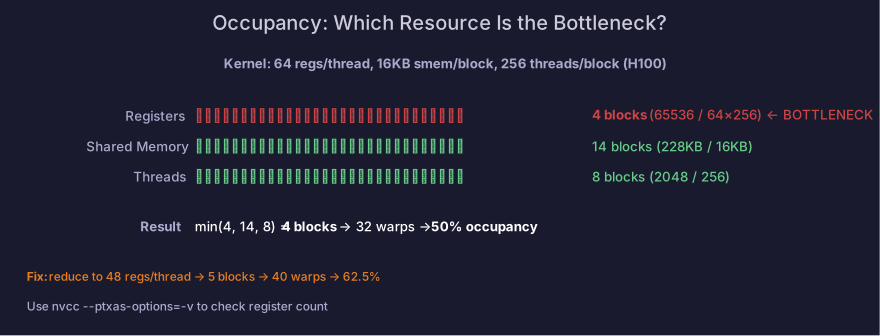
A kernel uses 64 registers/thread, 16 KB shared memory/block, 256 threads/block:
| Resource | Limit | Blocks allowed |
|---|---|---|
| Registers | 65,536 / (64 × 256) = 4 | 4 |
| Shared memory | 228 KB / 16 KB = 14 | 14 |
| Threads | 2048 / 256 = 8 | 8 |
| Block limit | 32 | 32 |
| Actual | min(4, 14, 8, 32) | 4 (register-limited) |
Occupancy: 4 blocks × 8 warps = 32 active warps / 64 max = 50%
To improve: reduce register usage. If we get to 48 registers/thread:
- 65,536 / (48 × 256) = 5 blocks → 40 warps → 62.5%
5. Using the Occupancy API
Compile-Time Analysis
nvcc --ptxas-options=-v kernel.cu
# Output: Used 48 registers, 16384 bytes smem, 0 bytes cmem
Runtime Optimal Block Size
int minGridSize, bestBlockSize;
cudaOccupancyMaxPotentialBlockSize(
    &minGridSize, &bestBlockSize,
    myKernel,
    0,    // dynamic shared mem (0 if static)
    0     // block size limit (0 = no limit)
);
printf("Optimal block size: %d, min grid: %d\n", bestBlockSize, minGridSize);
Runtime Occupancy Query
int maxActiveBlocks;
cudaOccupancyMaxActiveBlocksPerMultiprocessor(
    &maxActiveBlocks, myKernel, blockSize, sharedMemSize
);
float occupancy = (float)(maxActiveBlocks * blockSize / 32) / 64.0f;
printf("Occupancy: %.1f%%\n", occupancy * 100);
6. When High Occupancy Doesn’t Help
Compute-Bound Kernels
If a kernel has high arithmetic intensity (large GEMM), every warp is busy computing — there’s nothing to hide. More warps just compete for the same compute units.
Example: A GEMM kernel at 25% occupancy achieves 90% of peak TFLOPS because it’s compute-bound. Increasing to 50% occupancy doesn’t improve throughput — it just adds register pressure.
Diminishing Returns
Going from 25% → 50% occupancy can give 2× speedup (for memory-bound kernels). Going from 50% → 100% typically gives <20% improvement — once you have ~30 active warps, the scheduler has enough to keep the pipeline full.
The Tradeoff
Higher occupancy often requires:
- Fewer registers per thread → more register spilling → slower
- Less shared memory per block → less data reuse → slower
The optimal point: enough occupancy to hide latency, but not so much that you sacrifice per-thread efficiency.
Rule of thumb: Profile at 50% and 100% occupancy. If the difference is <10%, keep the lower occupancy (fewer registers = faster per-thread execution).
7. Occupancy Optimization Strategies
| Strategy | Effect on occupancy | Tradeoff |
|---|---|---|
Reduce registers (-maxrregcount=N) | ↑ More threads fit | May cause spilling |
| Reduce shared memory | ↑ More blocks fit | Less data reuse |
| Reduce block size | ↑ or ↓ depending | Fewer warps per block |
Use __launch_bounds__ | Compiler optimizes for target | Limits flexibility |
// Tell compiler to optimize for 256 threads, at least 4 blocks per SM
__global__ __launch_bounds__(256, 4)
void myKernel(...) { ... }
Self-Check
- Define occupancy and explain why it matters for latency hiding
- Calculate occupancy given register count, shared memory, and block size
- Identify which resource (registers, shared memory, threads) is the bottleneck
- Use
cudaOccupancyMaxPotentialBlockSizeto find the optimal block size - Explain why 100% occupancy can be slower than 50% for compute-bound kernels
- Use
__launch_bounds__to help the compiler optimize