Communication Primitives
Point-to-point send/recv and the five key collectives — Broadcast, AllReduce, AllGather, ReduceScatter, All-to-All — what data moves and how much.
Before understanding distributed training or inference, you need the vocabulary of multi-GPU communication. There are only 7 operations — learn these and you can analyze any parallelism strategy.
1. Point-to-Point: The Foundation
The simplest operation: one GPU sends data to another.
# GPU 0 sends tensor to GPU 1
if rank == 0:
    dist.send(tensor, dst=1)
elif rank == 1:
    dist.recv(tensor, src=0)
All collective operations are built from point-to-point sends under the hood. But you rarely use point-to-point directly — collectives are more efficient.
2. The Five Key Collectives
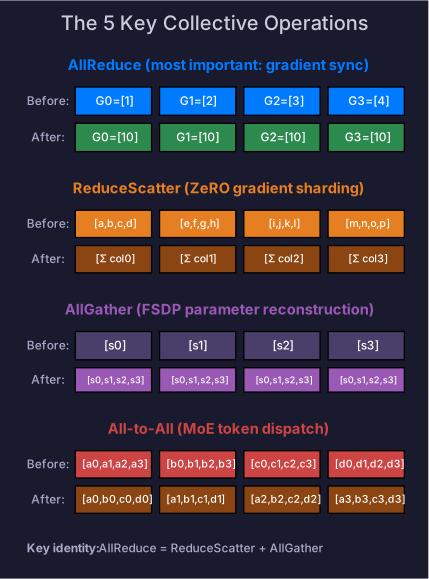
Broadcast: One → All
One GPU’s data is copied to all GPUs:
Before:  GPU0=[A]  GPU1=[_]  GPU2=[_]  GPU3=[_]
After:   GPU0=[A]  GPU1=[A]  GPU2=[A]  GPU3=[A]
Use case: Distributing model weights from GPU 0 to all GPUs at initialization.
Data moved: bytes × copies, where = tensor size, = GPU count.
Reduce: All → One
All GPUs contribute data, reduced (summed/averaged) to one GPU:
Before:  GPU0=[1]  GPU1=[2]  GPU2=[3]  GPU3=[4]
After:   GPU0=[10] GPU1=[_]  GPU2=[_]  GPU3=[_]   (sum = 10)
Use case: Rare in practice — AllReduce is almost always preferred.
AllReduce: All → Reduce → All ⭐
The most important collective in AI. All GPUs contribute, result available on all GPUs:
Before:  GPU0=[1]  GPU1=[2]  GPU2=[3]  GPU3=[4]
After:   GPU0=[10] GPU1=[10] GPU2=[10] GPU3=[10]  (sum on every GPU)
Use case: Gradient synchronization in data parallelism. Each GPU computes gradients on its data shard, AllReduce averages gradients across all GPUs, then every GPU has the same averaged gradient for the optimizer step.
The fundamental identity:
This decomposition is how NCCL actually implements AllReduce, and it’s the basis for ZeRO.
ReduceScatter: All → Reduce → Scatter
Reduce all data, then each GPU keeps only its shard of the result:
Before:  GPU0=[a0,a1,a2,a3]  GPU1=[b0,b1,b2,b3]  GPU2=[c0,c1,c2,c3]  GPU3=[d0,d1,d2,d3]
After:   GPU0=[a0+b0+c0+d0]  GPU1=[a1+b1+c1+d1]  GPU2=[a2+b2+c2+d2]  GPU3=[a3+b3+c3+d3]
Each GPU gets 1/P of the total reduced result.
Use case: ZeRO Stage 1-3. After backward pass, ReduceScatter gives each GPU the averaged gradient shard it needs for its optimizer partition.
AllGather: Scattered → All
The inverse of ReduceScatter — each GPU has a shard, AllGather assembles the full tensor on all GPUs:
Before:  GPU0=[s0]  GPU1=[s1]  GPU2=[s2]  GPU3=[s3]
After:   GPU0=[s0,s1,s2,s3]  GPU1=[s0,s1,s2,s3]  GPU2=[s0,s1,s2,s3]  GPU3=[s0,s1,s2,s3]
Use case: FSDP/ZeRO-3 forward pass. Parameters are sharded — before each layer, AllGather reconstructs the full parameters from all GPUs’ shards.
All-to-All: Everyone → Everyone (Different)
Each GPU sends a different piece to each other GPU:
Before:  GPU0=[a0,a1,a2,a3]  GPU1=[b0,b1,b2,b3]
After:   GPU0=[a0,b0]        GPU1=[a1,b1]
         GPU2=[a2,b2]        GPU3=[a3,b3]
GPU receives the -th piece from every GPU.
Use case: Expert parallelism (MoE). Tokens must be dispatched to the GPU holding their selected expert. Each GPU sends different tokens to different expert-GPUs.
3. Communication Volume Summary
For GPUs, each with bytes of data:
| Collective | Per-GPU send | Per-GPU receive | Total data moved |
|---|---|---|---|
| Broadcast | (from root) | (to each) | |
| Reduce | (from each) | (to root) | |
| AllReduce | |||
| ReduceScatter | |||
| AllGather | |||
| All-to-All |
Key insight: AllReduce moves twice the data of ReduceScatter or AllGather individually — because it’s ReduceScatter + AllGather combined. But for large messages, the per-GPU volume scales as — nearly independent of GPU count. This is why distributed training scales.
4. Where Each Collective Appears in AI
| Parallelism strategy | Primary collective | When |
|---|---|---|
| Data Parallel (DDP) | AllReduce | Gradient sync after backward |
| ZeRO Stage 1 | ReduceScatter | Gradient sharding |
| ZeRO Stage 3 / FSDP | AllGather + ReduceScatter | Parameter gather (forward) + gradient scatter (backward) |
| Tensor Parallel | AllReduce | After each TP layer (column/row parallel) |
| Pipeline Parallel | Point-to-point | Activation transfer between stages |
| Expert Parallel (MoE) | All-to-All | Token dispatch to/from experts |
| Context Parallel | AllGather or Ring | KV sharing across sequence chunks |
Understanding which collective each strategy uses tells you the communication cost — and where the bottleneck will be.
Self-Check
- Name the 5 key collectives and draw the before/after data distribution for each
- Explain why AllReduce = ReduceScatter + AllGather
- Calculate per-GPU communication volume for AllReduce with P GPUs and N bytes
- Explain why AllReduce volume is nearly independent of GPU count for large messages
- Map each parallelism strategy to its primary collective operation
- Explain why All-to-All is needed for MoE but not for dense models