Pipeline Parallelism
Splitting layers across stages — GPipe, 1F1B, interleaved schedules, and the bubble problem.
Pipeline parallelism (PP) partitions the model’s layers across GPUs in stages. GPU 0 runs layers 0-9, GPU 1 runs layers 10-19, etc. Data flows through the pipeline like an assembly line — but the “bubble” (idle time) at the start and end is the key challenge.
1. The Core Idea
Stage 0 (GPU 0): Layers 0-9       Stage 1 (GPU 1): Layers 10-19
  Input → [L0-L9] → activations →   [L10-L19] → activations →
                                      ...
Stage 2 (GPU 2): Layers 20-29     Stage 3 (GPU 3): Layers 30-39
→ [L20-L29] → activations → [L30-L39] → outputCommunication: Only point-to-point between adjacent stages — send activations forward, send gradients backward. Much less communication than TP (no AllReduce).
Memory per GPU: Each GPU holds only layers’ weights, gradients, and optimizer states. Memory splits linearly with PP degree.
2. The Bubble Problem
If we process one batch at a time, most GPUs are idle most of the time:
         Micro-batch 0 (forward then backward)
Stage 0: [F0]                         [B0]
Stage 1:      [F0]               [B0]
Stage 2:           [F0]     [B0]
Stage 3:                [F0][B0]
         ^^^^^^^ bubble: GPU 0 idle while other stages run ^^^^^^^
Bubble fraction: With stages and 1 micro-batch: . For : 75% of GPU time is idle. Unacceptable.
3. Micro-Batching: Filling the Pipeline
Split the batch into micro-batches and pipeline them:
GPipe Schedule
Process all micro-batch forwards first, then all backwards:
Stage 0: [F0][F1][F2][F3]                   [B3][B2][B1][B0]
Stage 1:      [F0][F1][F2][F3]         [B3][B2][B1][B0]
Stage 2:           [F0][F1][F2][F3][B3][B2][B1][B0]
Stage 3:                [F0][F1][F2][F3][B3][B2][B1][B0]
Bubble: . With : . Better, but still significant.
Memory issue: All micro-batches’ activations must be stored during forward for backward → activation memory.
1F1B (One Forward, One Backward)
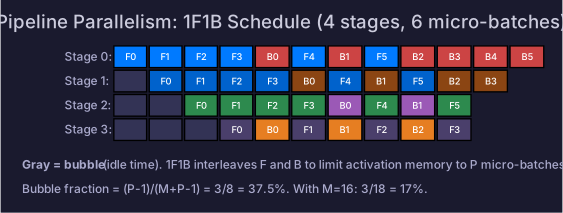
Interleave forward and backward passes:
Stage 0: [F0][F1][F2][F3][B0][F4][B1][F5][B2][F6][B3][B4][B5][B6]
Stage 1:      [F0][F1][F2][B0][F3][B1][F4][B2][F5][B3][B4][B5]
Stage 2:           [F0][F1][B0][F2][B1][F3][B2][F4][B3][B4]
Stage 3: [F0][B0][F1][B1][F2][B2][F3][B3]Advantage: Each stage keeps at most micro-batches’ activations in memory (not ), because backward frees activations as it goes.
Bubble: Same as GPipe — . But memory is much better.
Interleaved 1F1B (Virtual Stages)
Each GPU handles multiple non-contiguous stages (e.g., GPU 0 handles stages 0 and 4):
Physical GPU 0: Stage 0 (Layers 0-4) + Stage 4 (Layers 20-24)
Physical GPU 1: Stage 1 (Layers 5-9) + Stage 5 (Layers 25-29)
...Bubble: where = virtual stages per GPU. With : bubble halves.
Tradeoff: More point-to-point communication (stages are non-contiguous), but significantly less bubble time.
4. Communication
| Communication | Volume | Frequency |
|---|---|---|
| Activations (forward) | bytes per micro-batch | Once per stage boundary |
| Gradients (backward) | Same size | Once per stage boundary |
For , BF16: MB per transfer.
On InfiniBand (50 GB/s): 64 MB / 50 GB/s = 1.3 ms per transfer. With 4 stages: 3 boundaries × 1.3 ms = 3.9 ms per micro-batch direction. Acceptable on InfiniBand — this is why PP can be inter-node.
5. Pipeline Parallelism in Practice
# Megatron-LM / DeepSpeed
args.pipeline_model_parallel_size = 4    # 4 stages
args.num_micro_batches = 8                # 8 micro-batches per step
args.virtual_pipeline_model_parallel_size = 2  # interleaved
PP uses only point-to-point communication (low bandwidth), unlike TP which needs AllReduce (high bandwidth). This is why PP can go inter-node while TP must stay intra-node.
When to Use PP
| Condition | Use PP? |
|---|---|
| Model fits on one node with TP | No — TP + DP is enough |
| Model too large for one node | Yes — PP across nodes, TP within node |
| Communication bandwidth is low | Yes — PP needs only point-to-point (less than TP’s AllReduce) |
| Need to minimize latency | No — PP adds pipeline startup latency |
Typical composition: DP × PP × TP. Example: 256 GPUs = DP=8 × PP=4 × TP=8.
Self-Check
- Draw the pipeline bubble for 4 stages with 1 micro-batch
- Calculate the bubble fraction for GPipe with P stages and M micro-batches
- Explain the memory advantage of 1F1B over GPipe
- Explain interleaved stages and how they reduce the bubble
- Calculate point-to-point communication volume between PP stages
- Explain why PP can be inter-node while TP must be intra-node