Tensor Parallelism
Splitting weight matrices within a layer across GPUs — column/row parallel for attention and FFN, with AllReduce per layer.
When a model’s individual layers are too large for one GPU’s memory — or when you need lower latency than data parallelism provides — tensor parallelism splits each layer’s weight matrices across GPUs. Every GPU computes a portion of every layer, requiring AllReduce synchronization at each layer boundary.
1. The Core Idea
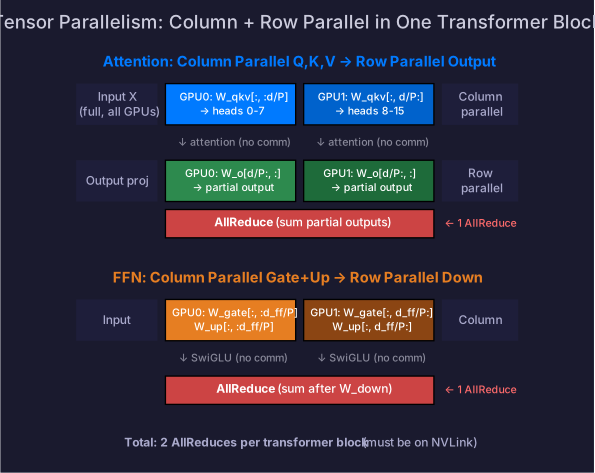
Instead of replicating the full weight matrix on every GPU, split it:
Column Parallel (split output dimension): Each GPU holds columns of , computes a slice of the output.
W = [W₀ | W₁ | W₂ | W₃]    (split across 4 GPUs)
Y₀ = X @ W₀  (GPU 0)        Y = [Y₀, Y₁, Y₂, Y₃]  (concatenate)
Y₁ = X @ W₁  (GPU 1)
Row Parallel (split input dimension): Each GPU holds rows of , computes with its slice of the input.
W = [W₀]     X = [X₀, X₁, X₂, X₃]    (input already split)
    [W₁]
    [W₂]     Y = X₀@W₀ + X₁@W₁ + X₂@W₂ + X₃@W₃  (AllReduce sum)
    [W₃]
2. TP for Transformer Layers
Attention (Column → Row)
Q, K, V projections:  Column parallel (each GPU gets N_h/P heads)
  → Each GPU computes attention for its own heads (no communication)
Output projection:     Row parallel
  → AllReduce to combine results

Communication: 1 AllReduce per attention layer
FFN (Column → Row)
Gate + Up projection: Column parallel (split d_ff across GPUs)
  → Each GPU computes its slice of the intermediate
Down projection:      Row parallel
  → AllReduce to combine

Communication: 1 AllReduce per FFN layer
Total per transformer block: 2 AllReduces (one for attention, one for FFN).
3. Communication Cost
Per block: 2 AllReduces of size in BF16:
For , BF16 on 8 GPUs with NVLink (450 GB/s):
32 blocks: ~4.2 ms total communication. If computation takes ~50 ms, that’s 8% overhead — acceptable on NVLink.
On InfiniBand (50 GB/s): same calculation gives ~38 ms → 43% overhead. TP across nodes is impractical — always keep TP intra-node.
TP always pairs with Sequence Parallelism to save activation memory. For AllReduce cost analysis, see Communication Cost Analysis.
4. Memory Savings
With TP degree :
- Weight memory per GPU: (each GPU holds 1/P of the weights)
- Activation memory: same (input/output activations are full-size)
- KV cache: per head (if heads are split)
For a 70B model with TP=8: GB weights per GPU. Fits easily on one H100.
5. TP in Practice
# Megatron-LM style TP
from megatron.core import tensor_parallel

# Column parallel linear
self.qkv_proj = tensor_parallel.ColumnParallelLinear(
    hidden_size, 3 * hidden_size, bias=False,
    gather_output=False  # keep split for attention computation
)

# Row parallel linear
self.out_proj = tensor_parallel.RowParallelLinear(
    hidden_size, hidden_size, bias=False,
    input_is_parallel=True  # input is already split across GPUs
)
When to Use TP
| Condition | Use TP? |
|---|---|
| Model fits on one GPU | No — use DP only |
| Model too large, have NVLink | Yes — TP within the node |
| Need low per-request latency | Yes — TP reduces per-GPU compute per layer |
| Only InfiniBand (no NVLink) | No — TP communication is too expensive |
Self-Check
- Explain column parallel vs row parallel and which layers use which
- Calculate the number of AllReduces per transformer block with TP
- Calculate TP communication time on NVLink vs InfiniBand
- Explain why TP must stay intra-node (NVLink requirement)
- Explain memory savings from TP and what is NOT reduced (activations)