Communication Overhead Estimation
Predicting AllReduce, P2P, and All-to-All times for different parallelism strategies on NVLink and InfiniBand — with formulas and practical numbers.
Memory determines if a configuration fits. Communication determines how fast it runs. This chapter gives you the formulas and practical numbers to predict communication overhead before running a single experiment.
1. The Communication Budget Framework
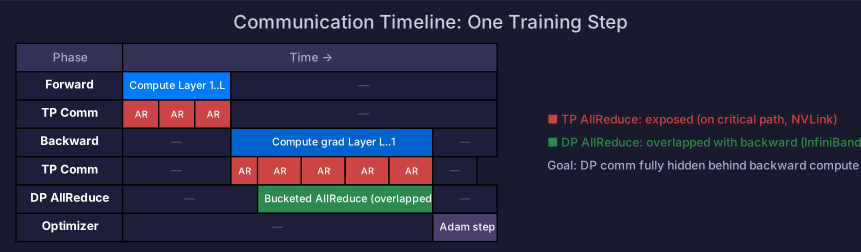
Each training step has communication from multiple parallelism dimensions. The total exposed overhead depends on what can be overlapped with compute:
| Communication | When it happens | Can overlap with… | Typical approach |
|---|---|---|---|
| TP AllReduce | After every layer | Nothing (on critical path) | Keep on NVLink |
| DP AllReduce | After backward | Backward compute (bucket by bucket) | Overlap with backward |
| PP P2P send/recv | Between micro-batches | Other micro-batch compute | Interleave 1F1B |
| EP All-to-All | Every MoE layer | Nothing (on critical path) | Keep on NVLink |
Key insight: TP and EP communication is exposed (can’t be hidden), so it must be fast (NVLink). DP communication is overlappable, so it can tolerate slower networks (InfiniBand).
2. Tensor Parallel Communication
Per-Layer Cost
Each Transformer layer with TP does 2 AllReduce operations (one for attention output, one for FFN output):
The factor of inside the AllReduce formula is from the ring AllReduce algorithm ( for large messages).
Worked Example: 70B, TP=8, NVLink 4.0
- , , ,
- Message size per AllReduce: MB
- Ring AllReduce time: ms per AllReduce
- Per layer: ms
- All 80 layers: ms total TP communication per step
What If TP Crosses Node Boundaries?
Same calculation but with InfiniBand (50 GB/s per NIC, ~100 GB/s aggregate for TP traffic):
That’s 9× slower than NVLink — this is why TP must stay intra-node.
3. Data Parallel Communication
Per-Step Cost
DP AllReduce synchronizes gradients once per training step:
Where is the parameter count after TP/PP sharding, and is the inter-node bandwidth.
Worked Example: 70B, TP=8, DP=32
- Parameters per GPU: 70B / 8 = 8.75B
- Gradient size: 8.75B × 2 bytes = 17.5 GB
- Ring AllReduce on IB NDR: ms
- Backward compute time (estimated): ~500 ms for 70B on H100
Overlap analysis: With gradient bucketing, NCCL starts AllReduce as soon as the last layer’s gradients are ready, while backward continues for earlier layers. If backward takes 500 ms and AllReduce takes 87.5 ms, the AllReduce is fully hidden — zero exposed overhead.
But if AllReduce > backward time, the excess is exposed:
When DP Overlap Fails
- Small models on many GPUs: 7B on 256 GPUs → gradients are tiny (0.25 GB per GPU), but AllReduce latency dominates
- Very large DP degree: Ring AllReduce latency scales as for tree, O(n) for ring start-up
- Network congestion: If IB is oversubscribed, actual bandwidth < theoretical
4. Pipeline Parallel Communication
Per-Micro-Batch Cost
PP sends/receives activation tensors between pipeline stages:
Worked Example: 70B, PP=4
- Activation tensor: MB
- IB NDR (one NIC): ms per send
With 1F1B schedule and micro-batches:
- Pipeline bubble: fraction of time wasted
- For PP=4, : bubble = 3/16 = 18.75% overhead
PP communication itself is fast (1.28 ms), but the pipeline bubble is the real cost. Use enough micro-batches to minimize it.
5. Expert Parallel Communication
Per-MoE-Layer Cost
EP does All-to-All to route tokens to experts:
This is complex because the traffic pattern depends on the routing decisions. Worst case: every token goes to an expert on a different GPU.
Worked Example: DeepSeek-V3 (671B MoE)
- 256 experts, top-2 routing, EP=64
- Per expert per token: KB
- Tokens per step:
- Total traffic: MB (dispersed across 64 GPUs)
- On NVLink (within node): ~0.25 ms
- On IB (across nodes): ~4.5 ms
This is why DeepSeek uses TP=4 (not 8) — they need to keep EP on NVLink within the 8-GPU node, using the remaining 2× for EP.
6. Summary: Communication Time Budget
For a complete training step with TP=8, PP=4, DP=8 on 256 H100 GPUs training 405B:
| Communication | Time | Overlapped? | Exposed |
|---|---|---|---|
| TP AllReduce (80 layers, NVLink) | ~22 ms | No | 22 ms |
| PP P2P (16 micro-batches, IB) | ~20 ms | With other micro-batches | ~4 ms (bubble) |
| DP AllReduce (IB) | ~100 ms | With backward | ~0 ms (fully overlapped) |
| Total exposed | ~26 ms | ||
| Compute per step | ~500 ms | ||
| Communication fraction | ~5% ✅ |
Target: < 10% of step time in communication. If higher, adjust parallelism.
7. Measuring Real Communication
Theory gives estimates. Validate with real measurements:
# NCCL AllReduce benchmark
mpirun -np 16 -H node0:8,node1:8 \
  ./nccl-tests/build/all_reduce_perf -b 1M -e 1G -f 2 -g 1

# Look for "busbw" column — this is the algorithm bandwidth
# H100 NVLink: expect ~850 GB/s busbw
# H100 IB NDR 8×: expect ~380 GB/s busbw

# PyTorch profiler with comm breakdown
with torch.profiler.profile(
    activities=[torch.profiler.ProfilerActivity.CUDA],
    record_shapes=True,
    profile_memory=True,
) as prof:
    train_step()

# Look for nccl:allReduce, nccl:send, nccl:recv in the trace
For profiling setup, see PyTorch Profiler.
Self-Check
- Calculate TP AllReduce time per layer on NVLink for a given model
- Explain why TP on InfiniBand is 9× slower and must stay intra-node
- Calculate DP AllReduce time and determine if it overlaps with backward
- Identify when DP overlap fails (small models, large DP degree)
- Calculate pipeline bubble fraction for a given PP degree and micro-batch count
- Estimate EP All-to-All time for a MoE model
- Use nccl-tests to validate theoretical bandwidth