Decision Process
The systematic approach to choosing TP/PP/DP/EP — fit check, minimum TP, communication budget, memory verification, and process group setup.
Given a model and a cluster, how do you choose the parallelism configuration? This chapter provides the systematic process — not guesswork, but a deterministic algorithm that any AI infrastructure engineer can follow. Then we show how the chosen configuration maps to PyTorch process groups.
1. The Inputs
You need three things:
| Input | What you need | Example |
|---|---|---|
| Model | Parameter count, architecture, MoE config | 70B dense, GQA-8, 80 layers, d=8192 |
| Cluster | GPU count, memory, NVLink/IB bandwidth | 32× H100 SXM (80 GB), NVLink 4.0, IB NDR |
| Target | Throughput, latency, or training time | Train on 2T tokens in 30 days |
2. The Six-Step Algorithm
Step 1: Can the Model Fit on One GPU?
Training memory per parameter (BF16 mixed precision + AdamW):
| Component | Precision | Bytes per param | Purpose |
|---|---|---|---|
| Parameters | BF16 | 2Ψ | Forward/backward working copy |
| Gradients | BF16 | 2Ψ | Backward output |
| FP32 master weights | FP32 | 4Ψ | Optimizer’s high-precision copy |
| Adam first moment (m) | FP32 | 4Ψ | Exponential moving average of gradients |
| Adam second moment (v) | FP32 | 4Ψ | EMA of squared gradients |
| Static total | 16Ψ | Without activations |
Key insight from optimizer accounting: The optimizer states alone (12Ψ) consume 75% of static training memory. This is exactly why ZeRO/FSDP shards optimizer states first — it’s the highest-ROI optimization.
Adding activation memory (depends on batch size , sequence length , hidden dimension , layers ):
where depends on whether activation checkpointing is used (roughly without checkpointing, with full checkpointing for a Transformer layer).
| Model | Static (16Ψ) | On 80 GB GPU? |
|---|---|---|
| 7B | 112 GB | ❌ (needs FSDP or TP) |
| 13B | 208 GB | ❌ |
| 70B | 1,120 GB | ❌ |
Surprise: Even a 7B model’s training state (112 GB) doesn’t fit on an 80 GB GPU! But with FSDP (ZeRO-3), the optimizer states and parameters are sharded across all GPUs. With 8 GPUs: 112/8 = 14 GB static per GPU — easily fits.
If sharded training fits on available GPUs: FSDP + DP is sufficient. Skip to Step 4. If model weights alone (2Ψ in BF16) exceed one GPU: Need TP and/or PP.
Step 2: Determine Minimum TP Degree
Round up to the nearest power of 2 that divides the attention head count.
| Model | Weights (BF16) | Min TP (80 GB GPU) | Typical TP |
|---|---|---|---|
| 7B | 14 GB | 1 (fits) | 1 |
| 13B | 26 GB | 1 (fits) | 1-2 |
| 70B | 140 GB | 3 → TP=4 | 4-8 |
| 405B | 810 GB | 15 → TP=8 + PP | 8 + PP=4 |
Constraint: TP ≤ GPUs per node. TP uses NVLink; crossing node boundaries is too slow.
For TP communication patterns (column/row splitting, AllReduce per layer), see Tensor Parallelism.
Step 3: Determine PP Degree (If Needed)
If TP alone doesn’t make the model fit:
| Model | With TP=8 | Memory per GPU | PP needed? |
|---|---|---|---|
| 70B | 140/8 = 17.5 GB | 17.5 GB | No |
| 405B | 810/8 = 101 GB > 80 GB | Overflow | Yes: PP=2 → 50.6 GB |
For PP scheduling (1F1B, interleaved), see Pipeline Parallelism.
Step 4: Assign Remaining GPUs to DP
For 70B on 256 GPUs: TP=8, PP=1 → DP = 256/8 = 32. For 405B on 256 GPUs: TP=8, PP=2 → DP = 256/16 = 16.
Step 5: Verify Communication Budget
Check that communication time ≤ compute time:
| Strategy | Communication per step | Formula |
|---|---|---|
| TP AllReduce | Per layer (very frequent) | |
| DP AllReduce | Per training step (overlapped) | |
| PP P2P | Per micro-batch |
If any check fails → increase TP (if NVLink available), reduce DP, or add PP.
For detailed communication cost formulas, see Communication Overhead Estimation.
Step 6: Add EP for MoE (If Applicable)
EP reduces DP degree:
3. From Configuration to Process Groups
Once you’ve determined (TP, PP, DP), you need to create sub-communication groups in PyTorch so each parallelism dimension has its own independent communication domain.
Why Sub-Groups?
The default process group contains all ranks. But TP AllReduce should only happen within 8 GPUs, not all 256. Each parallelism dimension needs its own group — like separate rehearsal rooms where different ensembles practice independently.
Example: TP=2, DP=4 on 8 GPUs
import torch.distributed as dist

# After init_process_group(backend="nccl")
rank = dist.get_rank()
tp_size, dp_size = 2, 4

# TP groups: ranks that do tensor-parallel together
# {0,1}, {2,3}, {4,5}, {6,7}
tp_group_ranks = [
    list(range(i, i + tp_size))
    for i in range(0, tp_size * dp_size, tp_size)
]

tp_group = None
for ranks in tp_group_ranks:
    group = dist.new_group(ranks=ranks)  # ALL ranks must call this!
    if rank in ranks:
        tp_group = group

# DP groups: same TP-position across TP groups
# {0,2,4,6}, {1,3,5,7}
dp_group_ranks = [
    list(range(i, tp_size * dp_size, tp_size))
    for i in range(tp_size)
]

dp_group = None
for ranks in dp_group_ranks:
    group = dist.new_group(ranks=ranks)
    if rank in ranks:
        dp_group = group

# Usage:
# dist.all_reduce(tensor, group=tp_group)   # TP AllReduce within {0,1}
# dist.all_reduce(grads, group=dp_group) # DP AllReduce within {0,2,4,6}Critical:
new_group()must be called by all processes even if they don’t belong to that group. If any process skips the call, the others will deadlock waiting.
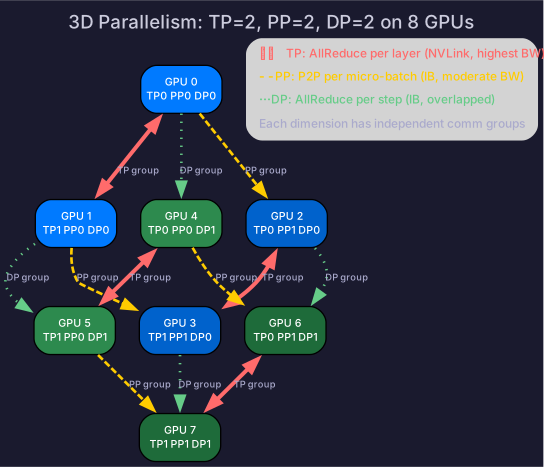
3D Parallelism: Three Dimensions of Groups
For TP=8, PP=4, DP=8 on 256 GPUs:
Rank layout (TP varies fastest, then PP, then DP):
  DP group 0: Ranks   0-31   (TP=8 × PP=4)
  DP group 1: Ranks  32-63
  ...
  DP group 7: Ranks 224-255

Within each DP group:
  PP stage 0: Ranks 0-7   (TP group)
  PP stage 1: Ranks 8-15
  PP stage 2: Ranks 16-23
  PP stage 3: Ranks 24-31

Three communication domains:
  TP group: {0,1,2,3,4,5,6,7}     — NVLink AllReduce per layer
  PP group: {0,8,16,24}           — IB P2P per micro-batch
  DP group: {0,32,64,...,224}     — IB AllReduce per step
Megatron-LM’s mpu.initialize_model_parallel() sets all this up automatically given (tp_size, pp_size, dp_size).
4. Output: The Configuration
| Model | GPUs | TP | PP | DP | EP | CP |
|---|---|---|---|---|---|---|
| 7B training | 8 | 1 | 1 | 8 | — | 1 |
| 70B training | 64 | 8 | 1 | 8 | — | 1 |
| 405B training | 256 | 8 | 4 | 8 | — | 1 |
| DeepSeek-V3 (671B MoE) | 2048 | 4 | — | 8 | 64 | 1 |
| 70B, 128K context | 64 | 8 | 1 | 4 | — | 2 |
Self-Check
- Walk through the 6-step algorithm for a 13B model on 16 GPUs
- Calculate static training memory using the 16Ψ formula
- Explain why optimizer states dominate training memory (12 out of 16 bytes/param)
- Determine when PP is needed on top of TP
- Create TP and DP sub-groups with
dist.new_group()for a given configuration - Explain why
new_group()must be called by all processes