Custom Collectives
MSCCL, NVIDIA Unified Bus, and programmable communication — when standard NCCL isn't enough.
Standard NCCL collectives are general-purpose — they work well for most patterns. But frontier training systems (DeepSeek, Megatron-LM) sometimes need custom communication patterns that NCCL can’t express efficiently. This chapter covers the tools for going beyond standard collectives.
1. When Standard NCCL Isn’t Enough
| Scenario | Problem with standard NCCL | Custom solution |
|---|---|---|
| MoE expert routing | All-to-All doesn’t match irregular token distribution | Custom dispatch with per-expert buffers |
| Pipeline + TP hybrid | Need overlapped send/recv + AllReduce simultaneously | MSCCL programmable schedules |
| Cross-node TP | AllReduce latency too high for per-layer sync | NVIDIA UB (fuse communication into compute) |
| Hierarchical AllReduce | Flat ring doesn’t exploit intra-node NVLink advantage | Two-level: intra-node NVLink ring + inter-node IB tree |
2. MSCCL: Programmable Collectives
MSCCL (Microsoft Collective Communication Library) lets you define custom collective algorithms as XML programs:
<!-- Custom 2-level AllReduce: intra-node ring + inter-node tree -->
<algo name="hierarchical_allreduce">
  <step type="ReduceScatter" gpus="0-7" algo="ring"/>    <!-- NVLink -->
  <step type="AllReduce" gpus="0,8,16,24" algo="tree"/>  <!-- IB, one per node -->
  <step type="AllGather" gpus="0-7" algo="ring"/>         <!-- NVLink -->
</algo>
Why MSCCL Exists
NCCL selects from a fixed set of algorithms (ring, tree). For specific topologies (e.g., Azure’s NDv4 with 8 A100s per node and 8 IB NICs), a custom hierarchical algorithm can be 20-40% faster than NCCL’s default by exploiting the exact topology.
Using MSCCL with NCCL
# MSCCL compiles to NCCL-compatible algorithms
export MSCCL_ALGO_DIR=/path/to/custom_algos
export NCCL_ALGO=MSCCL  # tell NCCL to use MSCCL algorithms
MSCCL is primarily used by cloud providers (Azure) and large training teams. Most users should stick with standard NCCL.
3. NVIDIA Unified Bus (UB)
Unified Bus fuses communication directly into compute kernels — instead of launching a compute kernel and then a communication kernel, a single kernel does both.
The Problem UB Solves
In tensor parallelism, every transformer layer requires:
Compute (GEMM) → AllReduce → Compute (GEMM) → AllReduce → ...With standard NCCL, this is:
[GEMM kernel] [NCCL AllReduce kernel] [GEMM kernel] [NCCL AllReduce kernel]
              ↑ GPU idle while waiting for AllReduce
With Unified Bus:
[GEMM kernel that also does AllReduce as it produces output]
  ↑ communication overlapped with the tail of computation
How It Works
UB enables GEMM kernels to write output tiles directly to remote GPUs’ memory as they’re computed — using NVLink DMA within the compute kernel. No separate communication launch.
Availability
- Integrated into Megatron-LM for tensor-parallel GEMM
- Requires NVLink (intra-node only)
- Used by NVIDIA’s internal training infrastructure and DeepSeek-V3
UB is cutting-edge — most teams don’t need it. It matters for >100B models where tensor parallelism’s AllReduce overhead is the training bottleneck.
4. Hierarchical Communication
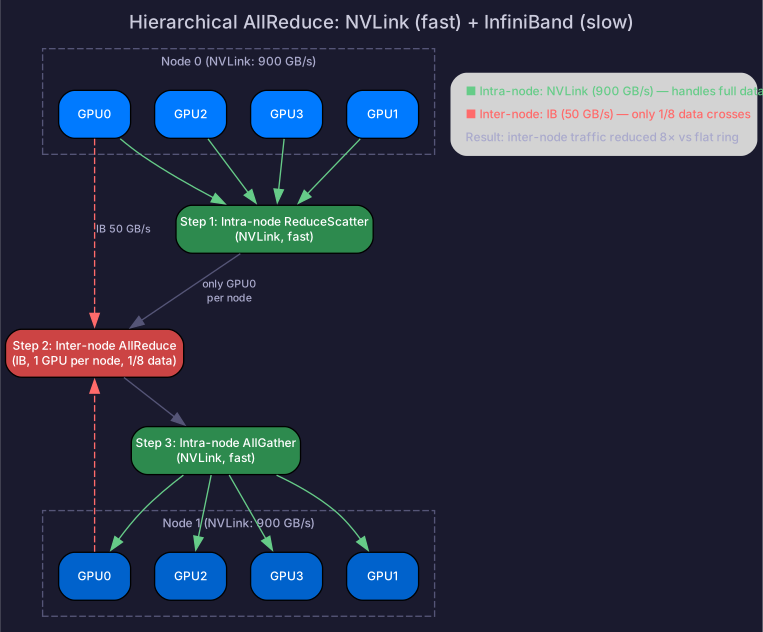
For large clusters, flat algorithms are suboptimal. Hierarchical approaches exploit the bandwidth asymmetry:
Step 1: Intra-node AllReduce (NVLink, 900 GB/s)
  GPU 0-7: ReduceScatter → AllGather (fast, NVLink)

Step 2: Inter-node AllReduce (InfiniBand, 50 GB/s per NIC)
  Node 0 GPU 0 ↔ Node 1 GPU 0 ↔ Node 2 GPU 0 ↔ ...
  (one representative per node, slower IB link)

Step 3: Intra-node broadcast (NVLink, fast)
GPU 0 broadcasts to GPUs 1-7Benefit: The expensive inter-node communication only transfers th of the data (one GPU’s share per node). The cheap intra-node NVLink handles the rest.
NCCL does this automatically for multi-node setups — but MSCCL lets you customize the exact strategy.
5. InfiniBand SHARP: Hardware AllReduce
SHARP (Scalable Hierarchical Aggregation and Reduction Protocol) offloads AllReduce to the InfiniBand switches themselves:
Without SHARP: GPU → NIC → Switch → NIC → GPU (data traverses full path)
With SHARP:    GPU → NIC → Switch(reduces here) → NIC → GPU
                              ↑ switch does the sum!
The switch performs the reduction in-network — reducing data volume by 2× and halving latency.
Availability: Requires Mellanox Quantum InfiniBand switches with SHARP support. Not available on Ethernet/RoCE.
Self-Check
- Name a scenario where standard NCCL is insufficient
- Explain what MSCCL does and when to use it vs standard NCCL
- Explain Unified Bus and why fusing communication into compute helps TP
- Explain hierarchical AllReduce and why it exploits NVLink/IB asymmetry
- Explain SHARP and how it reduces AllReduce to in-network computation