Data Center Network Design
Spine-leaf topologies, oversubscription ratios, traffic patterns from DP/TP/EP, and how physical network design constrains AI training.
The physical network topology of an AI cluster determines the upper bound on training performance. No amount of software optimization can overcome a network that doesn’t provide enough bandwidth for your parallelism strategy.
1. Traffic Patterns in AI Training
Different parallelism strategies generate different network traffic:
| Strategy | Traffic pattern | Bandwidth demand | Locality |
|---|---|---|---|
| Data Parallel | AllReduce across all nodes | High volume, bursty | All-to-all (no locality) |
| Tensor Parallel | AllReduce within a group | Very high, per-layer | Intra-node (NVLink) |
| Pipeline Parallel | Point-to-point between stages | Moderate, streaming | Adjacent nodes |
| Expert Parallel | All-to-All per MoE layer | High, bursty | All-to-all (no locality) |
| Checkpoint I/O | All nodes → storage | Burst write | Many-to-one |
Key insight: DP and EP create all-to-all traffic that stresses the network uniformly. PP creates localized traffic between neighbors. This determines the minimum oversubscription ratio.
2. Spine-Leaf (Clos) Topology
Two-Tier: Leaf + Spine
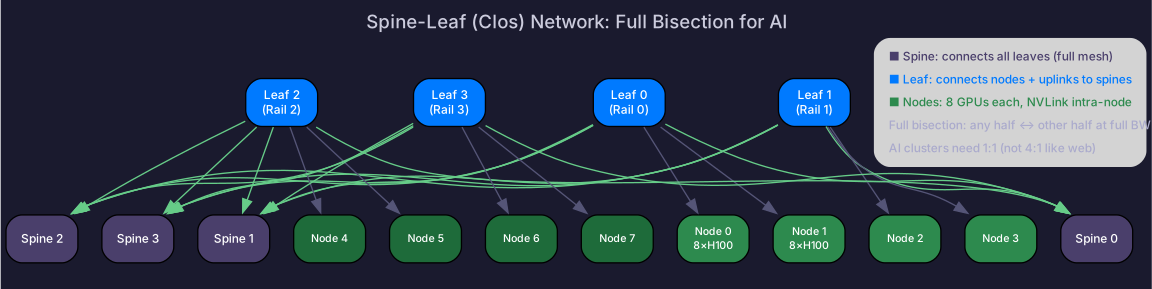
     S0    S1    S2    S3     ← Spine switches (IB or Ethernet)
     │╲    │╲    │╲    │╲
     │  ╲  │  ╲  │  ╲  │  ╲
    L0   L1   L2   L3   L4   ← Leaf switches
    │    │    │    │    │
N0-3 N4-7 N8-11 ... ... ← Nodes (4 per leaf)- Leaf: connects to nodes (downlinks) and spines (uplinks)
- Spine: connects all leaves (no direct node connections)
- Every leaf connects to every spine → any-to-any communication in 2 hops
Sizing
| Leaf has | Downlinks (to nodes) | Uplinks (to spines) | Oversubscription |
|---|---|---|---|
| 32 ports | 16 down | 16 up | 1:1 (full bisection) |
| 32 ports | 20 down | 12 up | 1.67:1 |
| 32 ports | 24 down | 8 up | 3:1 |
Full Bisection vs Oversubscribed
Full bisection (1:1): aggregate uplink bandwidth = aggregate downlink bandwidth. Any half of the cluster can talk to the other half at full speed.
Oversubscribed (e.g., 2:1): uplink bandwidth = half of downlink. Cheaper (fewer spine switches) but inter-leaf traffic is bottlenecked.
AI clusters should use 1:1 or at most 1.5:1 — AllReduce traffic is all-to-all with no locality, so any oversubscription directly reduces gradient sync throughput.
3. Mapping Parallelism to Topology
The Typical DGX SuperPOD Layout
1 SuperPOD = 32 DGX H100 nodes = 256 GPUs

Physical layout:
  Leaf group 0: Nodes 0-7   (8 nodes, 64 GPUs) ← TP + DP-local
  Leaf group 1: Nodes 8-15  (8 nodes, 64 GPUs)
  Leaf group 2: Nodes 16-23
  Leaf group 3: Nodes 24-31

Parallelism mapping for 70B model:
  TP=8 (within each node, NVLink)
  PP=4 (across 4 nodes in a leaf group, IB)
  DP=8 (across leaf groups, IB spine)
Communication hierarchy:
- TP AllReduce: NVLink within node → 900 GB/s
- PP P2P: InfiniBand within leaf group → 50 GB/s per NIC
- DP AllReduce: InfiniBand across leaf groups (through spines) → depends on oversubscription
4. Three-Tier for Large Clusters
For >1000 nodes (>10K GPUs):
Core switches ← connects pods
  │
Spine switches ← connects leaf groups within a pod
  │
Leaf switches ← connects nodes
  │
Nodes
Meta’s 24K GPU cluster: multiple pods, each ~2000 GPUs, connected via core switches. Inter-pod traffic (DP AllReduce across pods) is the bottleneck.
5. Network Design Checklist for AI
| Question | What to check |
|---|---|
| Is TP intra-node? | NVLink connectivity: nvidia-smi topo -m |
| Is inter-node BW sufficient for DP? | Per-node aggregate IB BW × oversubscription ratio |
| Is AllReduce latency acceptable? | nccl-tests across nodes |
| Can EP All-to-All cross leaf boundaries? | Spine bandwidth ≥ EP traffic volume |
| Is checkpoint I/O a bottleneck? | Storage network separate from training network? |
For communication cost formulas and worked examples, see Communication Cost Analysis.
Self-Check
- Name the traffic pattern for each parallelism strategy (DP, TP, PP, EP)
- Draw a 2-tier spine-leaf topology for 32 nodes
- Calculate the oversubscription ratio for a given leaf switch port allocation
- Explain why AI clusters need 1:1 bisection (unlike web/cloud at 4:1)
- Map TP/PP/DP to network tiers for a given cluster