Expert Parallelism
Distributing MoE experts across GPUs — All-to-All dispatch, load balancing, and how expert parallelism interacts with TP and DP.
Expert parallelism (EP) distributes Mixture-of-Experts FFN layers across GPUs — each GPU holds a subset of experts. Tokens are dispatched to the GPU holding their selected expert via All-to-All communication.
For MoE model architecture details (routing, shared experts, load balancing), see MoE Architecture. For All-to-All communication details, see Communication Primitives.
1. Why Expert Parallelism?
MoE models have many experts (8-256) with potentially 10× more total parameters than active parameters. Even though each token only uses 2-8 experts, all expert weights must be stored somewhere.
DeepSeek-V3: 256 experts × 3 weight matrices per expert. Total FFN params: ~500B. Can’t fit on one GPU — experts must be distributed.
2. The Dispatch Pattern
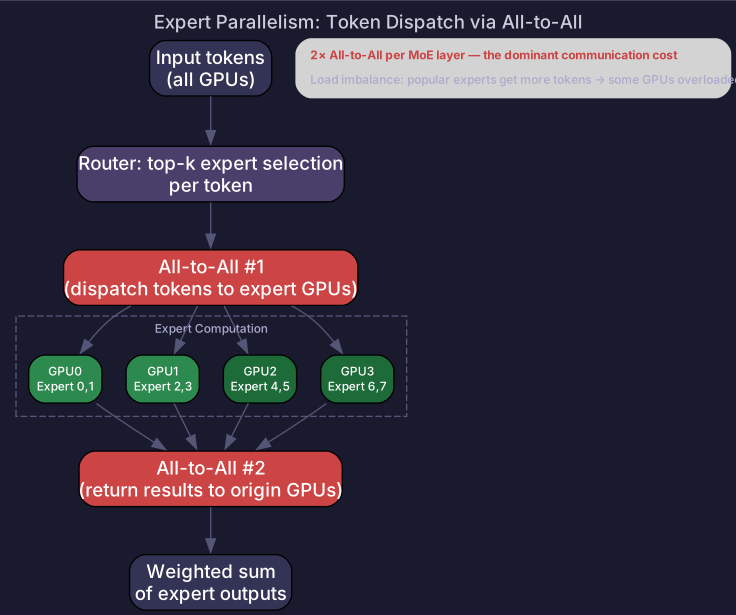
Input tokens on all GPUs
     │
     ▼
Router: assigns each token to top-k experts
     │
     ▼
All-to-All #1 (dispatch): send tokens to the GPU holding their expert
     │
     ▼
Expert computation: each GPU processes tokens through its local experts
     │
     ▼
All-to-All #2 (combine): send results back to the originating GPU
     │
     ▼
Weighted sum of expert outputs
Two All-to-All per MoE layer — this is the dominant communication cost.
3. Communication Cost
Each All-to-All: each GPU sends tokens to each other GPU.
Per MoE layer: bytes (two All-to-Alls).
For , BF16, 32 GPUs:
With 61 MoE layers: ms total All-to-All per step. Significant — but overlappable with non-MoE computation.
4. Load Balancing Challenges
The router may send unequal numbers of tokens to each expert (and thus each GPU):
| Problem | Impact | Mitigation |
|---|---|---|
| Popular experts get many tokens | Some GPUs overloaded, others idle | Auxiliary load-balancing loss |
| Expert capacity overflow | Tokens dropped if expert is “full” | Capacity factor > 1.0 |
| Skewed routing per batch | Variable compute time per GPU | Dynamic token redistribution |
Expert capacity factor: Max tokens per expert = capacity_factor × (total_tokens / num_experts). Typical: 1.0-1.5. Higher = fewer drops, more memory.
5. EP + TP + DP Composition
Expert parallelism interacts with other dimensions:
256 GPUs organized as:
  DP=8 × TP=4 × EP=8

- DP: 8 copies of the model, each on 32 GPUs
- TP: each model copy split across 4 GPUs (within a node)
- EP: 8 expert groups, each expert group on one TP group

Within a TP group: experts are NOT split (each GPU has full expert weights)
Across EP groups: each group has different experts
All-to-All in EP happens between expert groups (potentially inter-node), while TP AllReduce happens within groups (intra-node NVLink).
6. Optimizations
Overlapping All-to-All with Compute
MoE layers alternate with attention layers. While the attention layer computes, the All-to-All for the next MoE layer can start:
[Attention L1 compute] [All-to-All MoE L2 dispatch] (overlapped)
                       [MoE L2 compute]
Expert Replication
For popular experts, replicate them across multiple GPUs to reduce load imbalance:
GPU 0: Expert 0 (replica 1), Expert 1
GPU 1: Expert 0 (replica 2), Expert 2
→ Tokens for Expert 0 can go to either GPU 0 or GPU 1
Cost: More memory. Benefit: Better load balance, less token dropping.
Self-Check
- Explain why expert parallelism is needed (experts don’t fit on one GPU)
- Draw the two All-to-All dispatch pattern for one MoE layer
- Calculate All-to-All communication volume for given model and GPU count
- Explain load balancing challenges and the capacity factor tradeoff
- Explain how EP composes with TP and DP