MoE Architecture
Mixture of Experts — routing, expert design, load balancing, shared experts, and infrastructure implications of sparse models.
Mixture of Experts (MoE) is the architecture that enables models like DeepSeek-V3 (671B total, 37B active per token) and Mixtral (46.7B total, 12.9B active). The idea: not every token needs every parameter — route each token to a subset of “expert” FFN networks, achieving larger model capacity at lower per-token compute cost.
1. The Core Idea: Sparse Activation
In a standard Transformer, every token passes through every parameter. In MoE, the FFN is replaced by expert FFNs, and a router selects the top- experts for each token:
Where are routing weights from a gating function.
Per-token compute: only out of experts are activated. If , each token uses only 3% of expert parameters.
Total model capacity: much larger than the per-token compute suggests. DeepSeek-V3 has 671B parameters but activates only 37B per token — getting the quality benefits of a 671B model at the compute cost of a ~37B dense model.
2. The Router
Gating Function
The router is typically a simple linear layer + softmax:
Then select the top- experts and renormalize their weights:
def route(x, W_gate, k=2):
    scores = x @ W_gate          # (B*S, E)
    topk_scores, topk_ids = scores.topk(k, dim=-1)
    weights = softmax(topk_scores, dim=-1)
    return topk_ids, weights
Load Balancing
The biggest practical challenge: tokens may cluster on a few popular experts while others are idle — expert imbalance.
Auxiliary load balancing loss:
Where is the fraction of tokens routed to expert , and is the average routing probability for expert . This loss penalizes imbalance and is added to the training loss.
Expert capacity and token dropping: Each expert has a maximum number of tokens per batch (the capacity factor, typically 1.0–1.5× of average). Tokens routed to a full expert are dropped — they contribute nothing to the forward pass. This causes training instability, gradient noise, and the model may learn to avoid routing to high-demand experts.
Auxiliary-loss-free balancing (DeepSeek-V3): Instead of an explicit loss, uses a per-expert bias term updated based on load statistics. Over-loaded experts get a negative bias, reducing their routing probability — avoiding the training instability of the auxiliary loss approach.
Training Instability
MoE models are harder to train than dense models:
- Routing collapse: all tokens converge to 1–2 experts, starving the rest. The auxiliary loss prevents this but adds hyperparameter sensitivity.
- Loss spikes: load imbalance causes sudden gradient magnitude changes, especially early in training.
- Expert utilization drift: some experts become permanently underutilized after initial routing patterns are established.
The Switch Transformer (Fedus et al., 2022) used top-1 routing (one expert per token) and was the first to demonstrate MoE at scale, but required careful capacity factor tuning.
3. Expert Design Variants
Standard MoE
Replace FFN with identical FFN experts:
Input → Router → Top-k experts → Weighted sum → OutputEach expert is a standard SwiGLU FFN. Parameters: .
Shared Experts (DeepSeek)
DeepSeek-V2/V3 adds shared experts that process every token (not routed):
Input → Shared Expert(s) + Router → Top-k routed experts → Sum all → OutputShared experts capture common patterns; routed experts handle specialized knowledge. This improves quality and reduces the impact of routing errors.
Fine-Grained Experts (DeepSeek-V3)
Instead of large experts, use smaller experts with higher :
- DeepSeek-V3: 256 routed experts, top-8 active, plus 1 shared expert
- Each expert is smaller → more routing flexibility
- Higher with smaller experts ≈ similar compute but better coverage
4. Infrastructure Implications
MoE creates unique infrastructure challenges that don’t exist for dense models:
Expert Parallelism
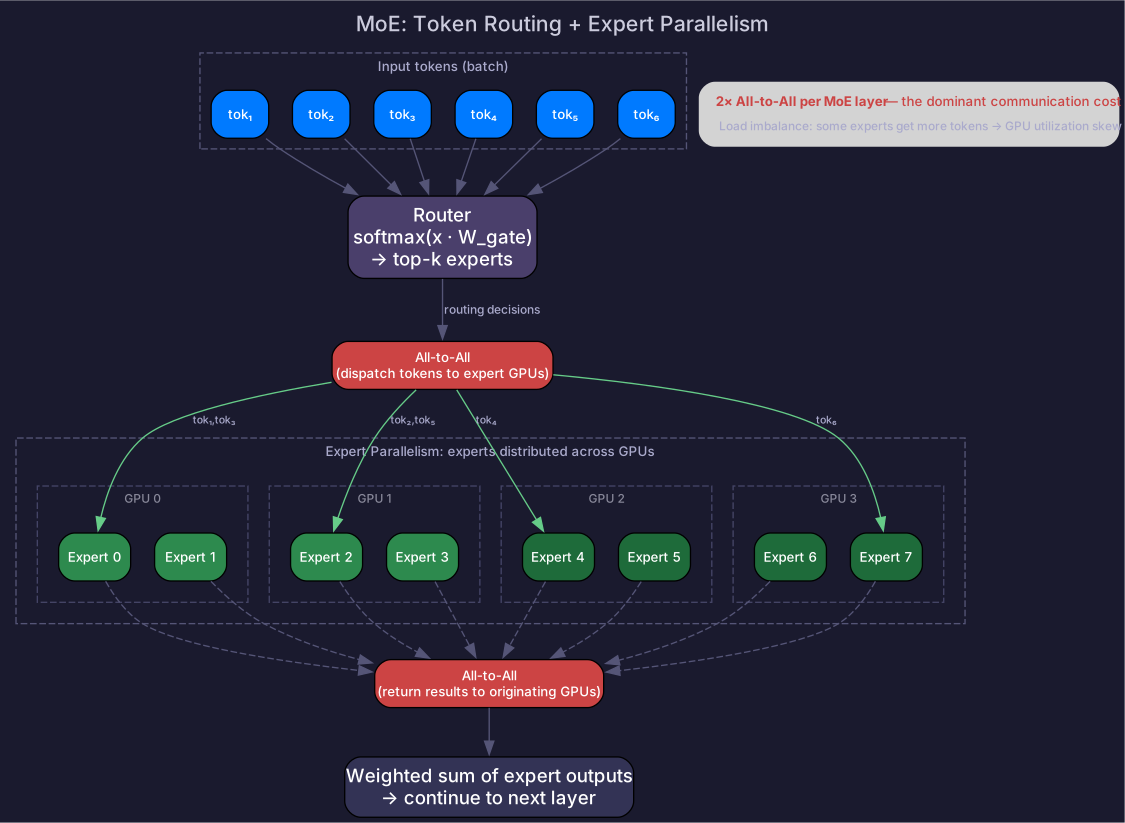
Experts are distributed across GPUs. Each token must be routed to the correct GPU:
GPU 0: Experts 0-15     GPU 1: Experts 16-31
GPU 2: Experts 32-47    GPU 3: Experts 48-63

Token routing requires All-to-All communication:
  1. Each GPU computes routing for its tokens
  2. All-to-All: send tokens to the GPU holding their selected experts
  3. Each GPU processes tokens through its local experts
  4. All-to-All: send results back to originating GPUs
Two All-to-All per MoE layer — this is the dominant communication cost for MoE training and inference.
Memory: Total vs Active
| Model | Total params | Active params/token | Memory for weights (FP16) |
|---|---|---|---|
| LLaMA-2-70B (dense) | 70B | 70B | 140 GB |
| Mixtral 8×7B | 46.7B | 12.9B | 93 GB |
| DeepSeek-V3 | 671B | 37B | 1.3 TB |
MoE models need all expert weights loaded — even though each token only uses a fraction. The memory requirement is based on total parameters, not active parameters.
Inference Challenges
- Load imbalance: some experts receive more tokens than others, creating GPU utilization skew
- Expert caching: popular experts should be cached in faster memory; cold experts can be offloaded
- Batch efficiency: different tokens in a batch may route to different experts, creating irregular compute patterns
- KV cache: same as dense models (MoE doesn’t change attention)
5. Model Comparison
| Model | Type | Experts | Active | Total params | Active params | Architecture |
|---|---|---|---|---|---|---|
| LLaMA-2-70B | Dense | — | — | 70B | 70B | GQA |
| Mixtral 8×7B | MoE | 8 | 2 | 46.7B | 12.9B | GQA + MoE FFN |
| DeepSeek-V3 | MoE | 256+1 shared | 8+1 | 671B | 37B | MLA + fine-grained MoE |
| Qwen2-57B-A14B | MoE | 64 | 8 | 57B | 14B | GQA + MoE FFN |
Self-Check
- Explain the difference between total parameters and active parameters in MoE
- Explain the router (gating function) and top-k expert selection
- Explain why load balancing is critical and how auxiliary loss helps
- Explain shared experts and why DeepSeek uses them
- Explain expert parallelism and the two All-to-All communications per MoE layer
- Calculate memory requirements for MoE vs dense models of similar quality