Transformer Architecture Overview
A high-level map of the Transformer — components, data flow, and how each part connects to AI infrastructure challenges.
Every optimization in AI infrastructure acts on some component of the Transformer. Before diving into the details, this chapter provides the map — what are the building blocks, how do they fit together, and why does each one matter for infrastructure.
1. Why AI Infra Engineers Must Understand the Transformer
The Transformer is not just a model architecture — it’s the compute workload that defines all AI infrastructure requirements. Every infrastructure decision maps to a Transformer component:
| Infra layer | Transformer component | Challenge |
|---|---|---|
| CUDA kernels | Attention, FFN, Softmax, LayerNorm | Optimizing individual operations (FlashAttention, fused kernels) |
| Distributed training | Attention heads, FFN weights, layers | Splitting the model across GPUs (tensor/pipeline/expert parallelism) |
| Inference serving | KV cache, autoregressive decode | Managing memory, batching, latency optimization |
| Hardware design | Matrix multiplications, memory access | Tensor Cores, HBM bandwidth, NVLink for parallelism |
Understanding which component dominates which cost tells you where to optimize.
2. The Building Blocks
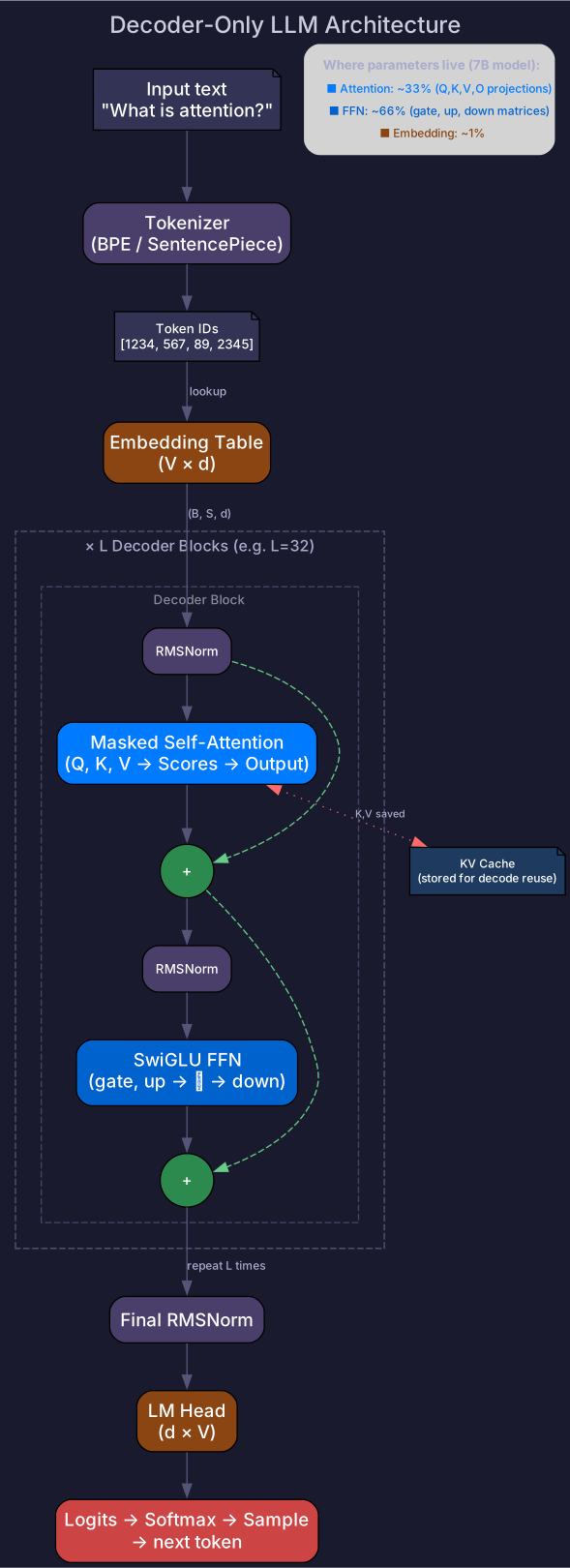
A modern decoder-only LLM has surprisingly few distinct components:
Input text
  → Tokenizer (text → token IDs)
  → Embedding table (token IDs → vectors)
  → N × Decoder Block:
      → RMSNorm → Masked Self-Attention → Residual
      → RMSNorm → SwiGLU FFN → Residual
  → Final RMSNorm
  → LM Head (vectors → vocabulary logits)
  → Sampling (logits → next token)
Only 7 distinct operation types: tokenization, embedding lookup, normalization, attention, FFN, linear projection, and softmax/sampling. Everything else is just these operations repeated and composed.
Component Map
| Component | What it does | Parameters | Compute cost | Memory concern |
|---|---|---|---|---|
| Embedding | Token ID → vector | Negligible (lookup) | Large if vocab is big | |
| Self-Attention | Token-to-token interaction | per layer | KV cache grows with sequence length | |
| FFN (SwiGLU) | Per-token processing | per layer | Activation memory | |
| RMSNorm | Stabilize activations | per instance | Negligible | — |
| LM Head | Vector → vocab probabilities | One GEMM | Often tied with embedding |
Where the parameters live: In a typical 7B model, ~66% of parameters are in FFN weights, ~33% in attention weights, and ~1% in everything else. In a 70B model with GQA, FFN dominance increases further.
Where the compute goes: For short sequences, FFN dominates compute. For long sequences, attention’s term takes over. The crossover point depends on model dimensions and sequence length.
3. How It Evolved
The Three Architecture Families
The original Transformer (2017) had an encoder-decoder design for machine translation. Three families emerged:
| Architecture | Key models | How it works | Status |
|---|---|---|---|
| Encoder-only | BERT, RoBERTa | Bidirectional attention, masked token prediction | Superseded for generation |
| Encoder-Decoder | T5, BART, Whisper | Encoder processes input, decoder generates | Used for translation, ASR |
| Decoder-only | GPT, LLaMA, Qwen, Mistral | Causal attention, next-token prediction | Dominant for LLMs |
Why Decoder-Only Won
- Simplicity: One stack of identical blocks — no encoder, no cross-attention
- Scalability: Just add more blocks. Same architecture from 1B to 400B+
- Unified: Next-token prediction handles every task when prompted correctly
- Inference efficiency: KV cache works naturally; encoder-decoder needs two separate caches
Key Architecture Innovations Since 2017
| Innovation | What changed | Why it matters for infra |
|---|---|---|
| GQA (2023) | Fewer KV heads than Q heads | 4-8× KV cache reduction |
| RoPE (2021) | Rotary position embedding | Enables long-context extension |
| SwiGLU (2020) | Gated FFN activation | 3 weight matrices instead of 2 |
| RMSNorm | Simpler normalization | 10-15% faster than LayerNorm |
| MoE (2022+) | Sparse expert routing | 10× parameters at ~1× compute |
| MLA (2024) | Latent KV compression | Further KV cache reduction |
| MTP (2024) | Multi-token prediction heads | Enables speculative verification |
4. Reading Order for This Section
The remaining articles in this section build on each other:
- Tokenization — How text becomes numbers (the input)
- Transformer as Compute Graph — Full forward pass with shapes and FLOPs
- Self-Attention — The core operation
- FFN & Normalization — The other half of each block
- Positional Encoding — How the model knows token order (RoPE)
- Autoregressive Generation — How the model actually generates text (prefill, decode, KV cache)
- Attention Variants — GQA, MLA, Mamba — reducing KV cache cost
- MoE Architecture — Sparse models for more capacity at less compute
Each article includes shape tracking, compute analysis, and connections to infrastructure challenges.
Self-Check
- Name the 7 distinct operation types in a decoder-only Transformer
- Explain where parameters and compute concentrate (FFN vs attention)
- Explain why decoder-only architecture became dominant
- Name 3 architecture innovations since the original Transformer and their infrastructure impact
- Explain the crossover between FFN-dominated and attention-dominated compute as sequence length grows