Workload Characterization
Not all model usage looks the same — prefill vs decode, chat vs agent, reasoning, multimodal, and training workloads each have different resource profiles.
The single most important skill in AI infrastructure is asking: “what kind of workload is this?” — because the answer determines whether you’re bottlenecked by compute, memory capacity, memory bandwidth, or network. Different workloads stress completely different parts of the hardware stack.
1. The Four Bottlenecks
Every AI workload hits one of these walls first:
| Bottleneck | What it means | Limited by | Example |
|---|---|---|---|
| Compute-bound | GPU math units are the limit | TFLOPS | Large-batch prefill, training forward pass |
| Memory-BW-bound | Data can’t be fed fast enough | HBM GB/s | Single-token decode, LayerNorm, activation functions |
| Memory-capacity-bound | Not enough memory | HBM GB | Large model weights, long-context KV cache |
| Network-bound | Communication between GPUs is the limit | NVLink/IB GB/s | Tensor parallelism AllReduce, expert parallelism All-to-All |
Most infrastructure mistakes come from optimizing the wrong bottleneck.
2. Inference Workloads
Prefill vs Decode
The two phases of every LLM request have opposite resource profiles:
| Property | Prefill | Decode |
|---|---|---|
| What happens | Process entire prompt in parallel | Generate one token at a time |
| GEMM M dimension | (all prompt tokens) | (one new token per request) |
| Bottleneck | Compute-bound | Memory-BW-bound |
| GPU utilization | High (80%+ at sufficient batch) | Low (<30% for single request) |
| Arithmetic intensity | High (large GEMMs) | ~1 (thin GEMMs) |
| Key metric | TTFT (Time to First Token) | TPOT (Time Per Output Token) |
Infrastructure consequence: Prefill and decode benefit from different hardware configurations. This is why prefill-decode disaggregation uses separate GPU pools.
Short Context vs Long Context
| Property | Short (< 4K tokens) | Long (32K–128K+) |
|---|---|---|
| Attention compute | Small ( is manageable) | Dominates ( explodes) |
| KV cache | Fits easily | Can consume most of GPU memory |
| Bottleneck | FFN compute or memory-BW | Attention compute + KV cache capacity |
| Typical use | Chat, Q&A | Document analysis, code repos |
At 128K context with LLaMA-2-7B, KV cache alone is ~64 GB — nearly all of an H100’s memory.
Chat vs Agent
| Property | Chat | Agent |
|---|---|---|
| Turn structure | Human → Model → Human → … | Model → Tool → Model → Tool → … |
| Latency tolerance | Interactive (< 2s TTFT) | Can be async (minutes OK) |
| Context management | Conversation history | + tool outputs, file contents, execution results |
| State | Stateless (per request) | Stateful (sandbox, files, processes persist) |
| Compute pattern | Single model call per turn | Multiple calls, branching, retries |
| Infrastructure | Standard serving | Sandbox orchestration, state management |
Agent workloads are fundamentally different — they require stateful compute environments (sandboxes), tool execution, and multi-step orchestration. This is covered in the Apps & Agents module.
Reasoning Models (Extended Thinking)
Models like o1, DeepSeek-R1, and QwQ generate long “thinking” traces before answering:
| Property | Standard generation | Reasoning |
|---|---|---|
| Output length | 100–1000 tokens | 1,000–50,000+ tokens |
| Decode time | Seconds | Minutes |
| KV cache | Moderate | Very large (thinking + answer) |
| Compute pattern | Mostly one decode sequence | May involve tree search, verification |
| Cost per request | $0.001–0.01 | $0.01–1.00+ |
Infrastructure consequence: Reasoning models need much longer decode, much more KV cache, and potentially speculative verification (multi-token prediction). The cost-per-request is 10–100× higher than standard chat.
Multimodal Workloads
| Modality | Input processing | Impact on compute | Impact on memory |
|---|---|---|---|
| Vision (images) | Vision encoder → patch embeddings → projector → LLM | Prefill gets a burst of image tokens (256–2048 per image) | KV cache inflated by image tokens |
| Audio (speech) | Whisper-style encoder → audio embeddings → LLM | Must process faster than audio plays (real-time factor < 1) | Streaming chunks, low latency |
| Image generation | LLM → diffusion model (iterative denoising) | Separate GPU pool for diffusion | VAE + denoising latents |
| Video | Many frames → vision encoder → very long context | Extremely long prefill | Massive KV cache |
Multimodal serving requires heterogeneous infrastructure — different model components on different hardware, with orchestration between them.
3. Training Workloads
Pre-training
The most resource-intensive phase:
| Property | Value |
|---|---|
| Data | Terabytes of tokenized text |
| Compute | 10K+ GPUs for weeks/months |
| Pattern | Forward → backward → gradient sync → optimizer step, repeat |
| Bottleneck | Compute-bound (large batch GEMMs) + network-bound (gradient sync) |
| Key metric | MFU (Model FLOPS Utilization) — typically 30–55% |
| Cost | 100M+ for frontier models |
Supervised Fine-Tuning (SFT)
| Property | Value |
|---|---|
| Data | Thousands to millions of (instruction, response) pairs |
| Compute | 8–64 GPUs for hours/days |
| Pattern | Same as pre-training but smaller scale |
| Bottleneck | Often memory-capacity-bound (fitting model + optimizer) |
| Key optimization | LoRA/QLoRA to reduce trainable parameters |
Reinforcement Learning (RLHF/GRPO)
| Property | Value |
|---|---|
| Pattern | Generate rollouts (inference) → score (inference) → update (training) |
| Bottleneck | Interleaving inference and training — different resource profiles |
| Complexity | Must manage separate GPU pools for generation vs training |
| Key challenge | Dynamic resource allocation between rollout and training phases |
RL training is uniquely hard for infrastructure — it combines inference workloads (rollout generation, reward model scoring) with training workloads (policy gradient updates) in the same training loop, requiring the system to dynamically shift resources.
Embedding & Retrieval Workloads
Often overlooked but extremely common in production:
| Property | Value |
|---|---|
| Task | Encode text/images into dense vectors for search/RAG |
| Pattern | Prefill-only (no generation), high batch size |
| Bottleneck | Compute-bound at high batch sizes (bulk encoding) |
| Key optimization | Large batches, variable-length packing, FP16/INT8 |
| Typical throughput | 10K–100K documents/second on one H100 |
Embedding is the “silent majority” of AI inference — every RAG system embeds queries and documents, often at millions of documents per day.
Batch vs Real-Time Inference
| Property | Real-time | Batch |
|---|---|---|
| Latency target | < 2s TTFT, < 50ms TPOT | Don’t care (hours OK) |
| Optimization focus | Latency → smaller batches, speculative decoding | Throughput → max batch size, max utilization |
| SLO | P99 latency | Tokens/second/dollar |
| Typical use | Chat, API, interactive | Document processing, evaluation, data labeling |
Infrastructure consequence: batch inference can use spot instances (2-3× cheaper) because latency doesn’t matter and restarts are acceptable.
Arithmetic Intensity: A Worked Example
To prove prefill is compute-bound and decode is memory-BW-bound, calculate arithmetic intensity for a 7B model on H100:
Prefill (S=2048, B=1): The dominant operation is FFN GEMM: .
- FLOPs:
- Bytes read:
- AI \approx 1636 — well above H100’s ops:byte of 295 → compute-bound ✓
Decode (S=1, B=1): Same weight matrix, but M=1: .
- FLOPs:
- Bytes read:
- AI \approx 1 — far below 295 → memory-BW-bound ✓
The weight matrix is the same size in both cases — but prefill reuses it across 2048 tokens while decode uses it for just 1.
4. Workload → Infrastructure Mapping
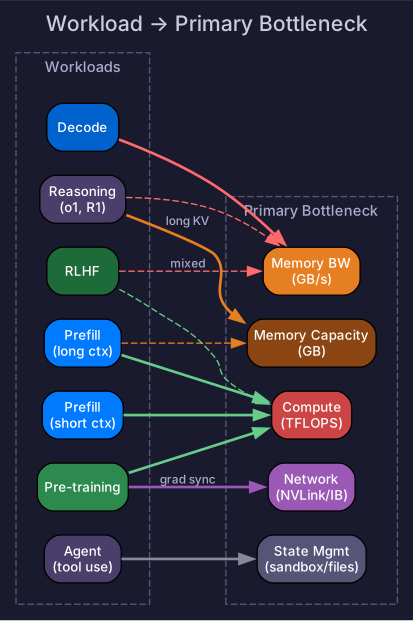
| Workload | Primary bottleneck | Key infra decision |
|---|---|---|
| Prefill (short) | Compute | Pack requests, maximize batch utilization |
| Prefill (long) | Compute + memory | Chunked prefill, sequence parallelism |
| Decode | Memory bandwidth | Batch many requests to amortize weight reads |
| Agent | Latency + state | Sandbox infra, async execution |
| Reasoning | KV cache + decode time | Large memory GPUs, long-request scheduling |
| Vision-language | Heterogeneous compute | Separate encoder/LLM pools |
| Pre-training | Compute + network | 3D/4D parallelism, fault tolerance |
| SFT | Memory capacity | LoRA, ZeRO, gradient checkpointing |
| RLHF | Mixed (inference + training) | Dynamic resource allocation |
| Embedding/retrieval | Compute | Large batches, packing, quantization |
| Batch inference | Throughput | Spot instances, max batch size |
The correct infrastructure choice always starts with: what is the workload?
Self-Check
- Name the four hardware bottlenecks and give an example workload for each
- Explain why prefill is compute-bound but decode is memory-BW-bound
- Explain how KV cache size changes with context length and why long context is hard
- Explain how agent workloads differ from chat workloads in infrastructure requirements
- Explain why reasoning models are 10–100× more expensive per request
- Explain why RLHF is uniquely challenging for infrastructure (mixed inference + training)