InfiniBand
NDR/XDR, multi-rail topology, why 8 NICs per node, rail-optimized vs full fat-tree — the inter-node backbone of AI clusters.
InfiniBand is the inter-node network for most large AI training clusters. While NVLink handles intra-node at 900+ GB/s, InfiniBand connects nodes at 50-100 GB/s per port — and the cluster topology determines how well distributed training scales.
1. InfiniBand Generations
| Generation | Year | Per-port BW | Typical per-node | Used by |
|---|---|---|---|---|
| HDR | 2019 | 200 Gb/s (25 GB/s) | 8 ports = 200 GB/s | A100 clusters |
| NDR | 2022 | 400 Gb/s (50 GB/s) | 8 ports = 400 GB/s | H100 clusters (DGX) |
| XDR | 2024 | 800 Gb/s (100 GB/s) | 8 ports = 800 GB/s | B200 clusters |
Multi-rail: Each node has 8 NICs (ConnectX-7/8), one per GPU pair. All 8 are used simultaneously for aggregate bandwidth.
2. Multi-Rail Topology
Why 8 NICs?
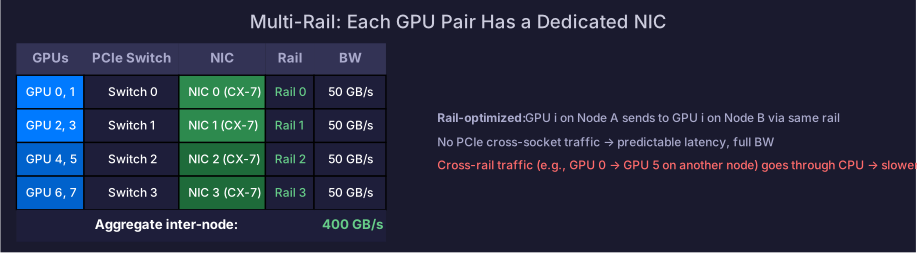
DGX H100 has 8 GPUs and 8 NICs. Each GPU pair is PCIe-adjacent to one NIC:
GPU 0,1 → NIC 0 (ConnectX-7, 400 Gb/s)
GPU 2,3 → NIC 1
GPU 4,5 → NIC 2
GPU 6,7 → NIC 3
GPU 0,1 → NIC 4 (second rail)
GPU 2,3 → NIC 5
GPU 4,5 → NIC 6
GPU 6,7 → NIC 7
Rail-optimized traffic: GPU on Node A sends to GPU on Node B via the same NIC/rail. This ensures:
- No PCIe cross-socket traffic
- Dedicated bandwidth per GPU pair
- Predictable latency
Aggregate Bandwidth
8 NICs × 50 GB/s = 400 GB/s per node (NDR). For AllReduce of 14 GB gradients:
Real-world: ~80-100 ms (protocol overhead, congestion).
3. Network Topology
InfiniBand networks use spine-leaf (Clos) topology for AI clusters. For detailed topology design, oversubscription ratios, and parallelism-to-network mapping, see Data Center Network Design.
Key point for InfiniBand: AI clusters need full bisection bandwidth (1:1 oversubscription) because AllReduce traffic is all-to-all with no locality. InfiniBand switches (Quantum-2 NDR) support 64 ports at 400 Gb/s each.
4. Rail-Optimized vs Full Fat-Tree
| Rail-Optimized | Full Fat-Tree | |
|---|---|---|
| Traffic pattern | GPU ↔ GPU across nodes (same rail) | Any GPU ↔ any GPU |
| Best for | Data parallel AllReduce (each rail independent) | Tensor parallel, expert parallel (arbitrary communication) |
| Switch cost | Lower (separate network per rail) | Higher (all rails share spines) |
| Flexibility | Low (optimized for one pattern) | High (any pattern works) |
DGX SuperPOD uses rail-optimized topology for DP traffic and a separate management network for control. Some clusters add a full fat-tree for EP All-to-All traffic.
5. Practical Verification
# Check IB link speed
ibstat | grep -E "Rate|State"
# Should show: Rate: 400 (NDR) or 200 (HDR)

# Check multi-rail configuration
ibv_devinfo | grep -E "hca_id|port:|active_speed"

# Measure inter-node bandwidth
ib_write_bw --size=1048576 <remote_ip>  # should see ~48 GB/s for NDR

# NCCL AllReduce benchmark across nodes
mpirun -np 16 -H node0:8,node1:8 \
  ./nccl-tests/build/all_reduce_perf -b 1M -e 1G -f 2 -g 1
For RDMA concepts (queue pairs, memory registration) and InfiniBand vs RoCE tradeoffs, see RDMA Concepts.
Self-Check
- Name InfiniBand generations and per-port bandwidth (HDR, NDR, XDR)
- Explain multi-rail topology and why DGX uses 8 NICs
- Calculate aggregate inter-node bandwidth for a DGX H100 node
- Explain spine-leaf topology and oversubscription ratio
- Explain rail-optimized vs full fat-tree and when each is used
- Verify InfiniBand speed with
ibstatandib_write_bw