Memory Budget Verification
Calculating per-GPU memory for a given parallelism configuration — weights, optimizer states, activations, and KV cache with exact formulas.
After choosing (TP, PP, DP), you must verify that the per-GPU memory actually fits. This chapter provides the exact formulas and a systematic method to add up every memory component.
1. The Complete Training Memory Ledger
Training memory has two parts: static (independent of batch size) and dynamic (scales with batch/sequence).
Static Memory: 16Ψ per Parameter
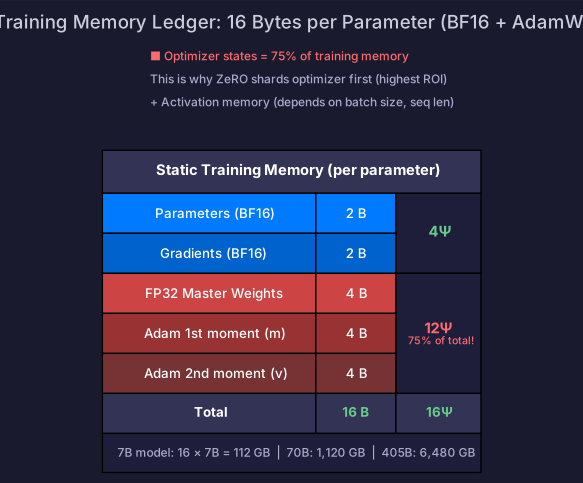
With BF16 mixed precision + AdamW:
| Component | Precision | Bytes/param | 7B model | 70B model |
|---|---|---|---|---|
| Parameters (working copy) | BF16 | 2 | 14 GB | 140 GB |
| Gradients | BF16 | 2 | 14 GB | 140 GB |
| FP32 master weights | FP32 | 4 | 28 GB | 280 GB |
| Adam 1st moment () | FP32 | 4 | 28 GB | 280 GB |
| Adam 2nd moment () | FP32 | 4 | 28 GB | 280 GB |
| Static total | 16 | 112 GB | 1,120 GB |
Why 16 and not 18? Some implementations keep an additional FP32 gradient accumulator (extra 4Ψ → 20Ψ). The canonical BF16 mixed-precision setup uses 16Ψ (BF16 gradients, FP32 optimizer states). Our Envelope Estimation chapter uses 18Ψ for a more conservative estimate. Both are valid — just be consistent.
How Parallelism Reduces Static Memory
| Strategy | Parameters per GPU | Optimizer per GPU | Gradients per GPU |
|---|---|---|---|
| No parallelism | Ψ | Ψ | Ψ |
| TP=T | Ψ/T | Ψ/T | Ψ/T |
| PP=P | Ψ/P (layers assigned) | Ψ/P | Ψ/P |
| FSDP (ZeRO-3) | Ψ/D (gathered on demand) | Ψ/D | Ψ/D |
| TP=T + PP=P + FSDP(D) | Ψ/(T×P×D) | Ψ/(T×P×D) | Ψ/(T×P×D) |
FSDP is the most memory-efficient for static memory because it shards everything across all DP ranks, gathering parameters on-the-fly during forward/backward.
2. Dynamic Memory: Activations
Activations are the intermediate tensors saved during forward pass for use in backward. This is the “variable cost” that depends on batch size and sequence length.
Per-Layer Activation Memory (Transformer)
For one Transformer layer with hidden dimension , sequence length , batch size , attention heads :
| Component | Shape | Bytes (BF16) |
|---|---|---|
| Input to attention (Q, K, V) | ||
| Attention scores | ||
| Attention output | ||
| FFN intermediate | (or ) | |
| LayerNorm inputs (×2) | ||
| Dropout masks | (various) | ~ |
| Per-layer total |
For layers:
Worked Example: 70B Model
Architecture: , , (GQA with 8 KV heads), , (micro-batch):
357 GB of activations for a single micro-batch! This is clearly impossible without mitigation.
Activation Checkpointing
Instead of saving all activations, recompute them during backward:
| Strategy | Memory | Compute overhead |
|---|---|---|
| No checkpointing | 0% | |
| Selective checkpointing | Save only cheap tensors, recompute attention | ~30% memory reduction, ~5% compute |
| Full checkpointing | Save only layer inputs, recompute everything | ~ (just inputs) |
With full activation checkpointing for the 70B example:
That’s 357 GB → 5.4 GB — a 66× reduction at the cost of 33% extra forward compute.
How Parallelism Reduces Activation Memory
| Strategy | Effect on activations |
|---|---|
| TP=T | Reduces some tensors by T (attention, FFN), but not all (LayerNorm is replicated) |
| PP=P | Only stores activations for assigned layers: layers |
| SP (Sequence Parallel) | Reduces by the SP degree for LayerNorm/Dropout regions |
| CP (Context Parallel) | Reduces by CP degree for attention computation |
| Gradient accumulation | Doesn’t reduce peak activation memory (still processes full micro-batch) |
3. The Complete Memory Budget Formula
Where:
- = micro-batch size (not global batch)
- ZeRO-stage: 1 (optimizer only) shards by D, 2 adds gradients, 3 adds params
- ≈ 1-4 GB for communication buffers, CUDA context, fragmentation
4. Memory Verification Checklist
For a given configuration, fill in this table:
| Component | Formula | Value | Notes |
|---|---|---|---|
| Parameters | __ GB | BF16 working copy | |
| Gradients | __ GB | Sharded further with FSDP | |
| Optimizer | __ GB | Always sharded across DP | |
| Activations | see formula | __ GB | With/without checkpointing |
| Comm buffers | ~2 GB | 2 GB | NCCL buffers |
| CUDA context | ~1 GB | 1 GB | Per-GPU fixed overhead |
| Total | sum | __ GB | Must be < 80 GB |
Worked Example: 70B, TP=8, PP=1, DP=32
| Component | Calculation | Value |
|---|---|---|
| Parameters | 140 GB / 8 | 17.5 GB |
| Gradients | 140 GB / 8 | 17.5 GB |
| Optimizer | 840 GB / (8 × 32) | 3.28 GB |
| Activations (full ckpt, b_μ=1) | 5.4 GB / 8 (rough TP reduction) | ~0.7 GB |
| Buffers + CUDA | 3 GB | |
| Total | 42.6 GB ✅ |
Plenty of headroom on 80 GB. Can increase micro-batch size to 2-4.
Worked Example: 405B, TP=8, PP=4, DP=8
| Component | Calculation | Value |
|---|---|---|
| Parameters | 810 GB / (8 × 4) | 25.3 GB |
| Gradients | 810 GB / (8 × 4) | 25.3 GB |
| Optimizer | 4,860 GB / (8 × 4 × 8) | 18.98 GB |
| Activations (full ckpt, b_μ=1) | ~2 GB (126/4 layers, TP=8) | ~2 GB |
| Buffers + CUDA | 3 GB | |
| Total | 74.6 GB ⚠️ tight |
Tight fit — micro-batch size must stay at 1, or use gradient accumulation.
5. Common Pitfalls
| Pitfall | What happens | Fix |
|---|---|---|
| Forgetting optimizer states | “70B = 140 GB, TP=8 = 17.5 GB, plenty of room!” | Include 12Ψ optimizer overhead |
| Ignoring activations | OOM at forward pass, not at parameter loading | Add activation checkpointing |
| Wrong micro-batch size | Calculated with but training uses | Verify with actual micro-batch |
| Fragmentation | Theoretical fits, practical OOM | Leave 10-15% headroom |
| PP stage imbalance | First/last stages have embedding layers | Account for embedding table size |
Self-Check
- Calculate the 16Ψ memory breakdown for a 13B model
- Explain why optimizer states are 12 out of 16 bytes per parameter
- Calculate activation memory for one Transformer layer with and without checkpointing
- Fill in the memory verification table for 70B on TP=8, DP=8
- Identify when a configuration won’t fit and what to adjust