Distributed KV Cache
Cross-instance prefix sharing, cache-affinity routing, distributed KV stores, and building a cluster-wide KV cache layer.
At cluster scale with multiple serving instances, each instance maintains its own KV cache — leading to redundant prefill of common prefixes. Distributed KV cache enables cross-instance sharing, turning prefix caching from a per-instance optimization into a cluster-wide one.
1. The Redundancy Problem at Scale
With independent vLLM instances serving the same model:
Instance 0: caches "System prompt A" → serves users 0-99
Instance 1: caches "System prompt A" → serves users 100-199  (REDUNDANT!)
Instance 2: caches "System prompt A" → serves users 200-299  (REDUNDANT!)
...
Without coordination, every instance independently prefills the same system prompt. With 100 requests/second and 10 instances: 10× redundant prefill of the same tokens.
The fix requires two capabilities:
- Shared KV storage: A place where KV cache computed by one instance is accessible to others
- Cache-aware routing: Direct requests to the instance most likely to have the relevant KV cached
2. Architecture
┌─────────────────────────────────────────────────┐
│  Router (cache-aware)                           │
│  Maintains: prefix → instance mapping           │
│  Routes: new request → instance with best match │
├─────────────────────────────────────────────────┤
│  Global KV Index                                │
│  Hash table: token_hash → {instance, blocks}    │
│  Updated on: prefill completion, eviction        │
├──────────┬──────────┬──────────┬────────────────┤
│ Instance │ Instance │ Instance │   Shared KV    │
│    0     │    1     │    2     │   Store        │
│ (local)  │ (local)  │ (local)  │ (CPU/disk/     │
│          │          │          │  network)      │
└──────────┴──────────┴──────────┴────────────────┘
3. Cache-Affinity Routing
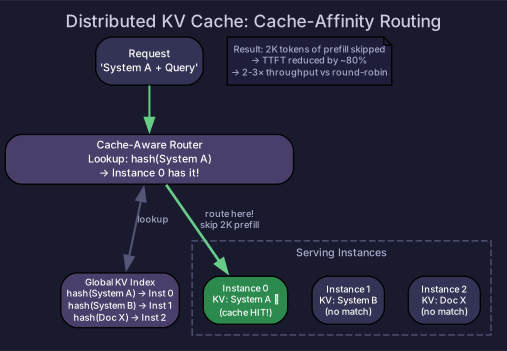
The router’s most important job: send requests to the instance that already has their prefix cached.
def route_request(request, instances, kv_index):
    prefix_hash = hash(request.prompt[:system_prompt_length])

    # Find instances with this prefix cached
    cached_on = kv_index.lookup(prefix_hash)

    if cached_on:
        # Route to least-loaded instance that has the cache
        target = min(cached_on, key=lambda i: i.queue_depth)
    else:
        # No cache hit — route to least-loaded instance
        target = min(instances, key=lambda i: i.queue_depth)

    return target
Impact of Cache-Affinity Routing
| Routing strategy | Cache hit rate | Throughput relative to random |
|---|---|---|
| Random (round-robin) | per instance | 1× |
| Cache-affinity | 80-95% | 2-3× |
| Cache-affinity + load-aware | 75-90% | 2.5-3.5× |
llm-d reports 3× higher throughput and 2× faster TTFT with prefix-cache-aware routing vs round-robin on Llama-3.1 70B.
4. Distributed KV Storage Options
| Storage | Bandwidth | Latency | Capacity | Use case |
|---|---|---|---|---|
| GPU HBM (local) | 3,350 GB/s | ns | 80-192 GB | Hot cache (current requests) |
| CPU DRAM (local) | 64 GB/s | μs | 512-2TB | Warm cache (recent evictions) |
| Remote GPU (RDMA) | 50 GB/s | μs | Other instance’s HBM | Cross-instance sharing |
| Distributed store | 10-50 GB/s | ms | Unlimited | Persistent, cluster-wide |
LMCache Approach
Tiered storage within each node, with a shared remote tier:
Request arrives → check local GPU cache → check local CPU → check remote store → prefillMooncake Approach
Centralized distributed store with RDMA transfer:
Request arrives → router checks global index → if cached on another instance:
  Transfer KV via RDMA (25-50ms for 4K context) vs full prefill (50-100ms)
5. Consistency and Eviction
Consistency Model
KV cache is immutable once written (the same token sequence always produces the same KV). This simplifies consistency — no need for write locks or invalidation. The only operations are:
- Write: After prefill, register KV blocks in the global index
- Read: On cache hit, read KV blocks (local or remote)
- Evict: When memory pressure rises, remove entries from index + storage
Eviction Strategy
# Global LRU eviction
# When any instance runs low on memory:
# 1. Evict least-recently-used entries from local GPU cache → move to CPU
# 2. If CPU full → move to remote store or discard
# 3. Update global index to reflect new location (or removal)

# Eviction priority: unique prefixes > shared prefixes
# (shared prefixes are more likely to be needed again)
6. When Distributed KV Cache Matters
| Scenario | Benefit | Why |
|---|---|---|
| Many instances, shared system prompts | High | Eliminate redundant prefill |
| RAG with repeated documents | High | Document KV reused across queries |
| Multi-turn chat | Medium | Session KV shared across turns (already handled per-instance) |
| All unique prompts | None | No sharing opportunity |
| Single instance | None | Already has its own prefix cache |
For the systems implementing distributed KV, see LMCache & Mooncake and llm-d.
Self-Check
- Explain the redundant prefill problem with multiple independent instances
- Describe cache-affinity routing and its throughput impact
- Compare distributed KV storage options (local GPU/CPU, remote RDMA, distributed store)
- Explain why KV cache immutability simplifies consistency
- Design an eviction strategy for a distributed KV store
- Identify workloads where distributed KV cache provides the most benefit