llm-d
Kubernetes-native inference stack — intelligent routing, prefix-cache-aware scheduling, autoscaling, multi-tenant serving, and wide expert parallelism.
llm-d is a Kubernetes-native distributed inference stack for production LLM deployments. While vLLM/SGLang handle single-instance serving and Dynamo handles disaggregation, llm-d focuses on operational excellence — routing, autoscaling, multi-tenancy, and reliability at cluster scale.
1. What llm-d Provides
llm-d sits above model servers (vLLM, SGLang) and provides the production infrastructure layer:
┌────────────────────────────────────────────────────┐
│  External Traffic (OpenAI-compatible API)           │
├────────────────────────────────────────────────────┤
│  llm-d Gateway                                     │
│  ├── Intelligent Router                            │
│  │   Prefix-cache-aware, load-aware, SLO-aware     │
│  ├── Flow Control                                  │
│  │   Rate limiting, priority queues, multi-tenant  │
│  └── Autoscaler                                    │
│      SLO-driven scaling, predictive scaling         │
├────────────────────────────────────────────────────┤
│  KV Cache Index (global)                           │
│  Tracks which prefix KV exists on which instance   │
│  Tiered offload: GPU → CPU → disk                  │
├──────────────┬──────────────┬──────────────────────┤
│  vLLM Pod 0  │  vLLM Pod 1  │  vLLM Pod 2  │ ...  │
│  (Kubernetes) │              │              │      │
└──────────────┴──────────────┴──────────────────────┘
2. Intelligent Routing
Prefix-Cache-Aware Routing
The router knows which KV cache each instance has:
Request: "You are a helpful assistant... What is CUDA?"

Route decision:
  Pod 0: has "You are a helpful assistant..." cached → cache HIT
  Pod 1: different system prompt cached → cache MISS
  Pod 2: cold (just scaled up) → cache MISS

→ Route to Pod 0: skip 2K tokens of prefill
This transforms prefix caching from a per-instance optimization to a cluster-wide optimization. Even with many instances, common prefixes are efficiently served.
Load-Aware Routing
Beyond cache affinity, the router considers:
- KV cache utilization: Don’t route to a pod that’s almost out of KV blocks
- Queue depth: Prefer pods with shorter request queues
- Predicted latency: Estimate TTFT based on prompt length and pod state
SLO-Aware Routing
For multi-tenant deployments:
tenants:
  premium:
    slo:
      ttft_p99: 500ms
      tpot_p99: 50ms
    priority: high

  standard:
    slo:
      ttft_p99: 2000ms
      tpot_p99: 100ms
    priority: normal
Premium requests are routed preferentially to less-loaded pods. Standard requests absorb more queuing to protect premium SLOs.
3. Tiered KV Cache Management
llm-d provides a global KV cache index across all pods:
Global KV Index:
  Hash("sys_prompt_v2 tokens 0-500") → Pod 0, blocks [7,12,15]
  Hash("sys_prompt_v2 tokens 0-500") → Pod 3, blocks [2,8,11]  (replicated)
  Hash("few_shot_math tokens 501-1200") → Pod 0, blocks [20,21,22]

When Pod 0's GPU memory fills:
  Offload least-recently-used KV to CPU memory (Pod 0)
  Still tracked in global index → can be restored if needed

When CPU fills:
  Offload to local disk
  Much slower to restore, but still cheaper than re-prefill
4. Autoscaling
SLO-Driven Scaling
Traditional autoscaling uses GPU utilization as the signal. llm-d uses inference-aware signals:
| Signal | What it means | Action |
|---|---|---|
| P99 TTFT rising | Too many prefill requests queued | Scale up prefill capacity |
| P99 TPOT rising | Too many concurrent decode requests | Scale up decode capacity |
| KV cache utilization >90% | Running out of memory for new requests | Scale up (more memory) |
| GPU compute <30% | Over-provisioned | Scale down |
Batch Processing
For offline workloads (evaluation, data processing):
# llm-d batch job
apiVersion: batch.llm-d.ai/v1
kind: InferenceBatch
spec:
  model: meta-llama/Llama-3.1-70B
  input: s3://my-bucket/prompts.jsonl
  output: s3://my-bucket/results.jsonl
  config:
    max_tokens: 1024
    temperature: 0.0
  resources:
    gpu_type: h100
    min_replicas: 4
    max_replicas: 16
Batch jobs use spot/preemptible instances and scale aggressively for throughput.
5. Large Model Serving
For models that require multi-node serving (DeepSeek-R1, GPT-class):
Wide Expert Parallelism
llm-d orchestrates MoE expert parallelism across nodes:
DeepSeek-R1 (671B MoE):
  Node 0-3: Attention layers (TP=4 per node)
  Node 4-11: Expert layers (EP=64 across 8 nodes)

llm-d manages:
  - Expert placement and load balancing
  - All-to-All routing for token dispatch
  - Autoscaling expert nodes based on routing patterns
6. Relationship to Other Projects
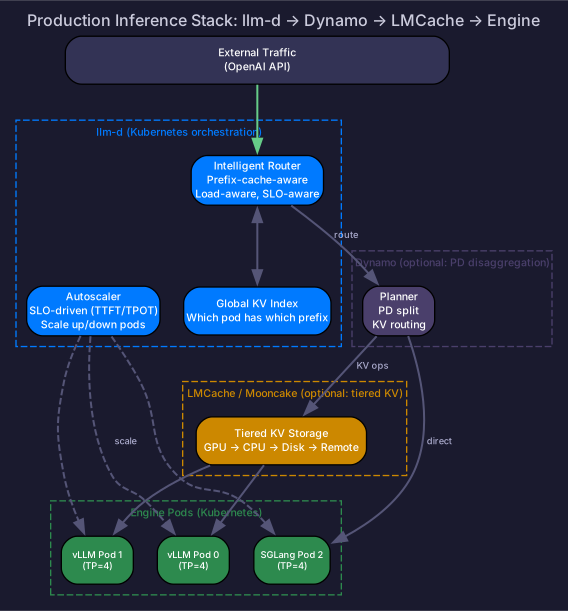
┌─────────────────────────────────────────────────┐
│  llm-d                                          │
│  (Kubernetes orchestration, routing, autoscaling)│
├─────────────────────────────────────────────────┤
│  Dynamo (optional)                              │
│  (PD disaggregation, KV transfer engine)         │
├─────────────────────────────────────────────────┤
│  LMCache / Mooncake (optional)                  │
│  (Tiered KV storage, cross-instance sharing)     │
├─────────────────────────────────────────────────┤
│  vLLM / SGLang                                  │
│  (Single-instance inference engine)              │
└─────────────────────────────────────────────────┘
These layers are composable — you can use llm-d with vLLM alone (simplest), or add Dynamo for disaggregation, or add LMCache for tiered storage. Each layer addresses a different concern.
For the PD disaggregation that llm-d orchestrates, see Dynamo. For the engines underneath, see vLLM Architecture.
Self-Check
- Explain what llm-d adds above vLLM/SGLang (routing, autoscaling, multi-tenancy)
- Describe prefix-cache-aware routing and its cluster-wide benefit
- Explain SLO-driven autoscaling signals (TTFT, TPOT, KV utilization)
- Describe the global KV cache index and tiered offload
- Draw the stack: llm-d → Dynamo → LMCache → vLLM/SGLang