Draft Strategies
Separate draft model, Medusa heads, EAGLE feature prediction, n-gram matching, prompt lookup — how to generate good candidates cheaply.
The draft strategy determines speculative decoding’s effectiveness. A good draft is fast (cheap to generate), accurate (high acceptance rate), and compatible (same tokenizer, same context). This chapter covers the full spectrum from separate models to self-draft approaches.
1. What Makes a Good Draft
| Property | Why it matters | Tradeoff |
|---|---|---|
| Speed | Draft time adds to every round | Faster draft = more net speedup |
| Accuracy | Higher acceptance rate = more tokens per round | Better draft often means larger/slower model |
| Compatibility | Must share tokenizer and produce valid continuations | Limits which models can pair |
The acceptance rate is the probability each candidate is accepted. With acceptance rate and candidates:
At , : expected 3.7 tokens per round. At : only 2.0 tokens.
2. Separate Draft Model
The simplest approach: use a smaller model from the same family.
# vLLM with separate draft model
vllm serve meta-llama/Llama-3.1-70B \
    --speculative-model meta-llama/Llama-3.1-8B \
    --num-speculative-tokens 5 \
--speculative-draft-tensor-parallel-size 1| Consideration | Details |
|---|---|
| Speed | ~5-10× faster than target (smaller model) |
| Accuracy | 60-85% acceptance rate (same family helps) |
| Compatibility | Must share tokenizer; same family strongly preferred |
| Resources | Separate GPU memory for draft model weights + KV cache |
Not any small model works: A 1B model drafting for 70B may have poor acceptance rate because the distribution mismatch is too large. Typically, draft should be 5-10× smaller (8B for 70B, 1B for 8B).
3. N-gram and Prompt Lookup
No draft model at all — find candidates from the existing context:
N-gram Matching
Search the already-generated text for n-grams that match the current suffix:
Generated so far: "The attention mechanism allows the model to focus on"
Current suffix (last 3 tokens): "to focus on"

Search history for "to focus on" → found at position 42:
  "to focus on relevant parts of the input"

Candidate: "relevant parts of the input" (next 5 tokens after match)Pros: Zero compute cost, zero extra memory. Cons: Only works when the model repeats itself (code, repetitive text). Acceptance rate varies wildly — 90%+ for repetitive code, <10% for creative text.
# vLLM with n-gram speculation
vllm serve meta-llama/Llama-3.1-70B \
    --speculative-model [ngram] \
    --num-speculative-tokens 5 \
    --ngram-prompt-lookup-max 4
Prompt Lookup
Similar but searches the input prompt rather than generated text. Useful when the output contains phrases from the input (summarization, extraction).
4. Medusa: Multi-Head Self-Draft
Medusa adds extra prediction heads to the target model itself — no separate model needed:
Standard LM:     hidden_state → LM_head → logits → 1 next token

Medusa:          hidden_state → LM_head    → logits → token t+1 (standard)
                              → Medusa_head_1 → logits → token t+2 (speculative)
                              → Medusa_head_2 → logits → token t+3 (speculative)
                              → Medusa_head_3 → logits → token t+4 (speculative)
Each Medusa head predicts a future token position from the current hidden state, without autoregressive dependency between heads.
Tree Attention
Since each head independently predicts multiple candidates, the candidates form a tree rather than a single chain:
Position t+1: [A, B]          (2 candidates from head 1)
Position t+2: [C, D, E]       (3 candidates from head 2)
Position t+3: [F, G]          (2 candidates from head 3)

Tree structure (12 paths):
  A → C → F
  A → C → G
  A → D → F
  ...
  B → E → G

Verify all 12 paths in one forward pass using tree attention mask
Tree attention lets the target verify all paths simultaneously — the attention mask ensures each path only sees its ancestors, not siblings.
Trade-offs
| Aspect | Medusa |
|---|---|
| Extra parameters | Small (one linear layer per head, ~0.5% of model) |
| Training required | Yes — heads must be trained on target model’s representations |
| Accuracy | Moderate (50-70%) — heads predict independently, miss inter-token dependencies |
| No separate model | ✅ No extra memory for draft model |
5. EAGLE: Feature-Level Prediction
EAGLE improves on Medusa by predicting in feature space rather than token space:
Medusa:  hidden_state_t → predict token_{t+1}, token_{t+2}, ... independently

EAGLE:   hidden_state_t + token_t → small autoregressive network →
         predict hidden_state_{t+1} → predict hidden_state_{t+2} → ...
         Then: each predicted hidden_state → LM_head → candidate token
Key difference: EAGLE’s draft network is autoregressive in feature space — each predicted hidden state depends on the previous one. This captures inter-token dependencies that Medusa’s independent heads miss.
EAGLE Versions
| Version | Innovation | Improvement |
|---|---|---|
| EAGLE | Autoregressive feature prediction | Higher acceptance than Medusa |
| EAGLE-2 | Confidence-based tree budget allocation | Spend more verification on likely paths |
| EAGLE-3 | Improved training + richer input features | Further accuracy gains |
Important: EAGLE checkpoints are model-specific. An EAGLE head trained for Llama-3.1-70B won’t work with Llama-3.1-8B or a different 70B model. Always verify checkpoint compatibility.
6. Choosing a Draft Strategy
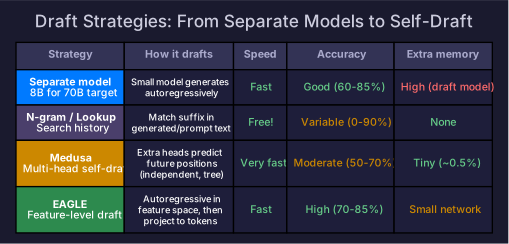
| Strategy | Speed | Accuracy | Extra memory | Training needed | Best for |
|---|---|---|---|---|---|
| Separate model | Fast (small model) | Good (same family) | Draft model weights | No | General purpose |
| N-gram | Free | Variable (0-90%) | None | No | Repetitive text, code |
| Prompt lookup | Free | Variable | None | No | Summarization, extraction |
| Medusa | Very fast (heads only) | Moderate | ~0.5% extra params | Yes | Low-latency, no extra memory |
| EAGLE | Fast | High | Small network | Yes | Best quality, single-user latency |
For how to measure acceptance rate and determine if speculative decoding helps your workload, see Acceptance Rate & Speedup Bounds.
Self-Check
- Calculate expected tokens per round for a given acceptance rate and speculation length
- Explain why draft model should be from the same family as target
- Describe n-gram matching and when it works well vs poorly
- Compare Medusa’s independent heads vs EAGLE’s autoregressive feature prediction
- Explain tree attention and why siblings can’t see each other
- Choose a draft strategy for: (a) general chat, (b) code completion, (c) latency-critical API