Prefill-Decode Disaggregation
Separate GPU pools for prefill vs decode, KV cache transfer, DistServe/Splitwise architectures, Goodput, and P/D ratio planning.
📄 DistServe (OSDI 2024), Splitwise (2024)
Prefill and decode have fundamentally different compute characteristics — mixing them on the same GPU causes interference. Disaggregation separates them into specialized pools, connected by KV cache transfer.
1. The Interference Problem
When prefill and decode share a GPU, long prefills block decode for all co-located requests:
| Metric | Unified (mixed) | Impact |
|---|---|---|
| Decode P99 TPOT | 3-5× worse during long prefills | Users see freezing/stuttering |
| Prefill throughput | Reduced by decode interruptions | Lower overall processing |
| GPU utilization | Suboptimal (neither workload fully served) | Wasted capacity |
Even with chunked prefill (which mitigates the worst case), there’s still interference because prefill chunks consume compute budget that decode needs.
2. The Disaggregated Architecture
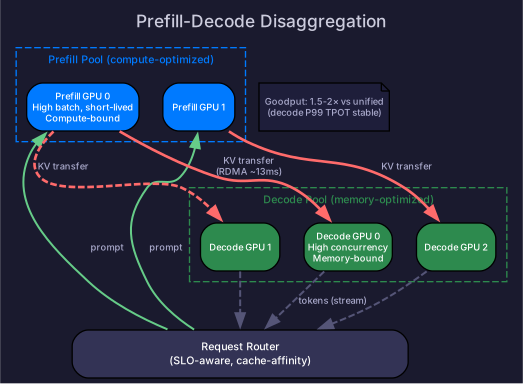
                    ┌────────────────────────┐
                    │  Request Router        │
                    │  (cache-aware, SLO)    │
                    └──────┬─────────────────┘
                           │
              ┌────────────┴────────────┐
              │                         │
    ┌─────────▼─────────┐   ┌──────────▼──────────┐
    │  Prefill Pool      │   │  Decode Pool         │
    │  (compute-optimized)│  │  (memory-optimized)   │
    │  • High batch size  │   │  • High concurrency  │
    │  • Short-lived req  │   │  • Long-lived req    │
    │  • GPU: compute-hot │   │  • GPU: memory-full  │
    └─────────┬──────────┘   └──────────▲──────────┘
              │                         │
              └───── KV Cache Transfer ─┘
                    (RDMA / NVLink / TCP)
How It Works
- Request arrives at router
- Router assigns request to a prefill worker (based on compute availability)
- Prefill worker processes the entire prompt → produces KV cache
- KV cache transferred to a decode worker (via RDMA, shared memory, or TCP)
- Decode worker continues token generation using the transferred KV
- When complete, decode worker frees KV and slot
3. KV Cache Transfer: The Critical Path
The transfer time determines whether disaggregation is practical:
| Model | Context | KV size | RDMA (50 GB/s) | TCP (10 GB/s) |
|---|---|---|---|---|
| 70B (GQA-8) | 2K | 0.63 GB | 13 ms | 63 ms |
| 70B (GQA-8) | 8K | 2.5 GB | 50 ms | 250 ms |
| 70B (GQA-8) | 32K | 10 GB | 200 ms | 1000 ms |
RDMA is essential for disaggregation — TCP transfer adds hundreds of milliseconds to TTFT, often negating the benefit.
KV Connector Abstraction
vLLM’s KV Connector provides a pluggable interface for transfer:
# Transfer backends:
# - NIXL: NVIDIA's high-performance transfer library
# - NCCL: GPU-to-GPU via collective communication
# - Shared memory: same-node transfer (fastest)
# - TCP: fallback for cross-datacenter
4. Key Research: DistServe and Splitwise
DistServe (OSDI 2024)
Systematic analysis proving that disaggregation improves goodput (throughput meeting SLA targets):
- Key finding: Under the same SLA (e.g., P99 TPOT < 100ms), disaggregated serving achieves 1.5-2× the goodput of unified serving
- Mechanism: Decode pool runs without prefill interference → P99 TPOT stays flat even under load
- Architecture: Prefill and decode as separate vLLM instances with KV transfer via NCCL
Splitwise (ISCA 2024)
Proposes optimizing GPU pool composition for each phase:
- Prefill pool: Compute-optimized GPUs (high TFLOPS, can use older/cheaper GPUs)
- Decode pool: Memory-optimized GPUs (high HBM bandwidth, more KV cache capacity)
- Heterogeneous hardware: Different GPU types for different phases
5. Goodput and SLO-Aware Scheduling
Goodput = throughput of requests that meet the SLA target. It’s the metric that matters:
| Configuration | Raw RPS | SLA compliance | Goodput |
|---|---|---|---|
| Unified, aggressive batching | 100 | 60% | 60 |
| Unified, conservative | 70 | 95% | 66.5 |
| Disaggregated | 90 | 95% | 85.5 |
Disaggregation wins on goodput because decode TPOT stays predictable — no prefill interference spikes.
6. P/D Pool Ratio
How many GPUs for prefill vs decode?
| Workload | Prefill fraction | Decode fraction | Recommended P:D ratio |
|---|---|---|---|
| Short prompts, long outputs (chat) | 10% compute | 90% compute | 1:8 |
| Long prompts, short outputs (summarization) | 70% compute | 30% compute | 2:1 |
| Balanced (general API) | 30% compute | 70% compute | 1:3 |
The ratio depends on your workload — measure prefill and decode compute fractions from your actual traffic, then allocate GPU pools proportionally.
7. When (Not) to Disaggregate
| Scenario | Disaggregate? | Why |
|---|---|---|
| Single-user low-latency | No | Transfer overhead > interference cost |
| Mixed workloads, SLA targets | Yes | Decode TPOT stability crucial |
| Long prompts + concurrent users | Yes | Prefill interference is worst here |
| Small model (8B) on one GPU | No | No interference (fast prefill) |
| All prompts same length | Maybe | Less interference variance, less benefit |
For the systems that implement disaggregation, see Dynamo and LMCache & Mooncake.
Self-Check
- Explain why prefill and decode interfere when mixed on the same GPU
- Calculate KV cache transfer time for a given model and context length
- Explain why RDMA is essential (vs TCP) for disaggregation
- Define goodput and calculate it for given RPS and SLA compliance
- Determine P/D GPU ratio for a given workload mix
- Identify when disaggregation helps vs adds unnecessary complexity