LMCache & Mooncake
Tiered KV storage (GPU→CPU→disk→remote), transfer engine, cross-instance KV sharing — the infrastructure layer for KV cache at cluster scale.
As inference scales beyond a single GPU, KV cache management becomes a distributed systems problem. LMCache and Mooncake provide the infrastructure layer — tiered storage, high-speed transfer, and cross-instance sharing — that makes disaggregated serving practical.
1. The Problem: KV Cache Doesn’t Fit on One GPU
At scale, three scenarios demand KV cache infrastructure beyond PagedAttention:
| Scenario | Problem | What’s needed |
|---|---|---|
| Long context (128K+) | KV cache exceeds GPU memory for many concurrent requests | Offload cold KV to CPU/disk |
| PD disaggregation | Prefill and decode on different GPUs | Transfer KV between machines at high speed |
| Multi-instance serving | Multiple vLLM/SGLang instances serving same model | Share cached prefixes across instances (avoid redundant prefill) |
2. LMCache: KV Cache Management Layer
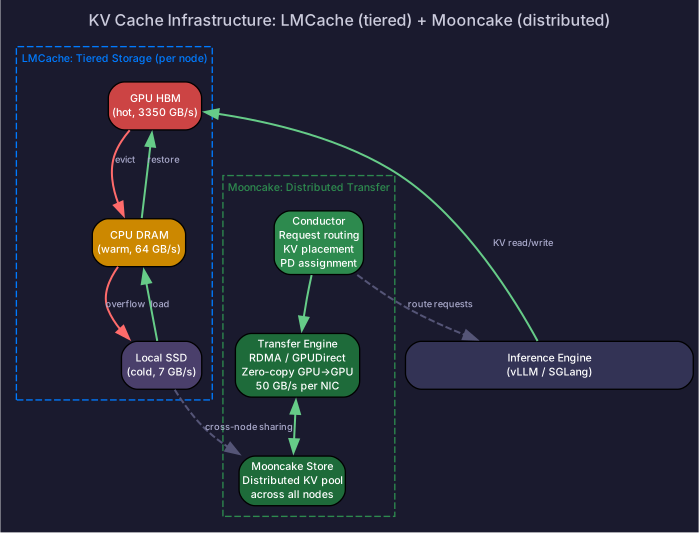
LMCache is a middleware that sits between the inference engine (vLLM/SGLang) and the storage hierarchy:
┌─────────────────────────────────────────────┐
│  Inference Engine (vLLM / SGLang)           │
│  Generates and consumes KV cache            │
├─────────────────────────────────────────────┤
│  LMCache Integration Layer                  │
│  KV event tracking, cache-aware scheduling  │
├──────────┬──────────┬───────────┬───────────┤
│  GPU     │  CPU     │  Local    │  Remote   │
│  HBM     │  DRAM    │  SSD      │  Network  │
│  (hot)   │  (warm)  │  (cold)   │  (shared) │
│  3350    │  64      │  7        │  25-100   │
│  GB/s    │  GB/s    │  GB/s     │  GB/s     │
└──────────┴──────────┴───────────┴───────────┘
Tiered Storage
LMCache manages KV cache across multiple storage tiers:
- GPU HBM (hot): Active KV for currently generating requests — fastest, most expensive
- CPU DRAM (warm): Recently evicted KV — fast to restore (~1ms for a block via PCIe)
- Local SSD (cold): KV from older requests — slower but much larger capacity
- Remote store (shared): KV accessible by other instances — enables prefix sharing across the cluster
Cache-Aware Scheduling
LMCache integrates with the inference engine’s scheduler to make KV-aware decisions:
# When a new request arrives:
# 1. Check if prefix KV exists in local GPU cache → skip prefill (fastest)
# 2. Check CPU DRAM → restore to GPU (fast)
# 3. Check local SSD → load to GPU (slower)
# 4. Check remote store → fetch via network (slowest, but avoids full prefill)
# 5. No cache hit → full prefill (most expensive)
Integration with vLLM
# vLLM with LMCache
from vllm import LLM

llm = LLM(
    model="meta-llama/Llama-3.1-70B",
    kv_connector="lmcache",
    kv_connector_config={
        "cpu_memory_gb": 32,        # 32 GB CPU for warm KV
        "disk_path": "/local_ssd/kv_cache",
        "remote_url": "redis://kv-store:6379",
    }
)
3. Mooncake: KV Cache-Centric Disaggregated Architecture
Mooncake takes a different approach — instead of adding caching to an existing engine, it builds the entire serving architecture around KV cache management.
Core Components
┌────────────────────────────────────────────────────┐
│  Conductor (orchestrator)                          │
│  Request routing, KV placement decisions,          │
│  prefill/decode assignment                         │
├─────────────┬──────────────────────────────────────┤
│  Transfer   │  Mooncake Store                      │
│  Engine     │  Distributed KV cache pool           │
│  RDMA/TCP   │  across all nodes                    │
│  direct     │  (CXL, RDMA, or TCP transport)       │
│  GPU-GPU    │                                      │
├─────────────┴──────────────────────────────────────┤
│  Prefill Workers    │    Decode Workers             │
│  (compute-heavy)    │    (memory-heavy)             │
│  Generate KV cache  │    Consume KV, generate tokens│
└─────────────────────┴──────────────────────────────┘
Transfer Engine
The heart of Mooncake — a high-performance data transfer layer for moving KV cache between GPUs:
| Transport | Bandwidth | Latency | Use case |
|---|---|---|---|
| GPU-GPU (NVLink) | 900 GB/s | ~5 μs | Same node |
| RDMA (InfiniBand) | 50 GB/s per NIC | ~2 μs | Cross-node |
| TCP | 10-25 GB/s | ~50 μs | Fallback |
Key optimization: Zero-copy transfer — KV blocks are sent directly from one GPU’s memory to another GPU’s memory via GPUDirect RDMA, bypassing CPU entirely.
KV Cache Transfer for PD Disaggregation
1. Request arrives at Conductor
2. Conductor assigns Prefill Worker (GPU with most compute capacity)
3. Prefill Worker processes prompt → KV cache produced in GPU memory
4. Transfer Engine moves KV cache to Decode Worker via RDMA
   (e.g., 1.25 GB for 70B 4K context → ~25ms at 50 GB/s)
5. Decode Worker starts generating tokens using transferred KV
The transfer latency (25ms for 4K context) is comparable to the prefill time itself — so PD disaggregation roughly doubles throughput by letting prefill and decode run in parallel on separate GPUs.
4. LMCache vs Mooncake
| LMCache | Mooncake | |
|---|---|---|
| Approach | Middleware layer added to existing engines | Complete disaggregated architecture |
| Integration | Plugin for vLLM/SGLang | Own orchestrator (Conductor) |
| Storage | Tiered (GPU → CPU → disk → remote) | Distributed KV store (Mooncake Store) |
| Transport | Standard networking | Custom Transfer Engine (RDMA-optimized) |
| Best for | Adding caching to existing deployment | Greenfield disaggregated deployment |
| Maturity | Production-ready with vLLM | Production at Moonshot AI, open-source |
Complementary Use
In practice, these tools complement each other:
- LMCache for tiered storage within a node (hot/warm/cold KV)
- Mooncake for high-speed KV transfer between nodes in a disaggregated setup
- Both can be used with vLLM/SGLang as the underlying engine
5. Practical Impact
| Metric | Without KV infra | With LMCache/Mooncake |
|---|---|---|
| Prefix cache hit rate (multi-instance) | 0% (each instance independent) | 60-90% (shared across instances) |
| Max concurrent requests (128K context) | 1 per 80GB GPU | 5-10× more (offload cold KV) |
| PD disaggregation feasible? | No (can’t transfer KV fast enough) | Yes (RDMA transfer ~25ms for 4K) |
| System throughput at scale | Limited by single-instance memory | 2-3× improvement from sharing + disaggregation |
For the conceptual foundation of prefix sharing, see Prefix Caching. For PD disaggregation concepts, see Distributed KV Cache (covered in the Distributed Inference section).
Self-Check
- Explain the three scenarios where KV cache infrastructure is needed beyond PagedAttention
- Describe LMCache’s tiered storage hierarchy and cache-aware scheduling
- Describe Mooncake’s Conductor + Transfer Engine architecture
- Calculate KV transfer time for PD disaggregation (70B, 4K context, RDMA)
- Compare LMCache vs Mooncake and when to use each