Tensor-Parallel Serving
Splitting a model across 2/4/8 GPUs within a node for latency reduction — how inference TP differs from training TP.
Tensor parallelism for inference splits model weights across GPUs within a node to reduce per-request latency and fit models that exceed single-GPU memory. The mechanics are the same as training TP, but the goals and tradeoffs differ.
1. Why TP for Inference
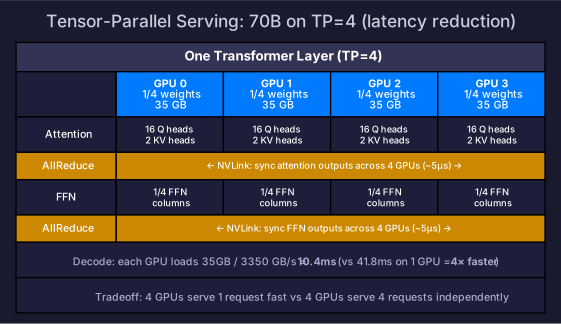
Two reasons to use TP for serving:
| Reason | Example |
|---|---|
| Model doesn’t fit | 70B BF16 = 140 GB > 80 GB GPU → need TP≥2 |
| Latency reduction | Decode step on 70B: 42ms (1 GPU) → ~5ms (TP=8) |
How TP Reduces Latency
Each GPU loads only of the weights. Decode is memory-bandwidth-bound:
8× less weight data → 8× faster decode (minus AllReduce overhead).
2. TP in Inference vs Training
| Aspect | Training TP | Inference TP |
|---|---|---|
| Goal | Fit model + activations | Fit model + KV cache, reduce latency |
| Communication per layer | 2× AllReduce (forward + backward) | 1× AllReduce (forward only) |
| Batch size | Large (hundreds of sequences) | Variable (1 to hundreds) |
| Key overhead | Acceptable (hidden by compute) | Critical (directly adds to TPOT) |
| Typical TP degree | 8 (full node) | 2, 4, or 8 (minimize for cost) |
Inference prefers the minimum TP degree that fits the model + KV cache. More TP = lower latency per request, but fewer requests per GPU (each GPU is partially occupied by one request’s TP group).
3. AllReduce Overhead for Inference
Each Transformer layer requires 2 AllReduce operations (attention output + FFN output). For inference:
For small messages (single-token decode: 16 KB per AllReduce), the overhead is dominated by latency (~5μs per AllReduce call on NVLink), not bandwidth:
Over 80 layers: total AllReduce overhead.
At larger batch sizes (batch=32+), the message grows to 512 KB+ and bandwidth starts to matter, but NVLink’s 900 GB/s keeps it under 1ms total.
On InfiniBand (50 GB/s, ~5μs latency), the same 160 AllReduces would take for latency alone — but real-world IB AllReduce for small messages takes ~20-50μs due to protocol overhead, giving . This is 6× slower than NVLink, making cross-node TP impractical for latency-sensitive serving.
4. TP and KV Cache
With TP, each GPU stores KV cache only for its assigned heads:
For GQA models with : TP=8 means each GPU stores just 1 KV head per layer. This is efficient — each GPU’s KV cache is 1/8 of the total.
But: If , some GPUs have no KV heads for certain layers. This happens with MQA () at TP>1 — the single KV head must be broadcast to all TP ranks, adding communication.
5. Choosing TP Degree for Serving
| Model | Weights (BF16) | Min TP (80GB) | Recommended TP | Why |
|---|---|---|---|---|
| 8B | 16 GB | 1 | 1 | Fits easily, TP adds overhead |
| 13B | 26 GB | 1 | 1 | Fits, avoid overhead |
| 70B | 140 GB | 2 | 2-4 | TP=2 fits, TP=4 halves latency |
| 70B (INT4) | 35 GB | 1 | 1 | Quantization removes the need for TP |
| 405B | 810 GB | 11 | 8 + PP=2 | Doesn’t fit even at TP=8 |
When TP Isn’t Enough: Pipeline Parallelism
For models that don’t fit even at TP=8 (e.g., 405B = 810 GB > 8 × 80 GB), add PP:
| Config | How it works | Latency impact |
|---|---|---|
| TP=8, PP=2 | 2 nodes, each with TP=8. Layers split across nodes. | ~2× per-layer latency (sequential across PP stages) |
| TP=4, PP=4 | 4 groups of 4 GPUs | Higher latency but uses less NVLink per group |
PP for inference has no pipeline bubble (only one request flows through at a time — no micro-batching). But each PP stage adds an inter-node P2P transfer, increasing TTFT and TPOT. Use PP only when TP alone can’t fit the model.
Key tradeoff: Higher TP = lower latency but fewer independent serving instances per node. TP=8 on 8 GPUs = 1 instance. TP=2 on 8 GPUs = 4 independent instances (higher aggregate throughput).
# vLLM with TP=4
vllm serve meta-llama/Llama-3.1-70B --tensor-parallel-size 4

# TP=2 for throughput (4 instances on 8 GPUs)
# Instance 0: GPUs 0,1
CUDA_VISIBLE_DEVICES=0,1 vllm serve ... --tensor-parallel-size 2 --port 8000
# Instance 1: GPUs 2,3
CUDA_VISIBLE_DEVICES=2,3 vllm serve ... --tensor-parallel-size 2 --port 8001
For TP mechanics (column/row splitting, AllReduce patterns), see Tensor Parallelism. For how engines implement TP workers, see vLLM Architecture.
Self-Check
- Calculate decode latency reduction from TP (weight size / TP / HBM bandwidth)
- Calculate AllReduce overhead per layer and total for a given model
- Explain why TP must stay intra-node (NVLink vs InfiniBand latency)
- Explain the TP-degree vs instance-count tradeoff for throughput
- Choose TP degree for a given model size and latency/throughput goal
- Explain how GQA interacts with TP for KV cache distribution