Edge Inference Engines
llama.cpp, ExecuTorch, ONNX Runtime Mobile, Core ML, MLC-LLM — cross-platform compilation and runtime selection.
Edge inference engines bridge the gap between trained models and on-device execution — handling model loading, graph optimization, hardware delegation, and memory management on constrained devices.
1. The Model-to-Device Pipeline
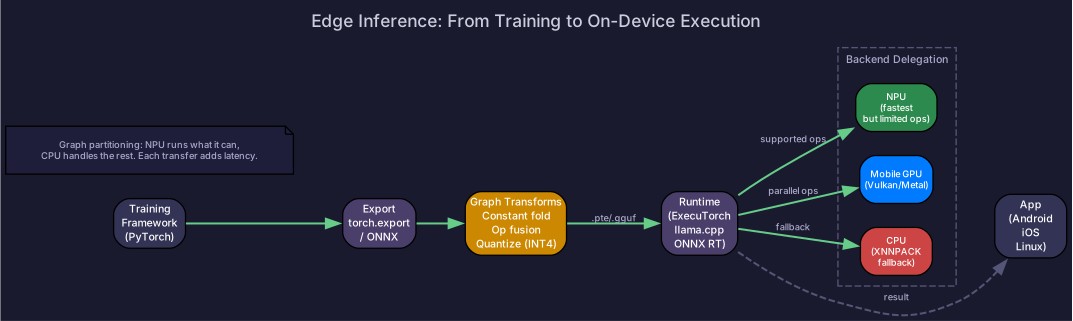
Training framework (PyTorch/TF)
  → Export (torch.export / ONNX)
  → Graph transforms (constant folding, op fusion, quantization)
  → Backend compilation (CPU/GPU/NPU/DSP delegation)
  → Runtime package (.pte / .gguf / .mlpackage / .tflite)
  → On-device execution
Three concepts to distinguish:
- Model format (IR): Describes the computation graph — ONNX, TorchScript, GGUF
- Runtime: Loads the model, manages memory, launches execution — ExecuTorch, ONNX Runtime
- Backend/Delegate: Actually computes operations — XNNPACK (CPU), Core ML (Apple), Vulkan (GPU), QNN (Qualcomm NPU)
The runtime doesn’t compute every op itself — it delegates supported subgraphs to hardware backends and falls back to CPU for unsupported ops.
2. Runtime Comparison
| Runtime | Source | Backends | LLM support | Best for |
|---|---|---|---|---|
| llama.cpp | GGUF | CPU, Metal, Vulkan, CUDA | ✅ Native | Local/edge LLM, simplest setup |
| ExecuTorch | torch.export | XNNPACK, Vulkan, Core ML, QNN | ✅ | PyTorch ecosystem, multi-backend |
| ONNX Runtime Mobile | ONNX | CPU, NNAPI, Core ML, DML | ⚠️ Limited | Cross-framework, broad compatibility |
| Core ML | Core ML model | Apple CPU, GPU, Neural Engine | ✅ (via converters) | iOS/macOS native apps |
| LiteRT (TFLite) | TFLite | CPU, GPU delegate, NNAPI | ⚠️ Limited | Google/Android ecosystem |
| MLC-LLM | Compiled | CPU, Metal, Vulkan, WebGPU | ✅ Native | Cross-platform compiled LLM |
| ncnn | ONNX/pnnx | ARM CPU, Vulkan | ❌ | Lightweight C++, mobile vision |
| MNN | ONNX/TFLite | CPU, GPU, Metal | ✅ | Chinese mobile ecosystem |
Choosing a Runtime
LLM on device?
  ├── Yes, simplest setup → llama.cpp (GGUF)
  ├── Yes, PyTorch ecosystem → ExecuTorch
  ├── Yes, cross-platform compiled → MLC-LLM
  └── Yes, iOS only → Core ML

Vision/audio model?
  ├── PyTorch model → ExecuTorch or ONNX Runtime
  ├── TensorFlow model → LiteRT
  ├── iOS only → Core ML
  └── Lightweight C++ → ncnn
3. llama.cpp: The Default for Edge LLMs
# Build
cmake -B build -DGGML_METAL=ON  # macOS with Metal GPU
cmake --build build

# Run 3B model in Q4_K_M quantization
./build/bin/llama-cli \
    -m llama-3.2-3b-Q4_K_M.gguf \
    -p "Explain CUDA in one paragraph" \
    -n 200 \
    --threads 4 \
    --gpu-layers 33  # offload all layers to GPU
Key features: Single-file GGUF format, built-in quantization, CPU+GPU hybrid (split layers between CPU and GPU), Metal/Vulkan GPU backends, runs on everything from Raspberry Pi to M4 Mac.
4. ExecuTorch: PyTorch Native
# Export model
import torch
from executorch.exir import to_edge

model = load_model("llama-3.2-1b")
example_input = torch.randint(0, 32000, (1, 128))
exported = torch.export.export(model, (example_input,))

# Lower to edge with XNNPACK backend
edge_program = to_edge(exported)
edge_program = edge_program.to_backend("XnnpackPartitioner")
et_program = edge_program.to_executorch()

# Save
with open("model.pte", "wb") as f:
    f.write(et_program.buffer)
Key features: Native PyTorch workflow (torch.export), pluggable backends (XNNPACK for CPU, Core ML, Vulkan, QNN), graph partitioning (unsupported ops fall back to CPU).
5. Graph Partitioning: The Real-World Challenge
No backend supports every operation. The runtime must:
- Analyze which ops the backend supports
- Partition the graph: supported subgraphs → backend, rest → CPU
- Execute with data transfers between partitions
Model graph: [Embedding → Attention → LayerNorm → FFN → ...]

NPU supports: Attention ✅, FFN ✅
NPU doesn't support: Embedding ❌, LayerNorm ❌

Partitioned:
  CPU: [Embedding] → transfer → NPU: [Attention] → transfer →
  CPU: [LayerNorm] → transfer → NPU: [FFN] → transfer → CPU: [...]
Each transfer adds latency. A model with 50% NPU coverage may be slower than 100% CPU due to transfer overhead. Always benchmark the partitioned execution, not just the supported ops.
For edge-cloud collaboration (when the device isn’t powerful enough), see Edge-Cloud Collaboration.
Self-Check
- Distinguish model format, runtime, and backend/delegate
- Choose a runtime for: (a) LLM on iPhone, (b) vision model on Android, (c) LLM on Linux laptop
- Set up llama.cpp with GPU layer offloading
- Export a PyTorch model to ExecuTorch with XNNPACK backend
- Explain graph partitioning and why partial NPU coverage can be slower than full CPU