Core Idea: Draft & Verify
Small model drafts K tokens, target model verifies all K in one forward pass — the acceptance rule, rejection sampling, and why it's mathematically lossless.
Speculative decoding turns the sequential decode bottleneck into a parallel verification problem: a fast draft model proposes multiple tokens, and the target model checks them all in one forward pass. When the draft is good, you get multiple tokens for the cost of ~one decode step.
1. The Serial Bottleneck
Standard autoregressive decoding generates one token per step. Each step loads the entire model’s weights from HBM — regardless of whether you generate 1 token or 100, the weight-loading cost is the same.
The insight: If we could verify candidate tokens in one forward pass (similar to prefill), we’d get tokens for roughly the cost of one. The model weights are loaded once, but do useful work for positions.
2. The Draft-Verify Loop
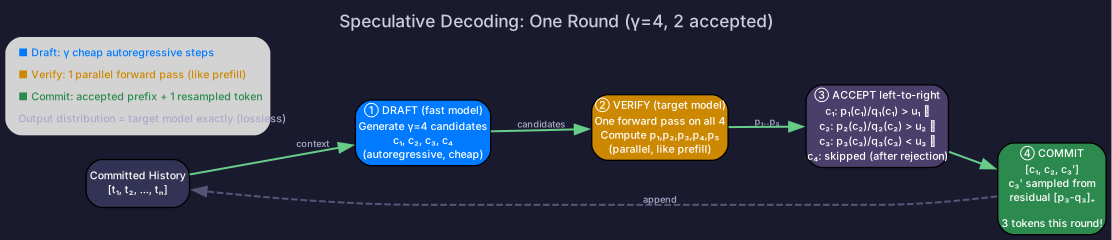
Each speculative decoding round:
1. DRAFT: Fast model generates γ candidate tokens autoregressively
   y₁, y₂, ..., yγ  (each conditioned on history + previous candidates)

2. VERIFY: Target model processes all γ candidates in ONE forward pass
   Computes p₁(·), p₂(·), ..., pγ(·), p_{γ+1}(·)
   (using causal attention — each position sees only prior tokens)

3. ACCEPT/REJECT: Check candidates left-to-right
   Accept y₁ if it passes → check y₂ → ... → stop at first rejection

4. COMMIT: Submit accepted prefix + one corrected token
   If all γ accepted → also sample from p_{γ+1} → submit γ+1 tokens
   If rejected at position k → submit y₁..y_{k-1} + resample from pₖ → k tokens
Why the target can verify in parallel: The candidates form a known sequence. Like prefill, the target computes all positions simultaneously via causal attention — position only sees the history and candidates , never peeking at future candidates.
3. The Acceptance Rule
Greedy Decoding (temperature = 0)
Simple: accept candidate if it equals the target’s argmax at that position:
Stop at the first mismatch; replace with the target’s choice.
Random Sampling (temperature > 0)
The standard speculative sampling rule — accept with probability proportional to how well the draft matches the target:
Draw . Accept if .
- If : target likes this token at least as much as draft → always accept
- If : draft overestimates → accept with probability
The Rejection Resample (Critical for Correctness)
When a candidate is rejected, you cannot simply sample from . The correct resample distribution compensates for the probability mass already “consumed” by the acceptance path:
Key insight: The acceptance path contributes tokens with probability . The rejection path must contribute the remaining probability mass to make the overall distribution exactly . Skipping this correction — e.g., just sampling from on rejection — subtly changes the output distribution.
4. Why This Is Mathematically Lossless
For any token at position , the probability of outputting is:
The two paths sum to exactly — the target model’s distribution. The output distribution is identical to running the target model alone. No quality degradation, no approximation.
This guarantee holds per-token. For sequences, once a token is accepted, the subsequent positions are conditioned on it — the chain of correct single-position distributions produces correct sequence distributions.
5. KV Cache Management
A subtle but important detail: draft tokens are candidates, not committed history.
Before round: KV cache has committed tokens [t₁, t₂, ..., tₙ]

Draft generates: [c₁, c₂, c₃, c₄]
  Draft model has its own KV cache (or shares with target)

Verify: target processes [c₁, c₂, c₃, c₄] with causal attention
  Target KV cache temporarily has [t₁..tₙ, c₁, c₂, c₃, c₄]

Accept: c₁, c₂ accepted, c₃ rejected → resample c₃'
  Keep KV for [t₁..tₙ, c₁, c₂, c₃']
  Discard KV for [c₃, c₄] from target cache

After round: KV cache = [t₁..tₙ, c₁, c₂, c₃']
The engine must roll back KV cache entries for rejected tokens. This is straightforward with PagedAttention — just don’t advance the sequence length past the accepted prefix.
For draft strategies and how to choose between them, see Draft Strategies. For speedup analysis, see Acceptance Rate & Speedup Bounds.
Self-Check
- Explain why the target can verify γ candidates in one forward pass (causal attention, like prefill)
- Write the acceptance probability formula for random sampling
- Explain why rejection resampling from is necessary (not just from )
- Prove that the output distribution equals the target’s:
- Describe KV cache management: what happens to rejected candidates’ KV entries
- Explain the difference between greedy and sampling acceptance rules