Expert Parallelism for MoE Inference
Expert placement, replication strategies, load balancing for skewed routing, and the All-to-All communication challenge.
MoE models like DeepSeek-V3 (671B, 256 experts) require expert parallelism at inference time — distributing experts across GPUs and routing tokens via All-to-All communication. The inference challenge is different from training: latency matters per-request, and routing patterns are unpredictable.
1. Why EP for Inference
MoE models have many parameters but only activate a subset per token:
| Model | Total params | Active params/token | Top-k | Experts |
|---|---|---|---|---|
| Mixtral 8×7B | 47B | 13B | 2 | 8 |
| DeepSeek-V3 | 671B | 37B | 2 | 256 |
| Llama-4 Maverick | 400B | 17B | 1 | 128 |
The total weight size may be too large for a single node. EP distributes experts across GPUs:
DeepSeek-V3 with EP=64: experts per GPU.
2. The All-to-All Communication Pattern
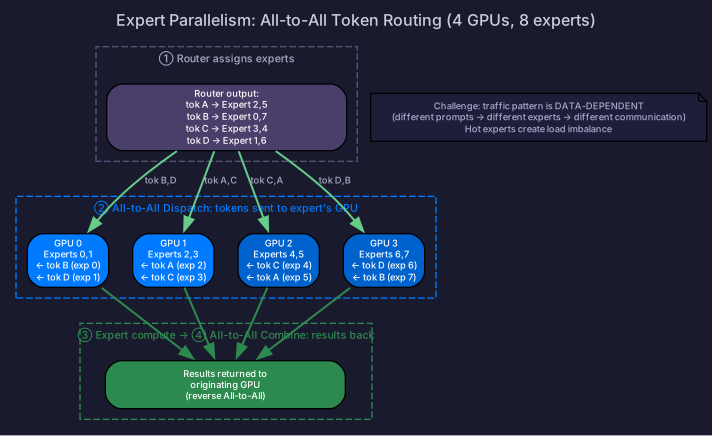
Each MoE layer requires token routing:
1. Router computes expert assignments for each token
2. ALL-TO-ALL DISPATCH: send each token to its assigned expert's GPU
3. Expert compute: each GPU runs its local experts
4. ALL-TO-ALL COMBINE: send results back to originating GPU
Unlike TP’s AllReduce (same data pattern every step), All-to-All traffic is data-dependent — different prompts route to different experts, creating unpredictable communication patterns.
3. Expert Placement Strategies
Uniform Placement
Simplest: distribute experts evenly across GPUs.
64 GPUs, 256 experts:
  GPU 0: experts 0-3
  GPU 1: experts 4-7
  ...
GPU 63: experts 252-255Problem: Some experts receive more tokens than others (skewed routing). Hot experts become bottlenecks while cold experts’ GPUs sit idle.
Replication of Hot Experts
Replicate frequently-used experts on multiple GPUs:
Expert 0 (hot): replicated on GPUs 0, 16, 32, 48
Expert 200 (cold): only on GPU 50

Router sends tokens to least-loaded replica of the assigned expertTradeoff: Replication uses more memory but balances load.
Dynamic Rebalancing
Monitor expert load and migrate/replicate at runtime:
If expert_load[i] > 2× average:
    Replicate expert i to an underloaded GPU
If expert_load[j] < 0.5× average:
    Remove one replica of expert j (free memory)
4. Load Balancing for Inference
| Challenge | Training solution | Inference difference |
|---|---|---|
| Skewed routing | Auxiliary loss | Can’t change loss at inference — must handle skew |
| Token dropping | Drop overflow tokens | Unacceptable — every token must be processed |
| Expert capacity | Fixed capacity per expert | Must handle worst-case without dropping |
Inference-Specific Solutions
- Expert capacity buffer: Over-provision each GPU’s compute for the expected maximum load
- Token buffering: Queue excess tokens and process in the next step (adds latency)
- Routing-aware scheduling: Batch requests with complementary routing patterns
5. Wide Expert Parallelism
For very large MoE models, EP spans multiple nodes:
DeepSeek-V3 on 8 nodes (64 GPUs):
  Node 0-1 (16 GPUs): Attention layers (TP=8 within each node)
  Node 2-7 (48 GPUs): Expert layers (EP=48, ~5 experts per GPU)

  All-to-All crosses InfiniBand between nodes — 50 GB/s per NIC
The InfiniBand bottleneck: All-to-All across 48 GPUs on IB is much slower than within a node on NVLink. llm-d’s “wide EP” approach addresses this with optimized NCCL configurations and UCCL transport.
6. EP for Inference: Practical Configuration
# vLLM doesn't directly expose EP — it's handled through TP
# For MoE models, vLLM places experts across TP ranks

# SGLang with EP support
python -m sglang.launch_server \
    --model deepseek-ai/DeepSeek-V3 \
    --tp 8 \
    --ep 8 \
    --trust-remote-code
For the training perspective on EP and All-to-All, see Expert Parallelism. For orchestrating wide EP at scale, see llm-d.
Self-Check
- Calculate experts per GPU for a given model and EP degree
- Describe the All-to-All dispatch/combine pattern for MoE inference
- Explain why load balancing is harder at inference than training (no aux loss, no dropping)
- Compare uniform placement vs hot-expert replication
- Explain the IB bottleneck for wide EP across nodes