vLLM Architecture
V1 engine internals — EngineCore, Scheduler, ModelRunner, Worker, KV cache coordinator, and how inference concepts map to production code.
vLLM is the most widely deployed open-source LLM inference engine. Understanding its architecture — how the concepts from previous chapters (PagedAttention, continuous batching, chunked prefill) are implemented as interacting components — is essential for anyone operating or extending an inference system.
1. Architecture Overview
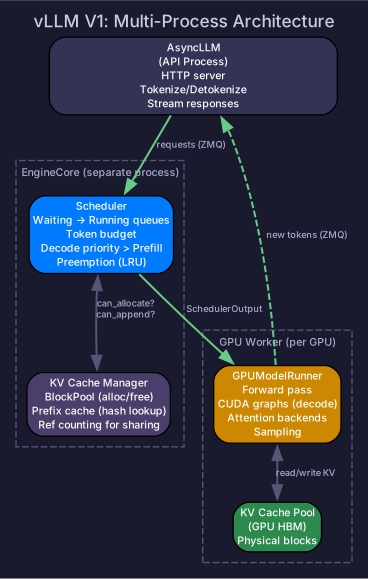
vLLM V1 has a multi-process architecture with clear separation of concerns:
┌─────────────────────────────────────────────────────────┐
│  AsyncLLM (API layer)                                   │
│  OpenAI-compatible HTTP server, request tracking        │
├────────────────────────┬────────────────────────────────┤
│  InputProcessor        │  OutputProcessor / Detokenizer │
│  Tokenize, validate    │  Detokenize, stream to client  │
├────────────────────────┴────────────────────────────────┤
│  EngineCore (separate process, ZMQ communication)       │
│  ┌──────────────────┐  ┌─────────────────────────────┐  │
│  │ Scheduler        │  │ KV Cache Manager            │  │
│  │ Token budget,    │  │ BlockPool, prefix caching,  │  │
│  │ request queues,  │  │ KV cache coordinator        │  │
│  │ preemption       │  │                             │  │
│  └──────────────────┘  └─────────────────────────────┘  │
├─────────────────────────────────────────────────────────┤
│  Worker(s) (one per GPU, may be separate processes)     │
│  ┌─────────────────────────────────────────────────┐    │
│  │ GPUModelRunner                                  │    │
│  │ Forward pass, attention backends, CUDA graphs,  │    │
│  │ sampling, KV cache pool on GPU                  │    │
│  └─────────────────────────────────────────────────┘    │
└─────────────────────────────────────────────────────────┘
Key Design Decisions
- EngineCore runs in a separate process from the API server — CPU-heavy scheduling doesn’t compete with I/O-heavy HTTP handling
- ZMQ for IPC — EngineCore and AsyncLLM communicate via ZeroMQ sockets (faster than Python multiprocessing queues)
- Scheduler is CPU-only — no GPU operations in the scheduling path, keeping it fast
- Worker owns the GPU — all CUDA operations (model forward, KV cache allocation, sampling) happen in the Worker process
2. The Main Loop
Every decode iteration:
# Simplified EngineCore.step()
def step(self):
    # 1. Scheduler decides what to run
    scheduler_output = self.scheduler.schedule()

    # 2. Send scheduled batch to GPU worker
    model_output = self.model_executor.execute(scheduler_output)

    # 3. Process outputs (new tokens, finish reasons)
    engine_outputs = self.process_outputs(model_output, scheduler_output)

    # 4. Send outputs to AsyncLLM (via ZMQ) for streaming
    return engine_outputs
This loop runs continuously — there’s no “wait for a batch to fill.” Every iteration, the scheduler assembles the best possible batch from waiting and running requests, and executes it immediately.
3. The Scheduler
The V1 scheduler (v1/core/sched/scheduler.py) manages three queues:
| Queue | Contains | Transitions |
|---|---|---|
| Waiting | New requests not yet started | → Running (when resources available) |
| Running | Active requests (prefill or decode) | → Finished (EOS/max_tokens) or → Waiting (preempted) |
| Completed | Requests that hit EOS/max_tokens | → output sent, resources freed |
Scheduling Algorithm
def schedule(self):
    budget = self.token_budget  # e.g., 2048
    batch = []

    # Priority 1: Running decode requests (1 token each)
    for req in self.running:
        if not self.kv_cache_manager.can_append(req):
            self.preempt(req)  # out of KV blocks → preempt
            continue
        batch.append(ScheduleDecodeOp(req))
        budget -= 1

    # Priority 2: Waiting requests get prefill chunks
    for req in self.waiting:
        chunk_size = min(req.remaining_prefill, budget)
        blocks_needed = ceil(chunk_size / self.block_size)
        if not self.kv_cache_manager.can_allocate(blocks_needed):
            break  # no memory → stop admitting
        batch.append(SchedulePrefillOp(req, chunk_size))
        budget -= chunk_size
        if budget <= 0:
            break

    return SchedulerOutput(batch)
The scheduler implements all the concepts from earlier chapters:
- Continuous batching: running requests are always included, new requests admitted per-step
- Chunked prefill:
chunk_size = min(remaining, budget)— long prefills are broken into pieces - Token budget: decode priority, prefill fills the remainder
- Preemption: when KV blocks run out, evict LRU requests
4. KV Cache Manager & Block Pool
The BlockPool is the physical memory allocator for KV cache:
class BlockPool:
    """Pool of physical KV cache blocks on GPU."""
    def __init__(self, num_blocks, block_size):
        self.free_blocks: list[int]     # indices of available blocks
        self.ref_counts: dict[int, int] # reference counting for sharing

    def allocate(self, n) -> list[int]:
        """Allocate n physical blocks from the free pool."""
        return [self.free_blocks.pop() for _ in range(n)]

    def free(self, block_ids):
        """Return blocks to free pool (if ref_count reaches 0)."""
        for bid in block_ids:
            self.ref_counts[bid] -= 1
            if self.ref_counts[bid] == 0:
                self.free_blocks.append(bid)
The KV Cache Coordinator sits above the block pool and handles:
- Prefix caching: hash-based lookup of cached KV blocks
- KV cache sharing: reference counting for shared prefix blocks
- Preemption policy: which requests to evict when blocks run out
5. GPU Model Runner
The GPUModelRunner (v1/worker/gpu_model_runner.py) executes the actual model forward pass:
class GPUModelRunner:
    def execute(self, scheduler_output: SchedulerOutput):
        # 1. Prepare input tensors
        input_ids, positions, block_tables = self.prepare_inputs(scheduler_output)

        # 2. Run forward pass (possibly via CUDA graph)
        if self.can_use_cuda_graph(scheduler_output):
            logits = self.cuda_graph_runner.run(input_ids, positions, block_tables)
        else:
            logits = self.model.forward(input_ids, positions,
                                         kv_caches=self.kv_cache_pool,
                                         block_tables=block_tables)

        # 3. Sample next tokens
        new_tokens = self.sampler.sample(logits, scheduler_output.sampling_params)

        return ModelOutput(new_tokens, logits)
Key optimizations:
- CUDA graphs for decode: Fixed-shape decode batches are captured as CUDA graphs — eliminating kernel launch overhead
- Piecewise graph capture: Attention (variable KV length) is excluded from graphs; FFN and other fixed-shape ops are captured
- In-place KV cache updates: New K,V values are written directly into the pre-allocated KV cache pool at the physical block locations specified by the block table
6. Tensor Parallelism & Multi-GPU
For models that don’t fit on one GPU, vLLM uses TP across GPUs within a node:
Node with 4 GPUs (TP=4):
  Worker 0: 1/4 of weight matrices, full KV cache for its heads
  Worker 1: 1/4 of weight matrices, full KV cache for its heads
  Worker 2: 1/4 of weight matrices
  Worker 3: 1/4 of weight matrices

  After each attention + FFN layer: AllReduce across workers (NCCL)
  Scheduler runs on Worker 0 only → broadcasts schedule to all workers
7. V1 vs Legacy Architecture
| Aspect | Legacy (V0) | V1 |
|---|---|---|
| Process model | Single process | Multi-process (EngineCore + AsyncLLM) |
| IPC | Python queues | ZMQ (faster) |
| Scheduler | Synchronous | Asynchronous (separate thread) |
| CUDA graphs | Basic | Piecewise (torch.compile integration) |
| KV cache | Single-type | Multi-type (supports different KV formats per layer) |
| Disaggregation | Not supported | Supported (KV connector, external KV stores) |
For how the scheduler concepts work in theory, see Continuous Batching and Chunked Prefill. For how the nano-vllm walkthrough relates, see Engine Walkthrough.
For SGLang’s alternative approach, see SGLang Architecture. For distributed KV cache infrastructure that extends vLLM, see LMCache & Mooncake.
Self-Check
- Draw the vLLM V1 multi-process architecture (AsyncLLM ↔ EngineCore ↔ Worker)
- Trace a request through the engine: HTTP → tokenize → schedule → execute → sample → stream
- Explain the scheduler’s three queues and two priorities (decode first, prefill fills budget)
- Explain BlockPool’s allocate/free with reference counting
- Explain why CUDA graphs are used for decode but not prefill
- Compare V0 vs V1 architecture differences